Khan Sadia N, McNab Duncan C, Sharples Linda D, Freeman Carol J, Hardy Ian, Stone David L, Schofield Peter M
Department of Cardiology, Papworth Hospital, Papworth Everard, Cambridge, UK.
Trials. 2008 Feb 28;9:9. doi: 10.1186/1745-6215-9-9.
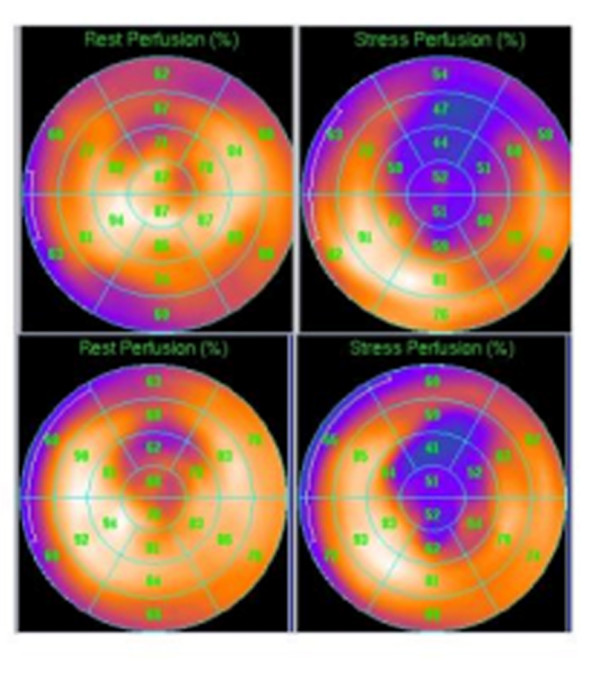
Spinal cord stimulation (SCS) and percutaneous myocardial laser revascularisation (PMR) are treatment modalities used to treat refractory angina pectoris, with the major aim of such treatment being the relief of disabling symptoms. This study compared the change in myocardial perfusion following SCS and PMR treatment.
Subjects with Canadian Cardiovascular Society class 3/4 angina and reversible perfusion defects as assessed by single-photon emission computed tomographic myocardial perfusion scintigraphy were randomised to SCS (34) or PMR (34). Twenty-eight subjects in each group underwent repeat myocardial perfusion imaging 12 months post intervention. Visual scoring of perfusion images was performed using a 20-segment model and a scale of 0 to 4.
The mean (standard deviation) baseline summed rest score (SRS) and stress scores (SSS) were 4.6 (5.7) and 13.6 (9.0) in the PMR group and 6.1 (7.4) and 16.8 (11.6) in the SCS group. At 12 months, SRS was 5.5 (6.0) and SSS 15.3 (11.3) in the PMR group and 6.9 (8.2) and 15.1 (10.9) in the SCS group. There was no significant difference between the two treatment groups adjusted for baseline (p = 1.0 for SRS, p = 0.29 for SSS).
There was no significant difference in myocardial perfusion one year post treatment with SCS or PMR.
脊髓刺激(SCS)和经皮心肌激光血运重建术(PMR)是用于治疗顽固性心绞痛的治疗方式,此类治疗的主要目的是缓解致残症状。本研究比较了SCS和PMR治疗后心肌灌注的变化。
患有加拿大心血管学会3/4级心绞痛且经单光子发射计算机断层扫描心肌灌注显像评估存在可逆性灌注缺损的受试者被随机分为SCS组(34例)或PMR组(34例)。每组28名受试者在干预后12个月接受重复心肌灌注成像。使用20节段模型和0至4分的量表对灌注图像进行视觉评分。
PMR组的平均(标准差)基线静息总分(SRS)和负荷总分(SSS)分别为4.6(5.7)和13.6(9.0),SCS组分别为6.1(7.4)和16.8(11.6)。在12个月时,PMR组的SRS为5.5(6.0),SSS为15.3(11.3),SCS组的SRS为6.9(8.2),SSS为15.1(10.9)。调整基线后,两个治疗组之间无显著差异(SRS的p = 1.0,SSS的p = 0.29)。
SCS或PMR治疗一年后心肌灌注无显著差异。