Kivipelto Miia, Rovio Suvi, Ngandu Tiia, Kåreholt Ingemar, Eskelinen Marjo, Winblad Bengt, Hachinski Vladimir, Cedazo-Minguez Angel, Soininen Hilkka, Tuomilehto Jaakko, Nissinen Aulikki
Aging Research Center, NVS, Karolinska Institutet, Stockholm, Sweden.
J Cell Mol Med. 2008 Dec;12(6B):2762-71. doi: 10.1111/j.1582-4934.2008.00296.x. Epub 2008 Feb 8.
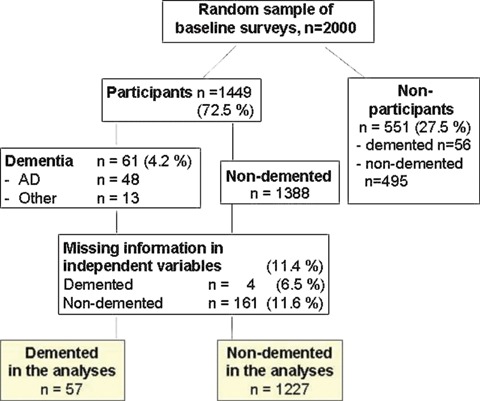
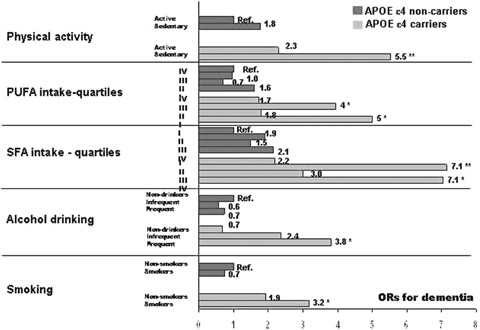
The risk of dementia and Alzheimer's disease (AD) probably results from an interaction between genetic and environmental factors. The aim of this study was to investigate the effects and putative interactions between the apoE epsilon4 allele and lifestyle related risk factors for dementia and AD. Participants of the Cardiovascular Risk Factors, Aging, and Dementia (CAIDE) study were derived from random, population-based samples previously studied in 1972, 1977, 1982 or 1987. After an average follow-up of 21 years, 1449 individuals (72.5%) aged 65-79 years were re-examined in 1998. The apoE epsilon4 allele was an independent risk factor for dementia/AD even after adjustments for sociodemographic, lifestyle and vascular factors (odds ratio [OR]=2.83, 95% confidence interval [CI]=1.61-4.97). Physical inactivity, alcohol drinking and smoking increased the risk of dementia/AD particularly among the apoE epsilon4 carriers. Furthermore, low-moderate intake of polyunsaturated, and moderate-high intake of saturated fats were associated with an increased risk of dementia/AD more pronouncedly among apoE epsilon4 carriers. Composite effect of the lifestyle factors was particularly seen among the epsilon4 carriers (OR=11.42, 95% CI=1.94-67.07 in the 4th quartile). Physical inactivity, dietary fat intake, alcohol drinking and smoking at midlife are associated with the risk of dementia and AD, especially among the apoE epsilon4 carriers. The apoE epsilon4 carriers may be more vulnerable to environmental factors, and thus, lifestyle interventions may greatly modify dementia risk particularly among the genetically susceptible individuals.
痴呆症和阿尔茨海默病(AD)的风险可能源于遗传因素和环境因素之间的相互作用。本研究的目的是调查载脂蛋白Eε4等位基因与痴呆症和AD的生活方式相关风险因素之间的影响及假定的相互作用。心血管危险因素、衰老和痴呆症(CAIDE)研究的参与者来自1972年、1977年、1982年或1987年之前基于人群的随机样本。经过平均21年的随访,1998年对1449名年龄在65 - 79岁的个体(72.5%)进行了重新检查。即使在对社会人口统计学、生活方式和血管因素进行调整之后,载脂蛋白Eε4等位基因仍是痴呆症/AD的独立危险因素(优势比[OR]=2.83,95%置信区间[CI]=1.61 - 4.97)。身体不活动、饮酒和吸烟会增加痴呆症/AD的风险,尤其是在载脂蛋白Eε4携带者中。此外,多不饱和脂肪的低 - 中度摄入以及饱和脂肪的中 - 高度摄入在载脂蛋白Eε4携带者中与痴呆症/AD风险增加的关联更为明显。生活方式因素的综合影响在ε4携带者中尤为明显(第四四分位数中OR=11.42,95% CI=1.94 - 67.07)。中年时期的身体不活动、饮食脂肪摄入、饮酒和吸烟与痴呆症和AD的风险相关,尤其是在载脂蛋白Eε4携带者中。载脂蛋白Eε4携带者可能对环境因素更敏感,因此,生活方式干预可能会极大地改变痴呆症风险,尤其是在基因易感性个体中。