Sutoh K, Ando M, Sutoh K, Toyoshima Y Y
Proc Natl Acad Sci U S A. 1991 Sep 1;88(17):7711-4. doi: 10.1073/pnas.88.17.7711.
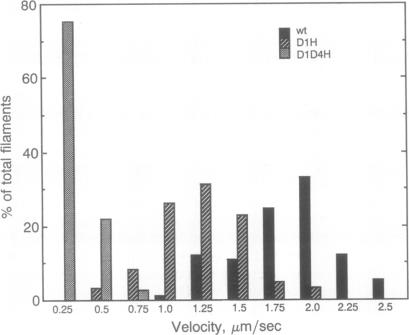
Aspartic acid residues in the N-terminal negative charge cluster of Dictyostelium actin were replaced with histidine residues by site-directed mutagenesis of the actin gene. The mutant actins were expressed in Dictyostelium cells and were purified to homogeneity by HPLC. Functional properties of the mutant actins were compared with those of the wild-type actin. (i) In vitro assays of the sliding movement of actin filaments driven by myosin showed that the movement was slowed by the mutations. (ii) The mutations diminished the actin-activated ATPase activity of myosin in such a way that the maximum turnover rate at infinite actin concentration (Vmax) dropped sharply without an appreciable change in the apparent affinity of actin and myosin (Kapp). These results indicate that the N-terminal negative charge cluster of actin is essential for the ATP-dependent actin-myosin interaction.
通过对肌动蛋白基因进行定点诱变,将盘基网柄菌肌动蛋白N端负电荷簇中的天冬氨酸残基替换为组氨酸残基。突变型肌动蛋白在盘基网柄菌细胞中表达,并通过高效液相色谱法纯化至同质。将突变型肌动蛋白的功能特性与野生型肌动蛋白的功能特性进行了比较。(i) 由肌球蛋白驱动的肌动蛋白丝滑动运动的体外测定表明,这些突变使运动减慢。(ii) 这些突变以这样一种方式降低了肌球蛋白的肌动蛋白激活ATP酶活性,即无限肌动蛋白浓度下的最大周转速率 (Vmax) 急剧下降,而肌动蛋白和肌球蛋白的表观亲和力 (Kapp) 没有明显变化。这些结果表明,肌动蛋白的N端负电荷簇对于ATP依赖的肌动蛋白-肌球蛋白相互作用至关重要。