Alford Daniel P, Richardson Jessica M, Chapman Sheila E, Dubé Catherine E, Schadt Robert W, Saitz Richard
Clinical Addiction Research and Education (CARE) Unit, Section of General Internal Medicine, Department of Medicine, Boston Medical Center, Boston, MA, USA.
BMC Med Educ. 2008 Mar 6;8:11. doi: 10.1186/1472-6920-8-11.
Physicians receive little education about unhealthy alcohol use and as a result patients often do not receive efficacious interventions. The objective of this study is to evaluate whether a free web-based alcohol curriculum would be used by physician educators and whether in-person faculty development would increase its use, confidence in teaching and teaching itself.
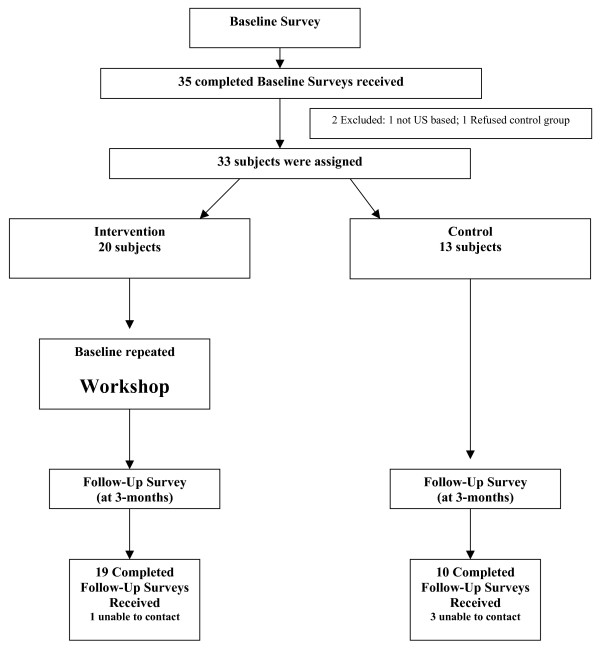
Subjects were physician educators who applied to attend a workshop on the use of a web-based curriculum about alcohol screening and brief intervention and cross-cultural efficacy. All physicians were provided the curriculum web address. Intervention subjects attended a 3-hour workshop including demonstration of the website, modeling of teaching, and development of a plan for using the curriculum. All subjects completed a survey prior to and 3 months after the workshop.
Of 20 intervention and 13 control subjects, 19 (95%) and 10 (77%), respectively, completed follow-up. Compared to controls, intervention subjects had greater increases in confidence in teaching alcohol screening, and in the frequency of two teaching practices - teaching about screening and eliciting patient health beliefs. Teaching confidence and teaching practices improved significantly in 9 of 10 comparisons for intervention, and in 0 comparisons for control subjects. At follow-up 79% of intervention but only 50% of control subjects reported using any part of the curriculum (p = 0.20).
In-person training for physician educators on the use of a web-based alcohol curriculum can increase teaching confidence and practices. Although the web is frequently used for dissemination, in-person training may be preferable to effect widespread teaching of clinical skills like alcohol screening and brief intervention.
医生接受的关于不健康饮酒的教育很少,因此患者往往得不到有效的干预措施。本研究的目的是评估医生教育工作者是否会使用免费的网络酒精课程,以及面对面的教员培训是否会增加该课程的使用、教学信心和教学效果。
研究对象为申请参加关于酒精筛查与简短干预及跨文化疗效的网络课程使用研讨会的医生教育工作者。所有医生都获得了课程网址。干预组的研究对象参加了一个3小时的研讨会,内容包括网站演示、教学示范以及制定使用该课程的计划。所有研究对象在研讨会前和研讨会后3个月都完成了一项调查。
在20名干预组和13名对照组研究对象中,分别有19名(95%)和10名(77%)完成了随访。与对照组相比,干预组研究对象在酒精筛查教学信心以及两种教学实践(筛查教学和引出患者健康信念)的频率方面有更大幅度的提高。干预组在10次比较中有9次教学信心和教学实践有显著改善,而对照组在0次比较中有改善。随访时,79%的干预组研究对象报告使用了课程的任何部分,而对照组只有50%(p = 0.20)。
对医生教育工作者进行关于使用网络酒精课程的面对面培训可以提高教学信心和教学实践。尽管网络经常用于传播,但面对面培训可能更有利于广泛开展诸如酒精筛查和简短干预等临床技能的教学。