Winters Ken C, Stinchfield Randy D, Latimer William W, Stone Andrea
Department of Psychiatry, University of Minnesota, F282/2A West, 2450 Riverside Avenue, Minneapolis, MN 55454, USA.
J Subst Abuse Treat. 2008 Oct;35(3):269-78. doi: 10.1016/j.jsat.2007.11.002. Epub 2008 Mar 6.
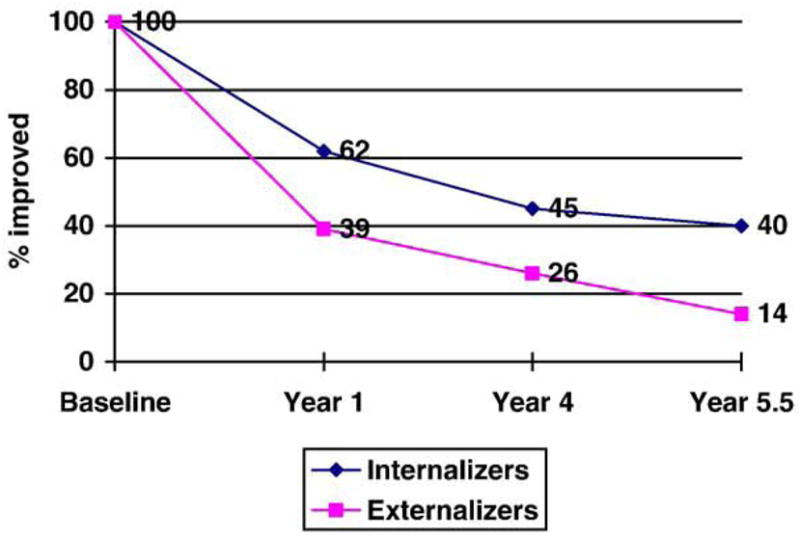
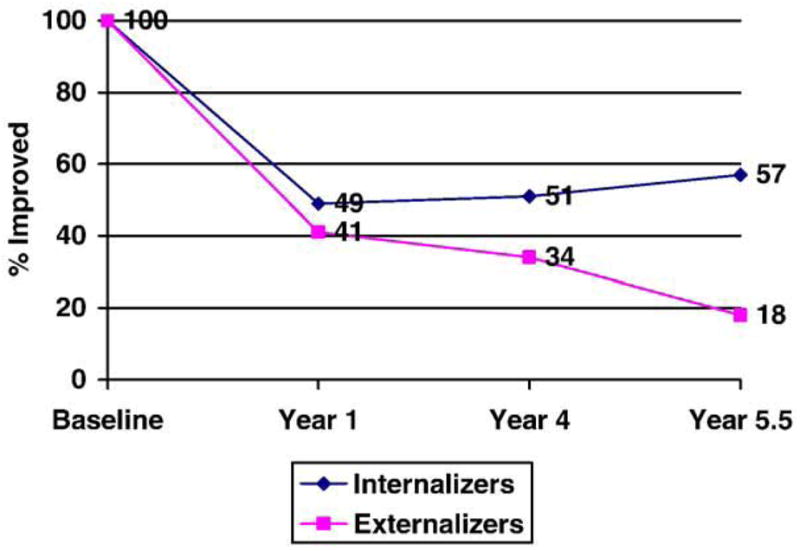
Whereas the treatment outcome research literature for adolescent alcohol and other drug abuse has shown recent advances (R. J. Williams, S. Y. Chang, & Addiction Centre Adolescent Research Group, 2000), significant knowledge gaps remain. A. E. Kazdin (2001) recently observed that one of the key questions for the field is to identify if client characteristics meaningfully mediate or moderate treatment outcome. There is support from the adolescent clinical literature that internalizing and externalizing personality subtypes are related to the onset and course of youth substance use disorders (D. B. Clark & O. G. Bukstein, 1998). The study extends this literature by examining the association of drug use behaviors outcome and subtyped adolescents (internalizers and externalizers; n = 141) who sought treatment at a 12-Step program. The analysis also includes a community-based control group (n = 94). Specifically, we examined the association of subtype and treatment retention and short-term (Year 1) and long-term (Year 4 and Year 5.5) drug involvement outcomes. Externalizers consistently showed poorer outcomes, including poorer treatment retention and greater drug use and drug disorder symptoms at each follow-up point. The treatment implications of the study are discussed.
尽管青少年酒精及其他药物滥用的治疗结果研究文献近期已取得进展(R. J. 威廉姆斯、S. Y. 张及成瘾中心青少年研究小组,2000年),但仍存在重大知识空白。A. E. 卡兹丁(2001年)最近指出,该领域的关键问题之一是确定服务对象特征是否对治疗结果有显著的中介或调节作用。青少年临床文献表明,内化型和外化型人格亚型与青少年物质使用障碍的发病及病程有关(D. B. 克拉克和O. G. 布克斯泰因,1998年)。本研究通过考察在一个十二步戒毒项目中接受治疗的亚型青少年(内化型和外化型;n = 141)的药物使用行为结果之间的关联,拓展了这一文献。分析还纳入了一个基于社区的对照组(n = 94)。具体而言,我们考察了亚型与治疗留存率以及短期(第1年)和长期(第4年和第5.5年)药物使用结果之间的关联。外化型青少年始终表现出较差的结果,包括较差的治疗留存率以及在每个随访点更高的药物使用率和药物障碍症状。本文讨论了该研究对治疗的启示。