Shrestha Bimmi, Ng Terry, Chu Hsien-Jue, Noll Michelle, Diamond Michael S
Department of Medicine, 660 S. Euclid Avenue, Box 8051, Washington University School of Medicine, St. Louis, MO 63110, United States.
Vaccine. 2008 Apr 7;26(16):2020-33. doi: 10.1016/j.vaccine.2008.02.009. Epub 2008 Feb 20.
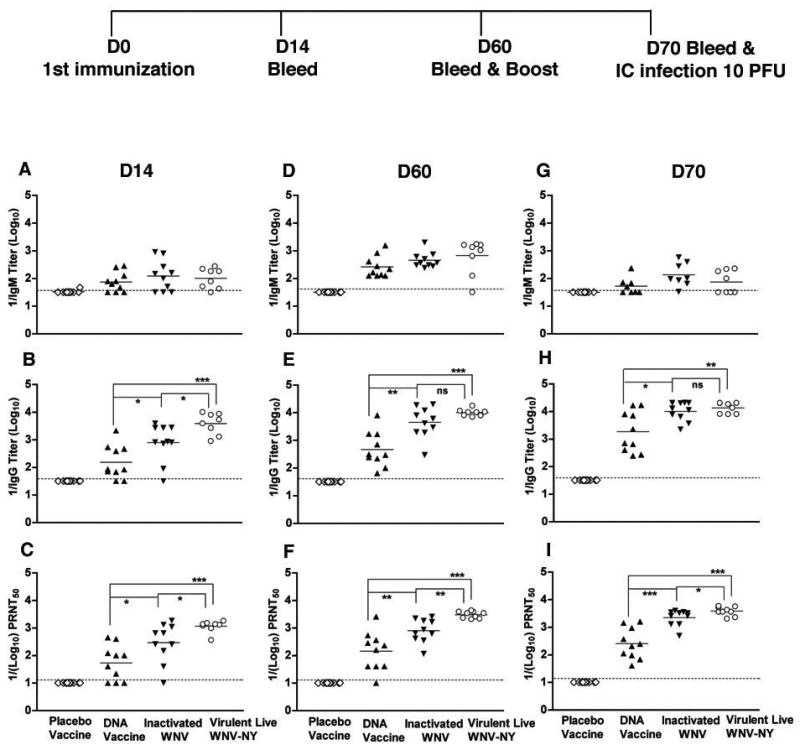
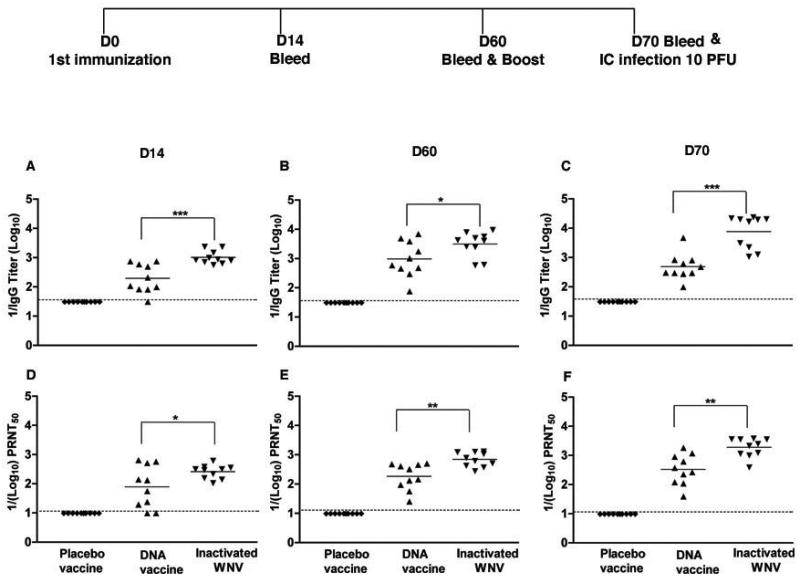
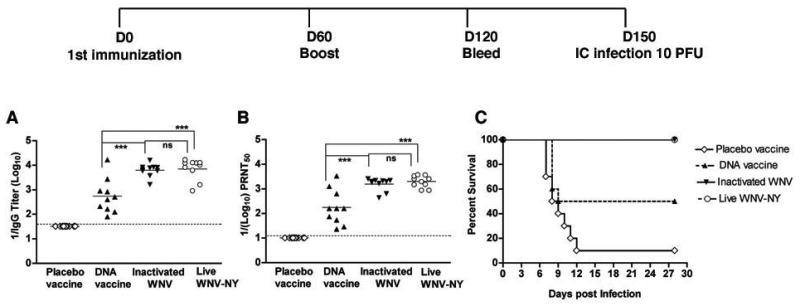
West Nile virus (WNV) is a mosquito borne, neurotropic flavivirus that causes a severe central nervous system (CNS) infection in humans and animals. Although commercial vaccines are available for horses, none is currently approved for human use. In this study, we evaluated the efficacy and mechanism of immune protection of two candidate WNV vaccines in mice. A formalin-inactivated WNV vaccine induced higher levels of specific and neutralizing antibodies compared to a DNA plasmid vaccine that produces virus-like particles. Accordingly, partial and almost complete protection against a highly stringent lethal intracranial WNV challenge were observed in mice 60 days after single dose immunization with the DNA plasmid and inactivated virus vaccines, respectively. In mice immunized with a single dose of DNA plasmid or inactivated vaccine, antigen-specific CD8(+) T cells were induced and contributed to protective immunity as acquired or genetic deficiencies of CD8(+) T cells lowered the survival rates. In contrast, in boosted animals, WNV-specific antibody titers were higher, survival rates after challenge were greater, and an absence of CD8(+) T cells did not appreciably affect mortality. Overall, our experiments suggest that in mice, both inactivated WNV and DNA plasmid vaccines are protective after two doses, and the specific contribution of antibody and CD8(+) T cells to vaccine immunity against WNV is modulated by the prime-boost strategy.
西尼罗河病毒(WNV)是一种由蚊子传播的嗜神经黄病毒,可导致人类和动物发生严重的中枢神经系统(CNS)感染。虽然有用于马匹的商业疫苗,但目前尚无获批用于人类的疫苗。在本研究中,我们评估了两种候选WNV疫苗在小鼠中的免疫保护效果和机制。与产生病毒样颗粒的DNA质粒疫苗相比,福尔马林灭活的WNV疫苗诱导产生了更高水平的特异性中和抗体。因此,在用DNA质粒疫苗和灭活病毒疫苗单剂量免疫60天后的小鼠中,分别观察到了对高度严格的致死性颅内WNV攻击的部分保护和几乎完全保护。在用单剂量DNA质粒或灭活疫苗免疫的小鼠中,诱导产生了抗原特异性CD8(+) T细胞,并且由于CD8(+) T细胞的获得性或遗传性缺陷降低了存活率,所以这些细胞对保护性免疫有贡献。相比之下,在加强免疫的动物中,WNV特异性抗体滴度更高,攻击后的存活率更高,并且缺乏CD8(+) T细胞对死亡率没有明显影响。总体而言,我们的实验表明,在小鼠中,灭活WNV疫苗和DNA质粒疫苗在两剂接种后均具有保护作用,并且抗体和CD8(+) T细胞对WNV疫苗免疫的具体贡献受初免-加强策略的调节。