Canel M, Secades P, Garzón-Arango M, Allonca E, Suarez C, Serrels A, Frame Mc, Brunton V, Chiara M-D
Servicio de Otorrinolaringología, Hospital Universitario Central de Asturias, Asturias, Spain.
Br J Cancer. 2008 Apr 8;98(7):1274-84. doi: 10.1038/sj.bjc.6604286. Epub 2008 Mar 18.
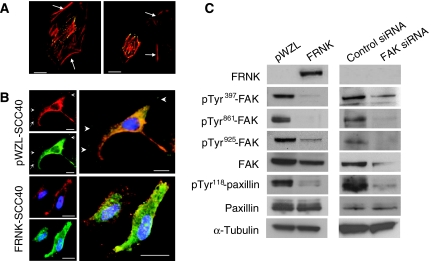
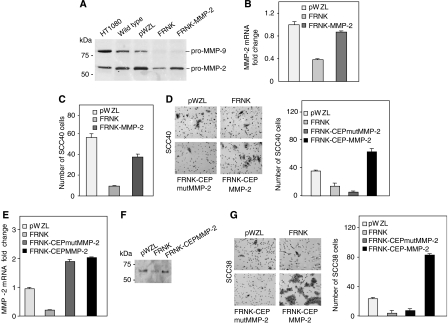
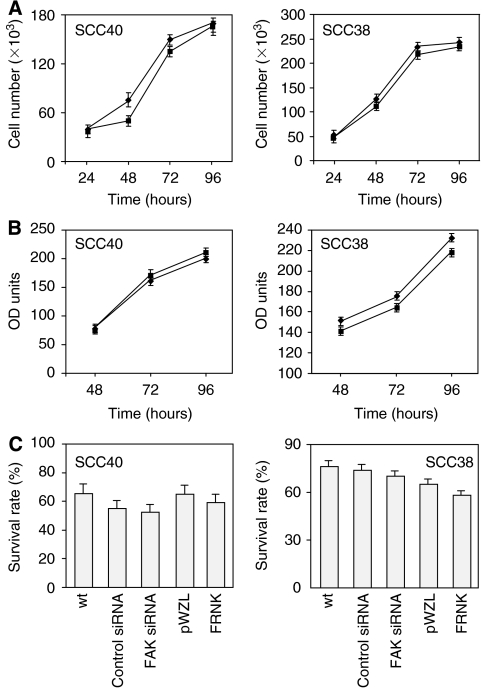
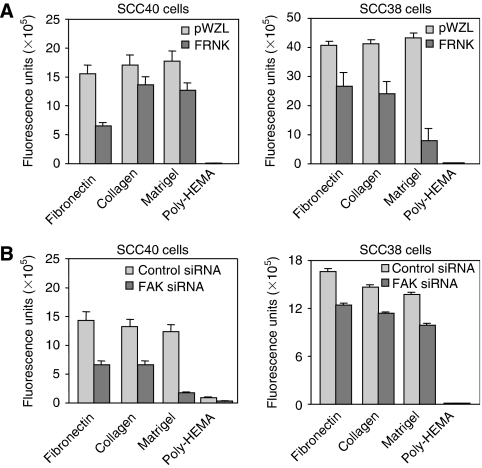
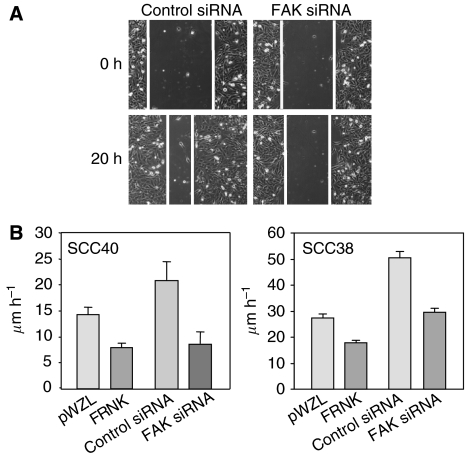
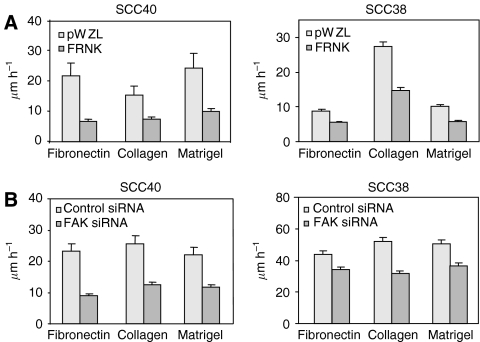
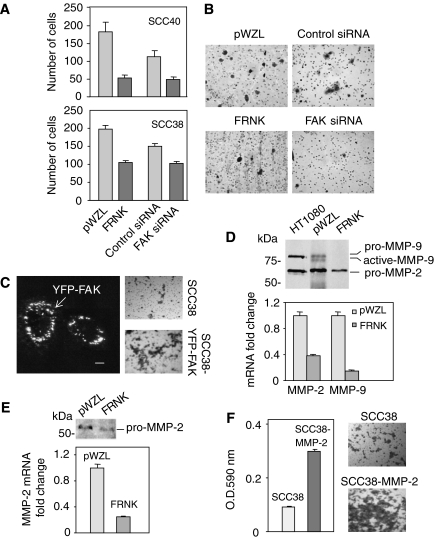
Focal adhesion kinase (FAK) is considered intimately involved in cancer progression. Our previous research has demonstrated that overexpression of FAK is an early and frequent event in squamous cell carcinomas of the supraglottic larynx, and it is associated with the presence of metastases in cervical lymph nodes. The purpose of this study was to examine the functional role of FAK in the progression of head and neck squamous cell carcinomas (HNSCC). To this end, expression of FAK-related nonkinase (FRNK) or small interfering RNA (siRNA) against FAK was used to disrupt the FAK-induced signal transduction pathways in the HNSCC-derived SCC40 and SCC38 cell lines. Similar phenotypic effects were observed with the two methodological approaches in both cell lines. Decreased cell attachment, motility and invasion were induced by FRNK and FAK siRNA, whereas cell proliferation was not impaired. In addition, increased cell invasion was observed upon FAK overexpression in SCC cells. FRNK expression resulted in a downregulation of MMP-2 and MMP-9 expression. Interestingly, MMP-2 overexpression in FRNK-expressing cells rescued FRNK inhibition of cell invasion. This is the first demonstration of a direct rescue of impaired cell invasion by the re-expression of MMP-2 in a tumour cell type with decreased expression of functional FAK. Collectively, these data reported here support the conclusion that FAK enhances invasion of HNSCC by promoting both increased cell motility and MMP-2 production, thus providing new insights into possible therapeutic intervention strategies.
粘着斑激酶(FAK)被认为与癌症进展密切相关。我们之前的研究表明,FAK的过表达是声门上喉鳞状细胞癌早期且常见的事件,并且它与颈部淋巴结转移的存在相关。本研究的目的是检测FAK在头颈部鳞状细胞癌(HNSCC)进展中的功能作用。为此,使用FAK相关非激酶(FRNK)或针对FAK的小干扰RNA(siRNA)来破坏HNSCC来源的SCC40和SCC38细胞系中FAK诱导的信号转导通路。在两种细胞系中,两种方法都观察到了相似的表型效应。FRNK和FAK siRNA诱导细胞附着、运动和侵袭能力下降,而细胞增殖未受损害。此外,在SCC细胞中FAK过表达时观察到细胞侵袭增加。FRNK表达导致MMP - 2和MMP - 9表达下调。有趣的是,在表达FRNK的细胞中MMP - 2过表达挽救了FRNK对细胞侵袭的抑制作用。这是首次证明在功能性FAK表达降低的肿瘤细胞类型中,通过重新表达MMP - 2直接挽救受损的细胞侵袭。总体而言,此处报道的这些数据支持以下结论:FAK通过促进细胞运动增加和MMP - 2产生来增强HNSCC的侵袭,从而为可能的治疗干预策略提供了新的见解。