Department of Cardiology, Lund University Hospital, 221 85, Lund, Sweden.
Purinergic Signal. 2007 Jun;3(3):195-201. doi: 10.1007/s11302-006-9028-9. Epub 2006 Nov 30.
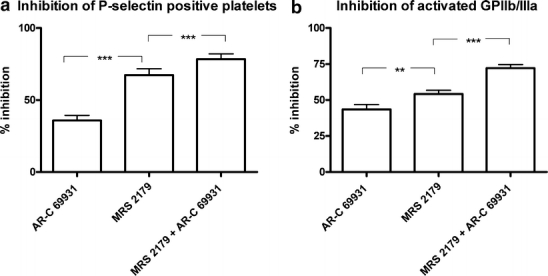
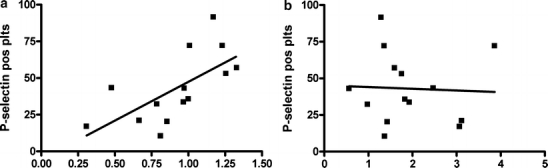
Two ADP receptors have been identified on human platelets: P2Y(1) and P2Y(12). The P2Y(12) receptor blocker clopidogrel is widely used to reduce the risks in acute coronary syndromes, but, currently, there is no P2Y(1) blocker in clinical use. Evidence for variable responses to clopidogrel has been described in several reports. The mechanistic explanation for this phenomenon is not fully understood. The aim of this study was to examine mechanisms responsible for variability of 2MeS-ADP, a stable ADP analogue, induced platelet reactivity in clopidogrel-treated patients. Platelet reactivity was assessed by flow cytometry measurements of P-selectin (CD62P) and activated GpIIb/IIIa complex (PAC-1). Residual 2MeS-ADP activation via the P2Y(12) and P2Y(1) receptors was determined by co-incubation with the selective antagonists AR-C69931 and MRS2179 in vitro. P2Y(1) and P2Y(12) receptor expression on both RNA and protein level were determined, as well as the P2Y(12) H1 or H2 haplotypes. Our data suggest that the residual platelet activation of 2MeS-ADP after clopidogrel treatment is partly due to an inadequate antagonistic effect of clopidogrel on the P2Y(12) receptor and partly due to activation of the P2Y(1) receptor, which is unaffected by clopidogrel. Moreover, a correlation between increased P2Y(12) protein expression on platelets and decreased response to clopidogrel was noticed, r(2)=0.43 (P<0.05). No correlation was found between P2Y(12) mRNA levels and clopidogrel resistance, indicating post-transcriptional mechanisms. To achieve additional ADP inhibition in platelets, antagonists directed at the P2Y(1) receptor could be more promising than the development of more potent P2Y(12) receptor antagonists.
已经在人血小板上鉴定出两种 ADP 受体:P2Y(1)和 P2Y(12)。P2Y(12)受体阻断剂氯吡格雷广泛用于降低急性冠状动脉综合征的风险,但目前临床上没有 P2Y(1)阻断剂。已经在几份报告中描述了对氯吡格雷反应不同的证据。这种现象的机制解释尚不完全清楚。本研究的目的是研究导致在接受氯吡格雷治疗的患者中,稳定的 ADP 类似物 2MeS-ADP 诱导的血小板反应性变异性的机制。通过流式细胞术测量 P-选择素(CD62P)和激活的 GpIIb/IIIa 复合物(PAC-1)来评估血小板反应性。通过在体外与选择性拮抗剂 AR-C69931 和 MRS2179 共同孵育来确定通过 P2Y(12)和 P2Y(1)受体残留的 2MeS-ADP 激活。还确定了 RNA 和蛋白质水平上的 P2Y(1)和 P2Y(12)受体表达,以及 P2Y(12)H1 或 H2 单倍型。我们的数据表明,氯吡格雷治疗后 2MeS-ADP 的残余血小板激活部分是由于氯吡格雷对 P2Y(12)受体的拮抗作用不足,部分是由于 P2Y(1)受体的激活,而氯吡格雷对 P2Y(1)受体没有影响。此外,还注意到血小板上 P2Y(12)蛋白表达增加与氯吡格雷反应降低之间存在相关性,r(2)=0.43(P<0.05)。未发现 P2Y(12)mRNA 水平与氯吡格雷耐药之间存在相关性,表明存在转录后机制。为了在血小板中实现额外的 ADP 抑制,针对 P2Y(1)受体的拮抗剂可能比开发更有效的 P2Y(12)受体拮抗剂更有前途。