Glinka Yelena, Prud'homme Gérald J
Department of Laboratory Medicine, St. Michael's Hospital, 30 Bond Street, Room 2-013CC, Toronto, Ontario, Canada M5B 1W8.
J Leukoc Biol. 2008 Jul;84(1):302-10. doi: 10.1189/jlb.0208090. Epub 2008 Apr 24.
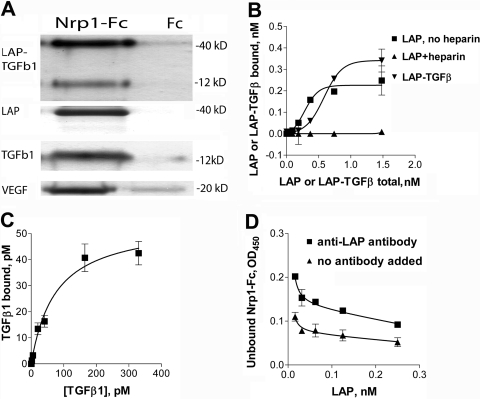
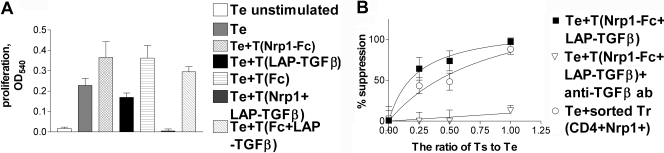
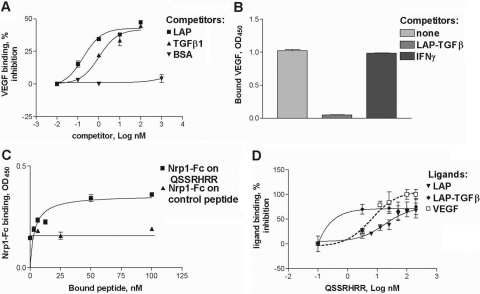
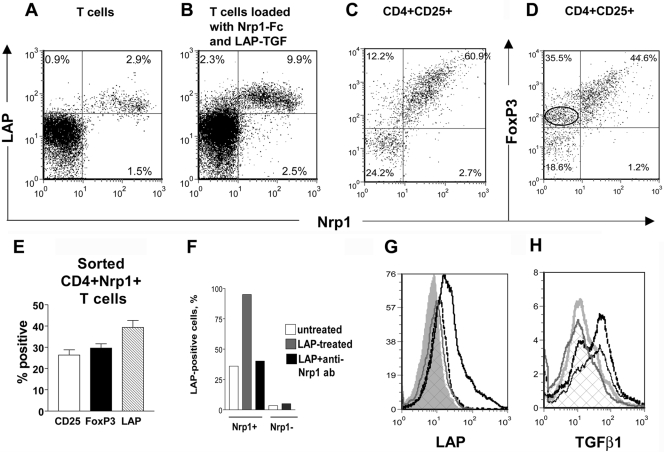
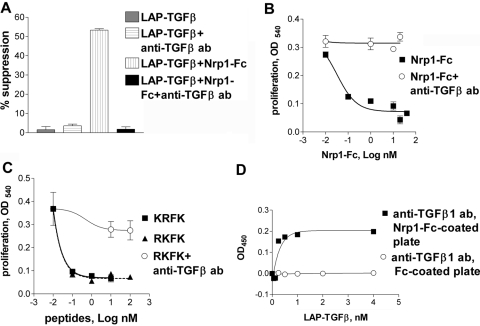
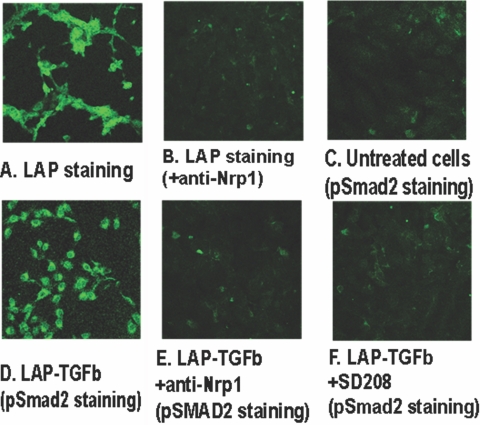
Neuropilin-1 (Nrp1) is a multifunctional protein, identified principally as a receptor for the class 3 semaphorins and members of the vascular endothelial growth factor (VEGF) family, but it is capable of other interactions. It is a marker of regulatory T cells (Tr), which often carry Nrp1 and latency-associated peptide (LAP)-TGF-beta1 (the latent form). The signaling TGF-beta1 receptors bind only active TGF-beta1, and we hypothesized that Nrp1 binds the latent form. Indeed, we found that Nrp1 is a high-affinity receptor for latent and active TGF-beta1. Free LAP, LAP-TGF-beta1, and active TGF-beta1 all competed with VEGF165 for binding to Nrp1. LAP has a basic, arginine-rich C-terminal motif similar to VEGF and peptides that bind to the b1 domain of Nrp1. A C-terminal LAP peptide (QSSRHRR) bound to Nrp1 and inhibited the binding of VEGF and LAP-TGF-beta1. We also analyzed the effects of Nrp1/LAP-TGF-beta1 coexpression on T cell function. Compared with Nrp1(-) cells, sorted Nrp1+ T cells had a much greater capacity to capture LAP-TGF-beta1. Sorted Nrp1(-) T cells captured soluble Nrp1-Fc, and this increased their ability to capture LAP-TGF-beta1. Conventional CD4+CD25(-)Nrp1(-) T cells coated with Nrp1-Fc/LAP-TGF-beta1 acquired strong Tr activity. Moreover, LAP-TGF-beta was activated by Nrp1-Fc and also by a peptide of the b2 domain of Nrp1 (RKFK; similar to a thrombospondin-1 peptide). Breast cancer cells, which express Nrp1, also captured and activated LAP-TGF-beta1 in a Nrp1-dependent manner. Thus, Nrp1 is a receptor for TGF-beta1, activates its latent form, and is relevant to Tr activity and tumor biology.
神经纤毛蛋白-1(Nrp1)是一种多功能蛋白,主要被鉴定为3类信号素和血管内皮生长因子(VEGF)家族成员的受体,但它还能进行其他相互作用。它是调节性T细胞(Tr)的标志物,调节性T细胞通常携带Nrp1和潜伏相关肽(LAP)-转化生长因子-β1(TGF-β1的潜伏形式)。信号传导性TGF-β1受体仅结合活性TGF-β1,我们推测Nrp1结合潜伏形式。事实上,我们发现Nrp1是潜伏和活性TGF-β1的高亲和力受体。游离的LAP、LAP-TGF-β1和活性TGF-β1都与VEGF165竞争结合Nrp1。LAP具有一个碱性的、富含精氨酸的C末端基序,类似于VEGF以及与Nrp1的b1结构域结合的肽段。一个C末端LAP肽段(QSSRHRR)与Nrp1结合,并抑制VEGF和LAP-TGF-β1的结合。我们还分析了Nrp1/LAP-TGF-β1共表达对T细胞功能的影响。与Nrp1(-)细胞相比,分选得到的Nrp1+ T细胞捕获LAP-TGF-β1的能力要强得多。分选得到的Nrp1(-)T细胞捕获可溶性Nrp1-Fc,这增强了它们捕获LAP-TGF-β1的能力。用Nrp1-Fc/LAP-TGF-β1包被的传统CD4+CD25(-)Nrp1(-)T细胞获得了强大的Tr活性。此外,LAP-TGF-β被Nrp1-Fc以及Nrp1的b2结构域的一个肽段(RKFK;类似于血小板反应蛋白-1肽段)激活。表达Nrp1的乳腺癌细胞也以Nrp1依赖的方式捕获并激活LAP-TGF-β1。因此,Nrp1是TGF-β1的受体,激活其潜伏形式,并且与Tr活性和肿瘤生物学相关。