Singh Guramrit, Rebbapragada Indrani, Lykke-Andersen Jens
Molecular, Cellular, and Developmental Biology, University of Colorado at Boulder, Boulder, Colorado, United States of America.
PLoS Biol. 2008 Apr 29;6(4):e111. doi: 10.1371/journal.pbio.0060111.
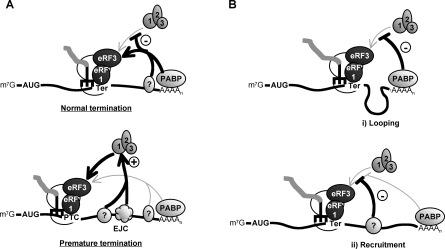
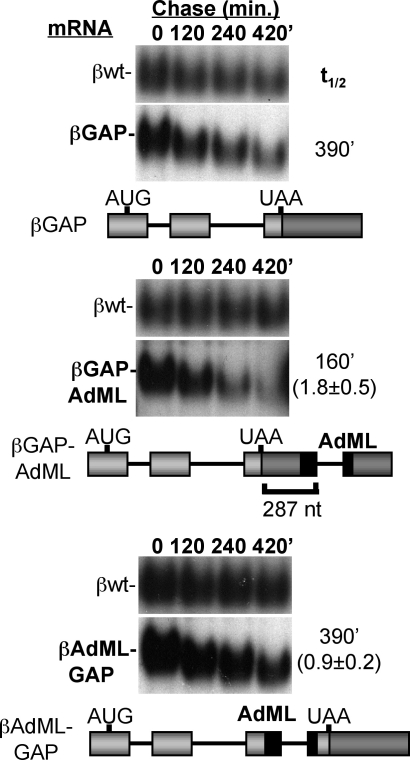
The nonsense-mediated decay (NMD) pathway subjects mRNAs with premature termination codons (PTCs) to rapid decay. The conserved Upf1-3 complex interacts with the eukaryotic translation release factors, eRF3 and eRF1, and triggers NMD when translation termination takes place at a PTC. Contrasting models postulate central roles in PTC-recognition for the exon junction complex in mammals versus the cytoplasmic poly(A)-binding protein (PABP) in other eukaryotes. Here we present evidence for a unified model for NMD, in which PTC recognition in human cells is mediated by a competition between 3' UTR-associated factors that stimulate or antagonize recruitment of the Upf complex to the terminating ribosome. We identify cytoplasmic PABP as a human NMD antagonizing factor, which inhibits the interaction between eRF3 and Upf1 in vitro and prevents NMD in cells when positioned in proximity to the termination codon. Surprisingly, only when an extended 3' UTR places cytoplasmic PABP distally to the termination codon does a downstream exon junction complex enhance NMD, likely through increasing the affinity of Upf proteins for the 3' UTR. Interestingly, while an artificial 3' UTR of >420 nucleotides triggers NMD, a large subset of human mRNAs contain longer 3' UTRs but evade NMD. We speculate that these have evolved to concentrate NMD-inhibiting factors, such as PABP, in spatial proximity of the termination codon.
无义介导的衰变(NMD)途径会使带有提前终止密码子(PTC)的mRNA迅速衰变。保守的Upf1-3复合物与真核生物翻译释放因子eRF3和eRF1相互作用,并在翻译终止于PTC时触发NMD。相互矛盾的模型假定,在哺乳动物中,外显子连接复合物在PTC识别中起核心作用,而在其他真核生物中,细胞质聚腺苷酸结合蛋白(PABP)起核心作用。在此,我们提供了一个NMD统一模型的证据,其中人类细胞中的PTC识别是由3'UTR相关因子之间的竞争介导的,这些因子刺激或拮抗Upf复合物募集到终止核糖体上。我们确定细胞质PABP是一种人类NMD拮抗因子,它在体外抑制eRF3与Upf1之间的相互作用,并在位于终止密码子附近时阻止细胞中的NMD。令人惊讶的是,只有当延伸的3'UTR将细胞质PABP置于终止密码子的远端时,下游外显子连接复合物才会增强NMD,这可能是通过增加Upf蛋白对3'UTR的亲和力来实现的。有趣的是,虽然大于420个核苷酸的人工3'UTR会触发NMD,但很大一部分人类mRNA含有更长的3'UTR却能逃避NMD。我们推测,这些mRNA已经进化到在终止密码子的空间附近聚集NMD抑制因子,如PABP。