Madsen Kenneth L, Eriksen Jacob, Milan-Lobo Laura, Han Daniel S, Niv Masha Y, Ammendrup-Johnsen Ina, Henriksen Ulla, Bhatia Vikram K, Stamou Dimitrios, Sitte Harald H, McMahon Harvey T, Weinstein Harel, Gether Ulrik
Department of Neuroscience and Pharmacology, Molecular Neuropharmacology Group, Center for Pharmacogenomics, The Panum Institute, University of Copenhagen, DK-2200 Copenhagen N, Denmark.
Traffic. 2008 Aug;9(8):1327-43. doi: 10.1111/j.1600-0854.2008.00761.x. Epub 2008 May 8.
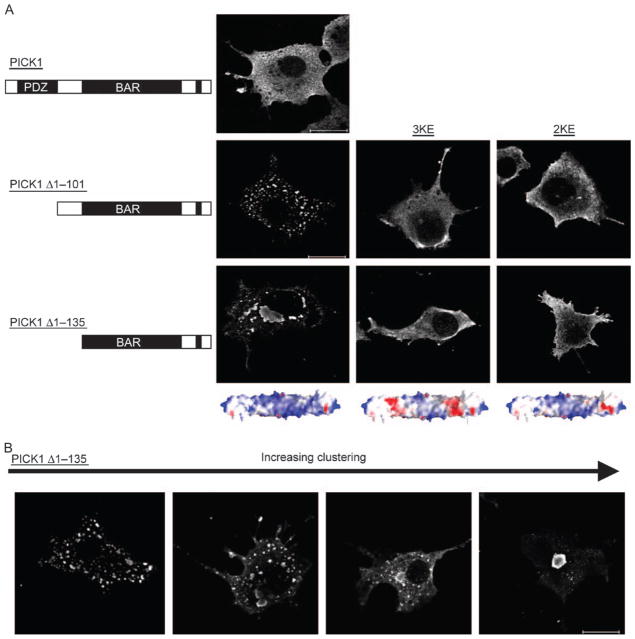
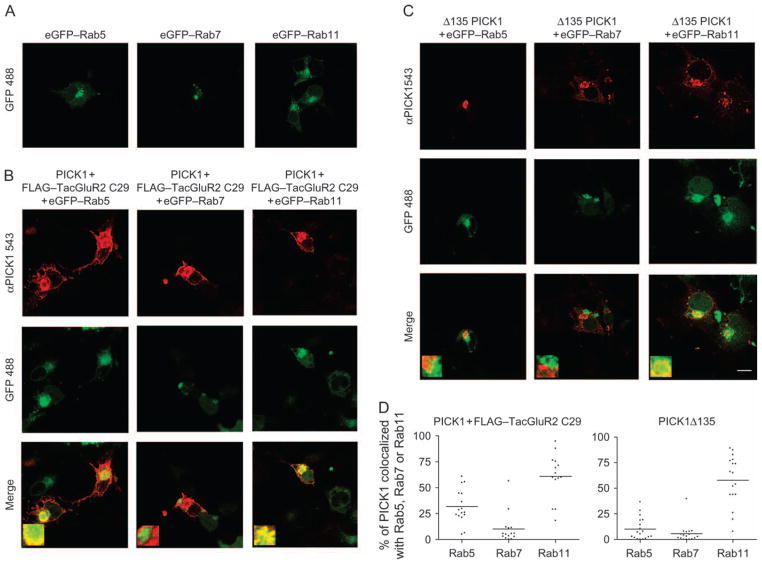
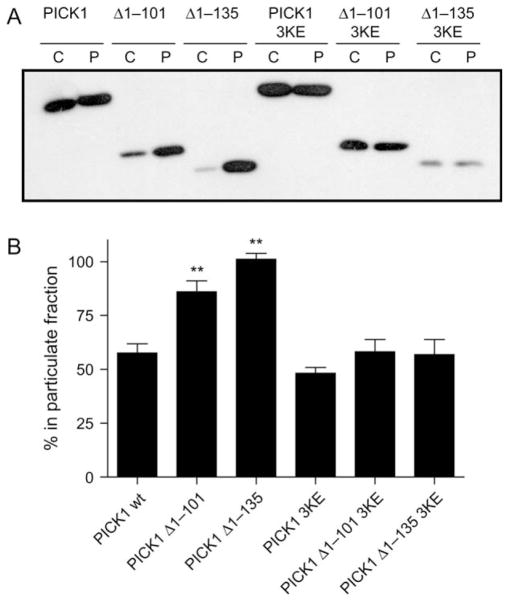
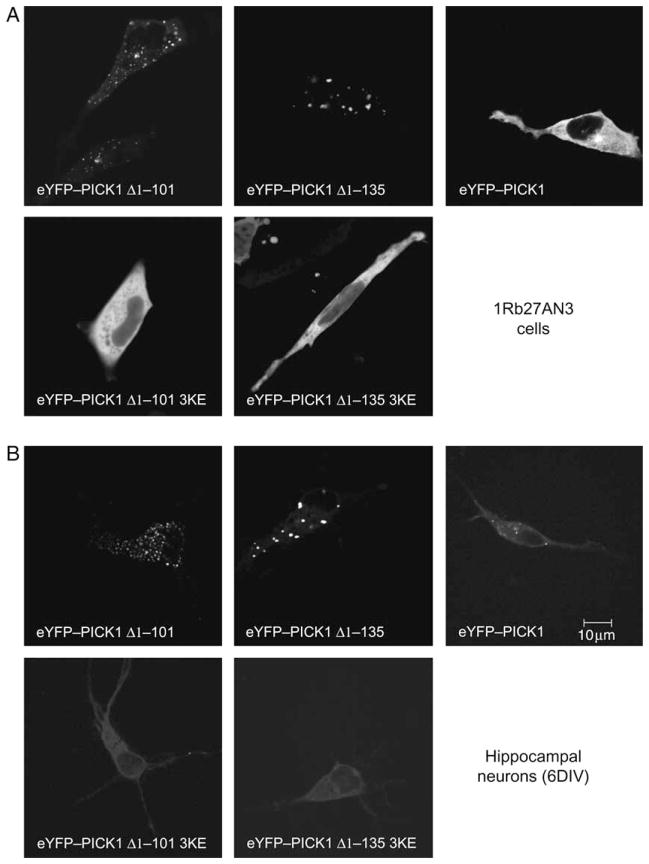
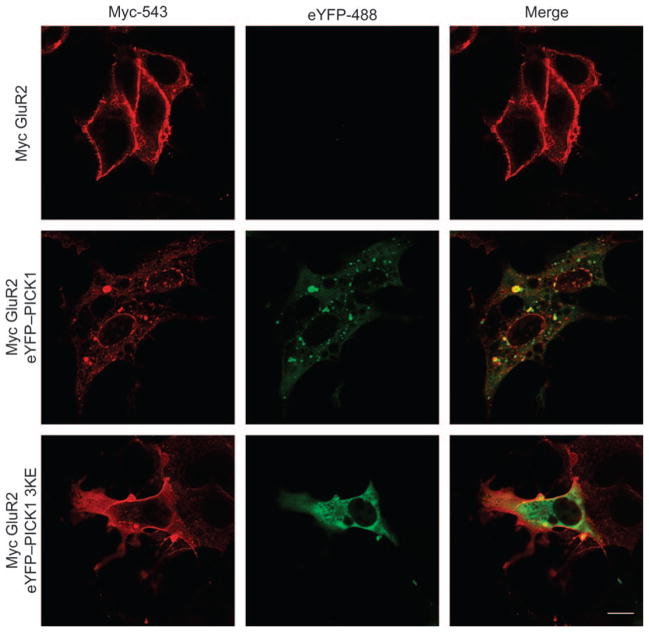
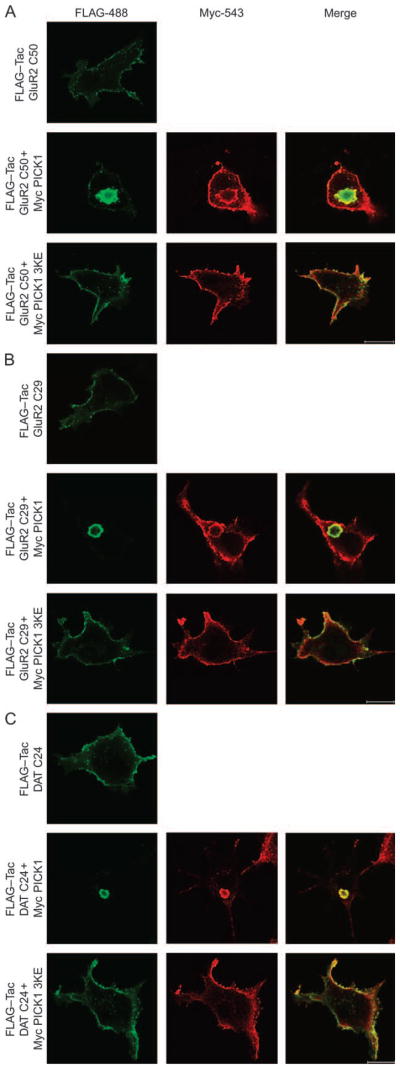
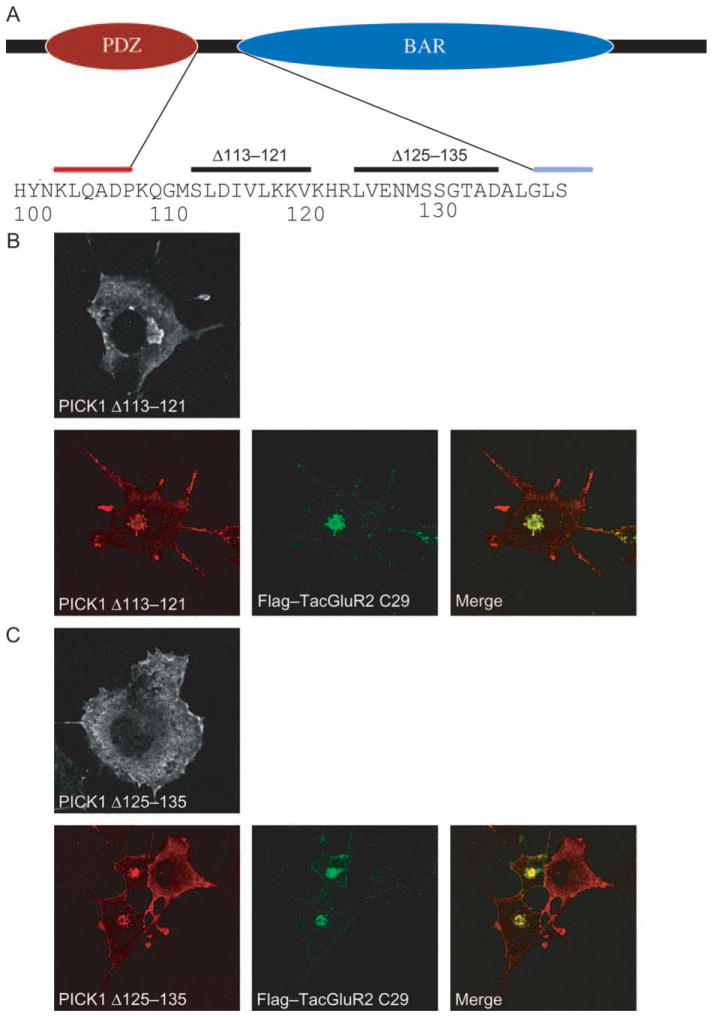
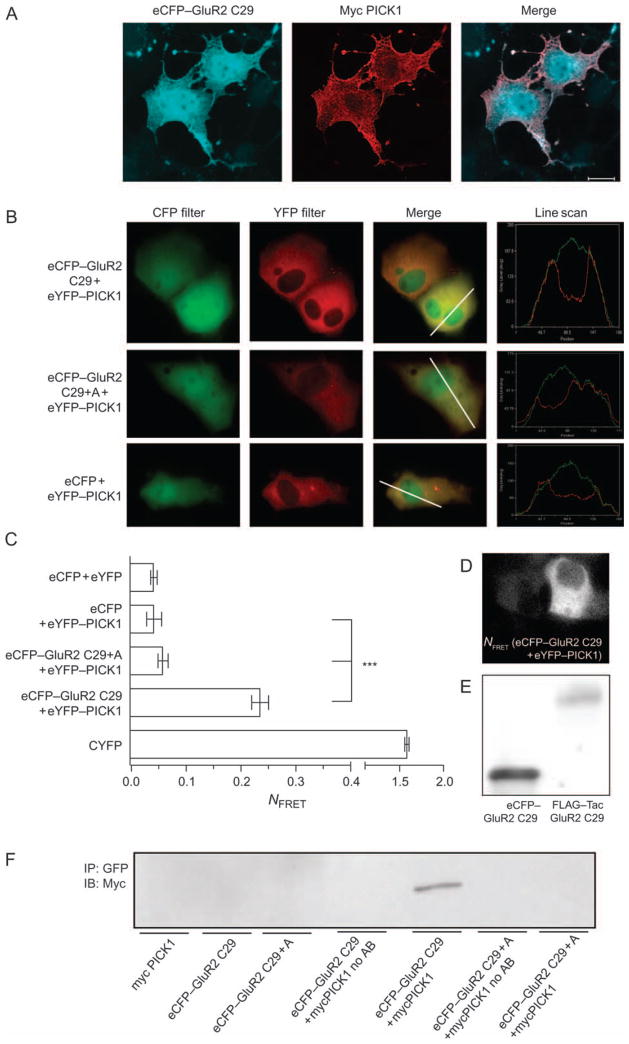
The PSD-95/Discs-large/ZO-1 homology (PDZ) domain protein, protein interacting with C kinase 1 (PICK1) contains a C-terminal Bin/amphiphysin/Rvs (BAR) domain mediating recognition of curved membranes; however, the molecular mechanisms controlling the activity of this domain are poorly understood. In agreement with negative regulation of the BAR domain by the N-terminal PDZ domain, PICK1 distributed evenly in the cytoplasm, whereas truncation of the PDZ domain caused BAR domain-dependent redistribution to clusters colocalizing with markers of recycling endosomal compartments. A similar clustering was observed both upon truncation of a short putative alpha-helical segment in the linker between the PDZ and the BAR domains and upon coexpression of PICK1 with a transmembrane PDZ ligand, including the alpha-amino-3-hydroxy-5-methyl-4-isoxazolepropionic acid (AMPA) receptor GluR2 subunit, the GluR2 C-terminus transferred to the single transmembrane protein Tac or the dopamine transporter C-terminus transferred to Tac. In contrast, transfer of the GluR2 C-terminus to cyan fluorescent protein, a cytosolic protein, did not elicit BAR domain-dependent clustering. Instead, localizing PICK1 to the membrane by introducing an N-terminal myristoylation site produced BAR domain-dependent, but ligand-independent, PICK1 clustering. The data support that in the absence of PDZ ligand, the PICK1 BAR domain is inhibited through a PDZ domain-dependent and linker-dependent mechanism. Moreover, they suggest that unmasking of the BAR domain's membrane-binding capacity is not a consequence of ligand binding to the PDZ domain per se but results from, and coincides with, recruitment of PICK1 to a membrane compartment.
PSD-95/盘状大蛋白/ZO-1同源(PDZ)结构域蛋白,即与C激酶1相互作用的蛋白(PICK1),含有一个介导对弯曲膜识别的C末端Bin/发动蛋白/Rvs(BAR)结构域;然而,控制该结构域活性的分子机制却知之甚少。与N末端PDZ结构域对BAR结构域的负调控一致,PICK1均匀分布于细胞质中,而PDZ结构域的截短导致BAR结构域依赖性地重新分布到与再循环内体区室标记物共定位的簇中。在PDZ和BAR结构域之间的连接子中一个短的假定α螺旋片段被截短后,以及在PICK1与跨膜PDZ配体共表达时均观察到类似的聚集,所述跨膜PDZ配体包括α-氨基-3-羟基-5-甲基-4-异恶唑丙酸(AMPA)受体GluR2亚基、转移至单跨膜蛋白Tac的GluR2 C末端或转移至Tac的多巴胺转运体C末端。相反,将GluR2 C末端转移至胞质蛋白青色荧光蛋白则不会引发BAR结构域依赖性聚集。取而代之的是,通过引入N末端肉豆蔻酰化位点将PICK1定位到膜上会产生BAR结构域依赖性但不依赖配体的PICK1聚集。这些数据支持在没有PDZ配体的情况下,PICK1 BAR结构域通过一种依赖PDZ结构域和连接子的机制受到抑制。此外,它们表明BAR结构域膜结合能力的暴露并非配体与PDZ结构域本身结合的结果,而是PICK1募集到膜区室的结果,并且与之同时发生。