Plumb M, Fulton R, Breimer L, Stewart M, Willison K, Neil J C
Beatson Institute for Cancer Research, Glasgow, Scotland.
J Virol. 1991 Apr;65(4):1991-9. doi: 10.1128/JVI.65.4.1991-1999.1991.
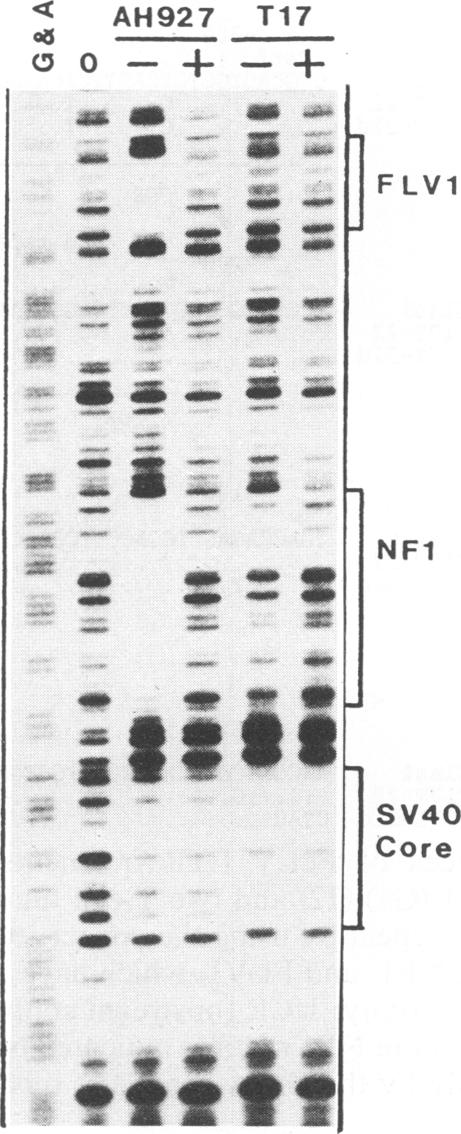
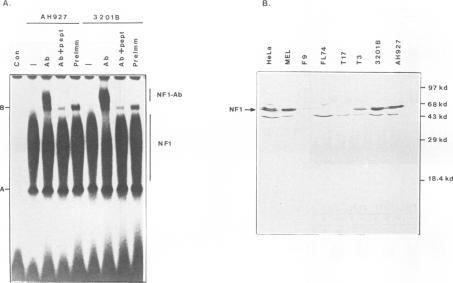
A recombinant feline leukemia virus (FeLV) proviral clone (T17T-22) with a long terminal repeat (LTR) which differs from prototype FeLV by a point mutation within a conserved nuclear factor 1 (NF1)-binding motif in the LTR enhancer domain was found to be poorly expressed after DNA transfection. The NF1 point mutation reduced in vitro protein binding as assessed by gel shift analysis and reduced promoter activity significantly (2- to 10-fold). However, the degree of promoter impairment due to the NF1 site mutation varied according to cell type and was least severe in a feline leukemia cell line (T3) which had low levels of nuclear NF1 DNA-binding activity. Low NF1 DNA-binding activity was observed in three FeLV-induced leukemia cell lines (T3, T17, and FL74) and in murine F9 embryonal carcinoma cells. While similar levels of NF1 gene mRNA transcripts were detected in all cell lines, Western immunoblot analysis of F9, T17, and FL74 but not T3 nuclear extracts revealed very low levels of nuclear NF1 protein. These results indicate that NF1 activity is down-regulated in FeLV-induced leukemia cells by diverse posttranscriptional mechanisms. We suggest that NF1 down-regulation may be an important characteristic of target cells susceptible to FeLV transformation in vivo and may provide the selective pressure which favors duplication of the LTR core enhancer sequence in T-cell leukemogenic FeLV variants.
一种重组猫白血病病毒(FeLV)前病毒克隆(T17T - 22),其长末端重复序列(LTR)与原型FeLV的不同之处在于,LTR增强子结构域中保守的核因子1(NF1)结合基序内存在一个点突变。经DNA转染后发现该克隆表达不佳。凝胶迁移分析表明,NF1点突变降低了体外蛋白结合能力,并显著降低了启动子活性(2至10倍)。然而,由于NF1位点突变导致的启动子损伤程度因细胞类型而异,在核NF1 DNA结合活性水平较低的猫白血病细胞系(T3)中最不严重。在三种FeLV诱导的白血病细胞系(T3、T17和FL74)以及小鼠F9胚胎癌细胞中均观察到低NF1 DNA结合活性。虽然在所有细胞系中检测到的NF1基因mRNA转录本水平相似,但对F9、T17和FL74而非T3核提取物进行的Western免疫印迹分析显示,核NF1蛋白水平极低。这些结果表明,在FeLV诱导的白血病细胞中,NF1活性通过多种转录后机制被下调。我们认为,NF1下调可能是体内易受FeLV转化的靶细胞的一个重要特征,并且可能提供有利于T细胞致白血病FeLV变体中LTR核心增强子序列复制的选择压力。