Donzelli Sonia, Espey Michael Graham, Flores-Santana Wilmarie, Switzer Christopher H, Yeh Grace C, Huang Jinming, Stuehr Dennis J, King S Bruce, Miranda Katrina M, Wink David A
Tumor Biology Section, Radiation Biology Branch, National Cancer Institute, NIH, Bethesda, MD 20892, USA.
Free Radic Biol Med. 2008 Sep 1;45(5):578-84. doi: 10.1016/j.freeradbiomed.2008.04.036. Epub 2008 May 3.
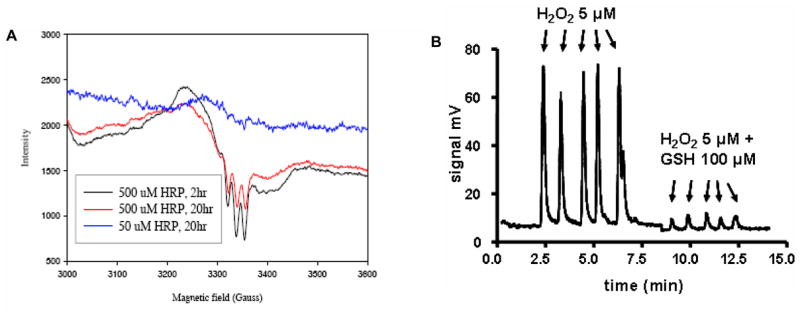
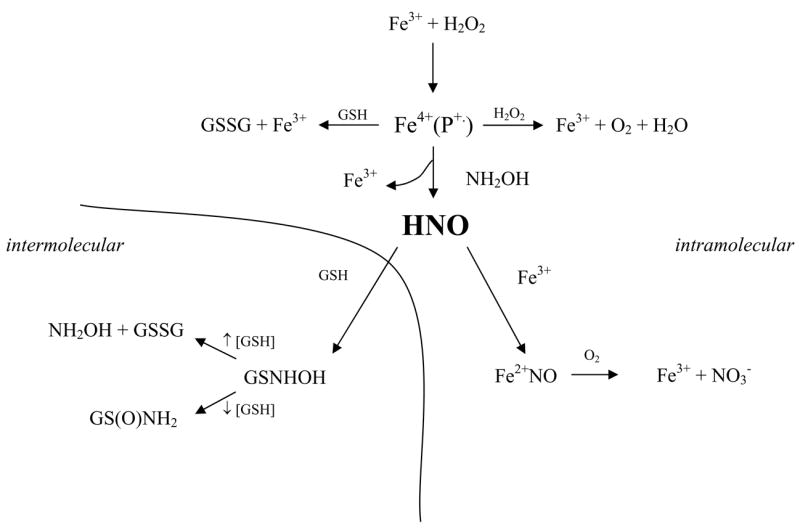
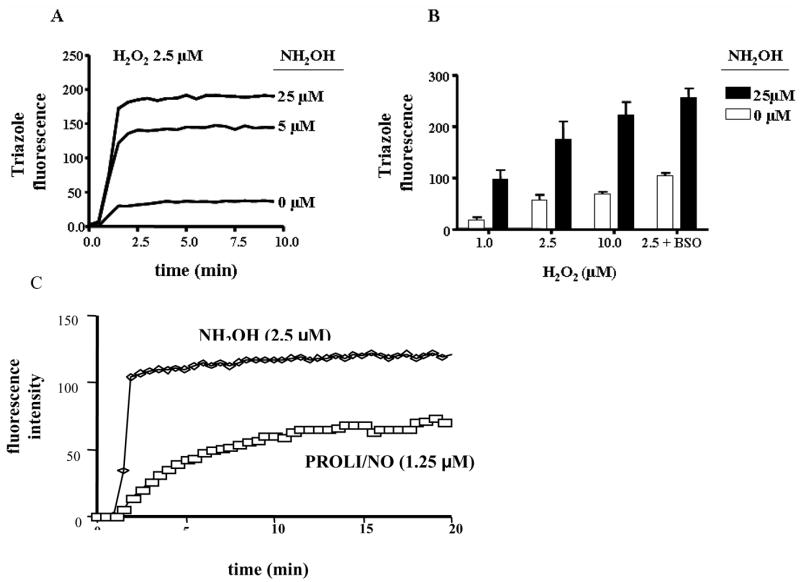
The chemical reactivity, toxicology, and pharmacological responses to nitroxyl (HNO) are often distinctly different from those of nitric oxide (NO). The discovery that HNO donors may have pharmacological utility for treatment of cardiovascular disorders such as heart failure and ischemia reperfusion has led to increased speculation of potential endogenous pathways for HNO biosynthesis. Here, the ability of heme proteins to utilize H2O2 to oxidize hydroxylamine (NH2OH) or N-hydroxy-L-arginine (NOHA) to HNO was examined. Formation of HNO was evaluated with a recently developed selective assay in which the reaction products in the presence of reduced glutathione (GSH) were quantified by HPLC. Release of HNO from the heme pocket was indicated by formation of sulfinamide (GS(O)NH2), while the yields of nitrite and nitrate signified the degree of intramolecular recombination of HNO with the heme. Formation of GS(O)NH2 was observed upon oxidation of NH2OH, whereas NOHA, the primary intermediate in oxidation of L-arginine by NO synthase, was apparently resistant to oxidation by the heme proteins utilized. In the presence of NH2OH, the highest yields of GS(O)NH2 were observed with proteins in which the heme was coordinated to a histidine (horseradish peroxidase, lactoperoxidase, myeloperoxidase, myoglobin, and hemoglobin) in contrast to a tyrosine (catalase) or cysteine (cytochrome P450). That peroxidation of NH2OH by horseradish peroxidase produced free HNO, which was able to affect intracellular targets, was verified by conversion of 4,5-diaminofluorescein to the corresponding fluorophore within intact cells.
对硝酰基(HNO)的化学反应性、毒理学和药理反应通常与一氧化氮(NO)明显不同。HNO供体可能具有治疗心力衰竭和缺血再灌注等心血管疾病的药理作用这一发现,引发了人们对HNO生物合成潜在内源性途径的更多猜测。在此,研究了血红素蛋白利用过氧化氢将羟胺(NH2OH)或N-羟基-L-精氨酸(NOHA)氧化为HNO的能力。使用最近开发的选择性测定法评估HNO的形成,其中在存在还原型谷胱甘肽(GSH)的情况下,通过HPLC对反应产物进行定量。亚磺酰胺(GS(O)NH2)的形成表明HNO从血红素口袋中释放,而亚硝酸盐和硝酸盐的产量则表示HNO与血红素分子内重组的程度。氧化NH2OH时观察到GS(O)NH2的形成,而NOHA是一氧化氮合酶氧化L-精氨酸的主要中间体,显然对所使用的血红素蛋白的氧化具有抗性。在存在NH2OH的情况下,与酪氨酸(过氧化氢酶)或半胱氨酸(细胞色素P450)配位的血红素蛋白相比,血红素与组氨酸配位的蛋白(辣根过氧化物酶、乳过氧化物酶、髓过氧化物酶、肌红蛋白和血红蛋白)观察到最高产量的GS(O)NH2。辣根过氧化物酶对NH2OH的过氧化产生游离HNO,能够影响细胞内靶点,这通过在完整细胞内将4,5-二氨基荧光素转化为相应的荧光团得到验证。