Benmessaoud Dalila, Hamdani Nora, Boni Claudette, Ramoz Nicolas, Hamon Michel, Kacha Farid, Gorwood Philip
Etablissement Hospitalier Spécialisé Psychiatrique M. Boucebci. Cheraga, Alger, Algeria.
BMC Psychiatry. 2008 May 30;8:40. doi: 10.1186/1471-244X-8-40.
The -1438A/G polymorphism of the 5-HT2A gene has been found to be associated with clinical response to clozapine and other second generation antipsychotics. Testing the impact of this marker on response to first generation antipsychotics (which have a lower affinity for the 5-HT2A receptor) provides the opportunity to help disentangling the two different roles that this polymorphism might have. A psychopharmacogenetic role should be detected only for antipsychotics with high affinity to the 5-HT2A receptor (therefore to second generation antipsychotics). An alternative role would imply tagging a subgroup of patients responsive to any antipsychotic, whatever their affinity, meaning that the association is more depending on non pharmacological charaterictics, such as clinical specificities.
A family-based sample of 100 Algerian patients with schizophrenia (according to DSM-IV criteria) and their 200 biological parents was recruited, in order to avoid stratification biases. Patients were all treated, or have been treated, by conventional antipsychotics (mainly haloperidol) for at least four weeks, at appropriate dosage. May and Dencker scale was used to distinguish responders and non responders.
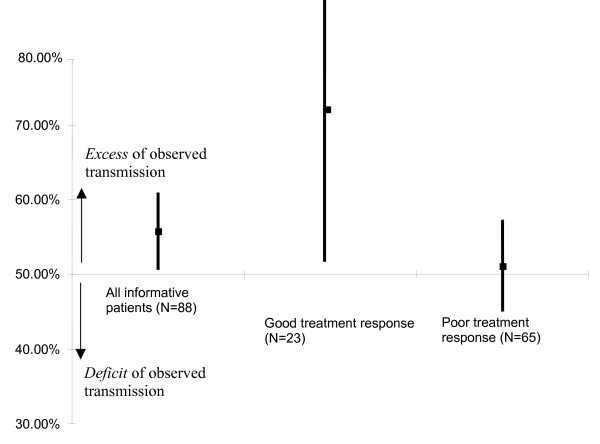
No allele of the -1438A/G polymorphism of the 5-HT2A gene was transmitted in excess (50 transmitted for 38 untransmitted) in the whole sample of patients with schizophrenia (p = .90). In contrast, a significant excess of transmission of the G allele was observed (p = .02) in the subgroup of patients with good treatment response (17 transmitted for 6 untransmitted).
Using a TDT approach, we showed that the G allele of the -1438A/G polymorphism of the gene coding for the 5-HT2A receptor was associated to schizophrenia with good response to conventional antipsychotics, although this conclusion is based on 88 informative patients only. Because previous data showed the same result with atypical antipsychotics, it can be concluded that the G allele tags a subgroup of schizophrenic patients with greater chance of improvement with antipsychotics of either type.
已发现5-HT2A基因的-1438A/G多态性与氯氮平和其他第二代抗精神病药物的临床反应相关。测试该标志物对第一代抗精神病药物(对5-HT2A受体亲和力较低)反应的影响,为帮助厘清这种多态性可能具有的两种不同作用提供了契机。仅对与5-HT2A受体具有高亲和力的抗精神病药物(即第二代抗精神病药物)应检测到心理药物遗传学作用。另一种作用则意味着标记出对任何抗精神病药物有反应的患者亚组,无论其亲和力如何,这意味着这种关联更多地取决于非药理学特征,如临床特异性。
招募了一个基于家庭的样本,包括100名符合DSM-IV标准的阿尔及利亚精神分裂症患者及其200名生物学父母,以避免分层偏差。所有患者均接受或曾接受常规抗精神病药物(主要是氟哌啶醇)治疗至少四周,剂量适当。使用May和Dencker量表区分反应者和无反应者。
在整个精神分裂症患者样本中,5-HT2A基因的-1438A/G多态性的等位基因没有过度传递(传递50个,未传递38个)(p = 0.90)。相比之下,在治疗反应良好的患者亚组中观察到G等位基因有显著的过度传递(p = 0.02)(传递17个,未传递6个)。
使用传递不平衡检验方法,我们表明编码5-HT2A受体的基因的-1438A/G多态性的G等位基因与对常规抗精神病药物反应良好的精神分裂症相关,尽管这一结论仅基于88名信息丰富的患者。由于先前的数据显示非典型抗精神病药物也有相同结果,因此可以得出结论,G等位基因标记出了一组精神分裂症患者,他们使用任何一种类型的抗精神病药物都有更大的改善机会。