Miller Jason L, Le Coq Johanne, Hodes Asher, Barbalat Roman, Miller Jeff F, Ghosh Partho
Department of Chemistry and Biochemistry, University of California San Diego, La Jolla, California, United States of America.
PLoS Biol. 2008 Jun 3;6(6):e131. doi: 10.1371/journal.pbio.0060131.
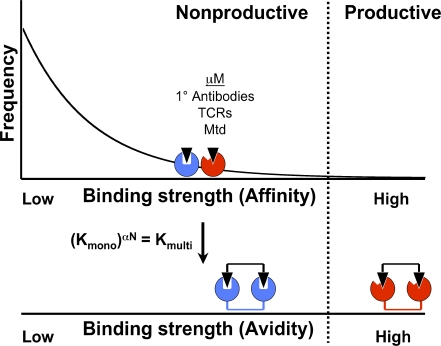
Diversity-generating retroelements (DGRs) recognize novel ligands through massive protein sequence variation, a property shared uniquely with the adaptive immune response. Little is known about how recognition is achieved by DGR variable proteins. Here, we present the structure of the Bordetella bacteriophage DGR variable protein major tropism determinant (Mtd) bound to the receptor pertactin, revealing remarkable adaptability in the static binding sites of Mtd. Despite large dissimilarities in ligand binding mode, principles underlying selective recognition were strikingly conserved between Mtd and immunoreceptors. Central to this was the differential amplification of binding strengths by avidity (i.e., multivalency), which not only relaxed the demand for optimal complementarity between Mtd and pertactin but also enhanced distinctions among binding events to provide selectivity. A quantitatively similar balance between complementarity and avidity was observed for Bordetella bacteriophage DGR as occurs in the immune system, suggesting that variable repertoires operate under a narrow set of conditions to recognize novel ligands.
多样性产生逆转录元件(DGRs)通过大量蛋白质序列变异来识别新的配体,这是一种仅与适应性免疫反应共有的特性。关于DGR可变蛋白如何实现识别,人们知之甚少。在这里,我们展示了与受体百日咳杆菌黏附素结合的博德特氏菌噬菌体DGR可变蛋白主要嗜性决定簇(Mtd)的结构,揭示了Mtd静态结合位点具有显著的适应性。尽管配体结合模式存在很大差异,但Mtd和免疫受体之间选择性识别的基本原理却惊人地保守。其核心是通过亲和力(即多价性)对结合强度进行差异放大,这不仅放宽了对Mtd与百日咳杆菌黏附素之间最佳互补性的要求,还增强了结合事件之间的差异以提供选择性。在博德特氏菌噬菌体DGR中观察到的互补性和亲和力之间的定量相似平衡与免疫系统中发生的情况相同,这表明可变库在一组狭窄的条件下运作以识别新的配体。