Van Bortel Wim, Trung Ho Dinh, Thuan Le Khanh, Sochantha Tho, Socheat Duong, Sumrandee Chalao, Baimai Visut, Keokenchanh Kalouna, Samlane Phompida, Roelants Patricia, Denis Leen, Verhaeghen Katrijn, Obsomer Valerie, Coosemans Marc
Institute of Tropical Medicine, Dept, Parasitology, Nationalestraat 155, B-2000 Antwerpen, Belgium.
Malar J. 2008 Jun 5;7:102. doi: 10.1186/1475-2875-7-102.
Knowledge on insecticide resistance in target species is a basic requirement to guide insecticide use in malaria control programmes. Malaria transmission in the Mekong region is mainly concentrated in forested areas along the country borders, so that decisions on insecticide use should ideally be made at regional level. Consequently, cross-country monitoring of insecticide resistance is indispensable to acquire comparable baseline data on insecticide resistance.
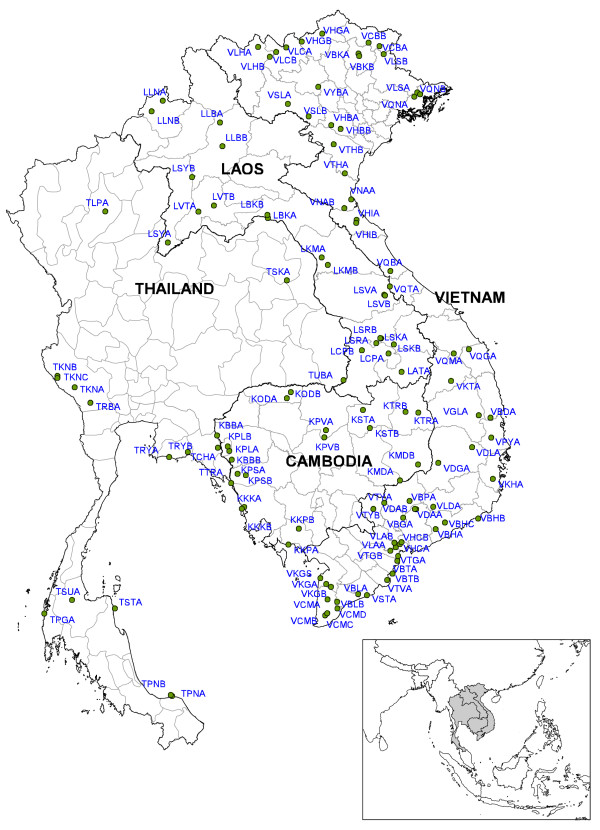
A network for the monitoring of insecticide resistance, MALVECASIA, was set up in the Mekong region in order to assess the insecticide resistance status of the major malaria vectors in Cambodia, Laos, Thailand, and Vietnam. From 2003 till 2005, bioassays were performed on adult mosquitoes using the standard WHO susceptibility test with diagnostic concentrations of permethrin 0.75% and DDT 4%. Additional tests were done with pyrethroid insecticides applied by the different national malaria control programmes.
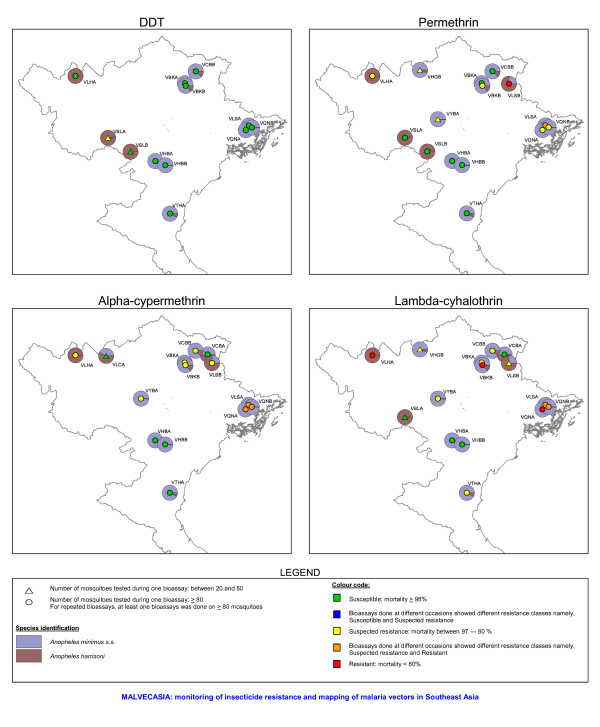
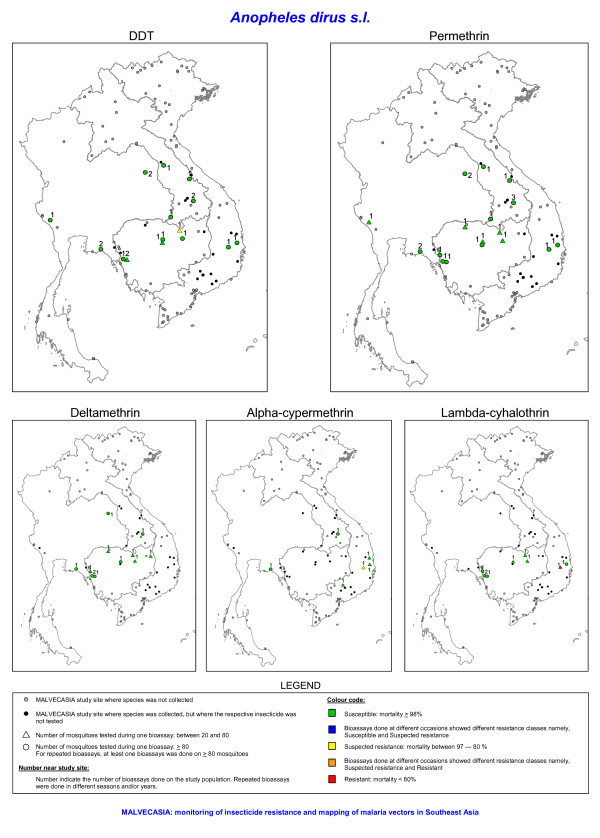
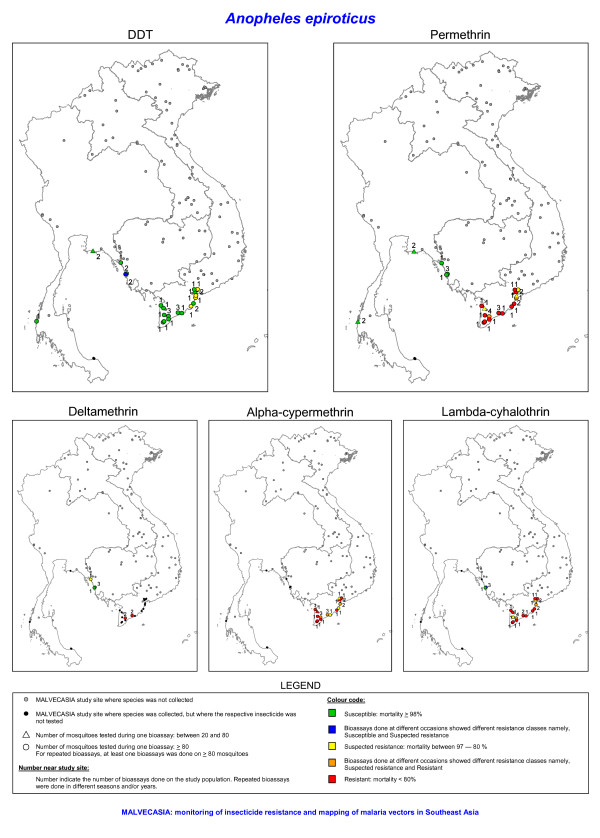
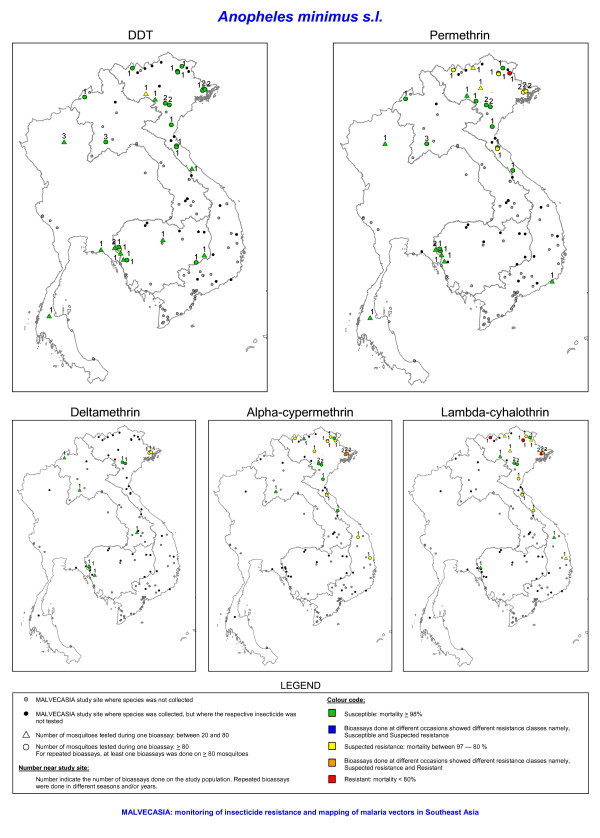
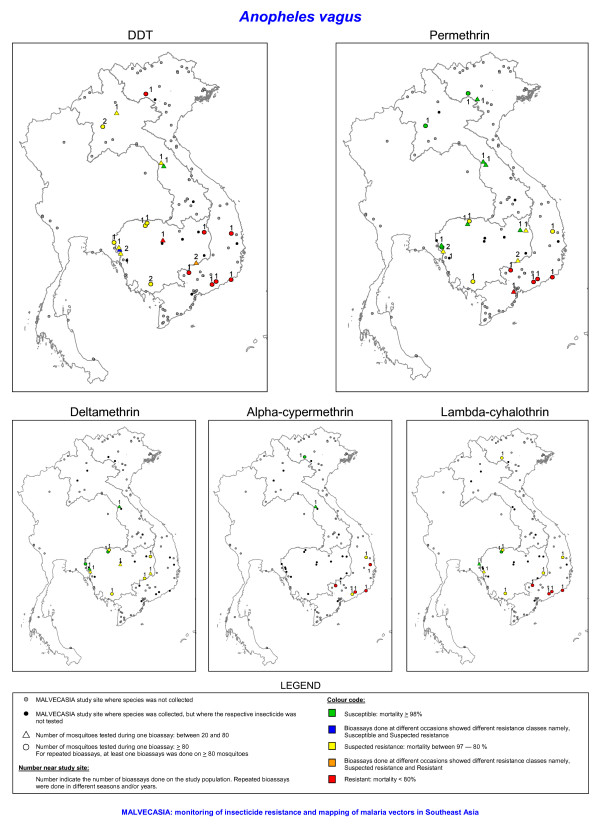
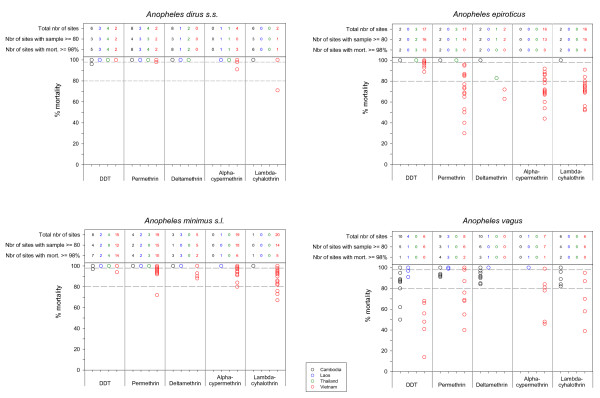
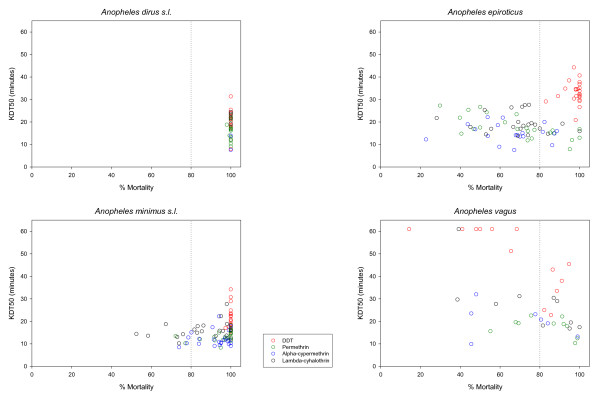
Anopheles dirus s.s., the main vector in forested malaria foci, was susceptible to permethrin. However, in central Vietnam, it showed possible resistance to type II pyrethroids. In the Mekong delta, Anopheles epiroticus was highly resistant to all pyrethroid insecticides tested. It was susceptible to DDT, except near Ho Chi Minh City where it showed possible DDT resistance. In Vietnam, pyrethroid susceptible and tolerant Anopheles minimus s.l. populations were found, whereas An. minimus s.l. from Cambodia, Laos and Thailand were susceptible. Only two An. minimus s.l. populations showed DDT tolerance. Anopheles vagus was found resistant to DDT and to several pyrethroids in Vietnam and Cambodia.
This is the first large scale, cross-country survey of insecticide resistance in Anopheles species in the Mekong Region. A unique baseline data on insecticide resistance for the Mekong region is now available, which enables the follow-up of trends in susceptibility status in the region and which will serve as the basis for further resistance management. Large differences in insecticide resistance status were observed among species and countries. In Vietnam, insecticide resistance was mainly observed in low or transmission-free areas, hence an immediate change of malaria vector control strategy is not required. Though, resistance management is important because the risk of migration of mosquitoes carrying resistance genes from non-endemic to endemic areas. Moreover, trends in resistance status should be carefully monitored and the impact of existing vector control tools on resistant populations should be assessed.
了解目标物种对杀虫剂的抗性是指导疟疾控制项目中杀虫剂使用的基本要求。湄公河地区的疟疾传播主要集中在国界沿线的森林地区,因此理想情况下,杀虫剂使用的决策应在区域层面做出。因此,跨国监测杀虫剂抗性对于获取关于杀虫剂抗性的可比基线数据是必不可少的。
在湄公河地区建立了一个监测杀虫剂抗性的网络MALVECASIA,以评估柬埔寨、老挝、泰国和越南主要疟疾传播媒介的杀虫剂抗性状况。从2003年到2005年,使用世界卫生组织标准易感性试验,对成年蚊子进行生物测定,使用的诊断浓度为0.75%的氯菊酯和4%的滴滴涕。不同国家的疟疾控制项目还使用拟除虫菊酯类杀虫剂进行了额外测试。
森林疟疾疫源地的主要传播媒介中华按蚊对氯菊酯敏感。然而,在越南中部,它对II型拟除虫菊酯表现出可能的抗性。在湄公河三角洲,嗜人按蚊对所有测试的拟除虫菊酯类杀虫剂高度抗性。它对滴滴涕敏感,但在胡志明市附近表现出可能的滴滴涕抗性。在越南,发现了对拟除虫菊酯敏感和耐受的微小按蚊种群,而来自柬埔寨、老挝和泰国的微小按蚊对拟除虫菊酯敏感。只有两个微小按蚊种群表现出对滴滴涕的耐受性。在越南和柬埔寨,迷走按蚊对滴滴涕和几种拟除虫菊酯表现出抗性。
这是湄公河地区首次对按蚊物种的杀虫剂抗性进行大规模跨国调查。现在已有湄公河地区关于杀虫剂抗性的独特基线数据,这有助于跟踪该地区易感性状况的趋势,并将作为进一步抗性管理的基础。在物种和国家之间观察到杀虫剂抗性状况存在很大差异。在越南,杀虫剂抗性主要在低传播或无传播地区观察到,因此不需要立即改变疟疾传播媒介控制策略。不过,抗性管理很重要,因为携带抗性基因的蚊子有从非流行地区迁移到流行地区的风险。此外,应仔细监测抗性状况的趋势,并评估现有传播媒介控制工具对抗性种群的影响。