Airaksinen Anu J, Nag Sangram, Finnema Sjoerd J, Mukherjee Jogeshwar, Chattopadhyay Sankha, Gulyás Balázs, Farde Lars, Halldin Christer
Karolinska Institutet, Department of Clinical Neuroscience, Psychiatry Section, Karolinska Hospital, S-17176 Stockholm, Sweden.
Bioorg Med Chem. 2008 Jul 1;16(13):6467-73. doi: 10.1016/j.bmc.2008.05.039. Epub 2008 May 20.
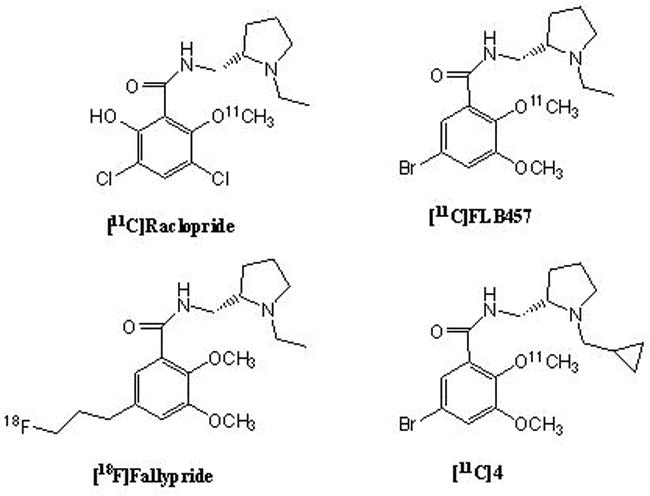
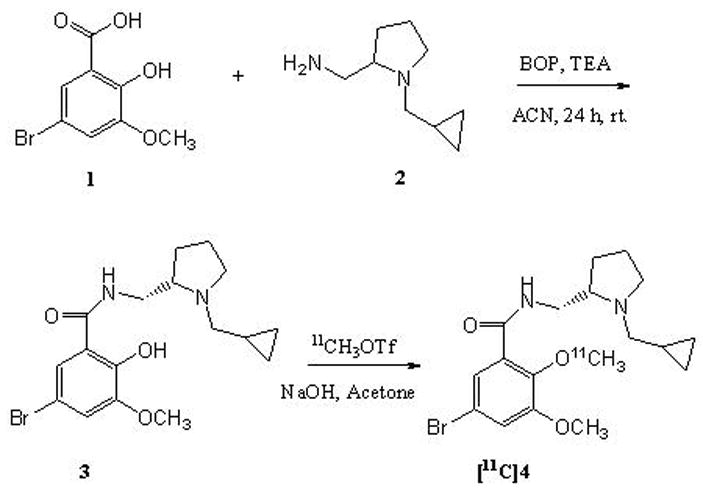
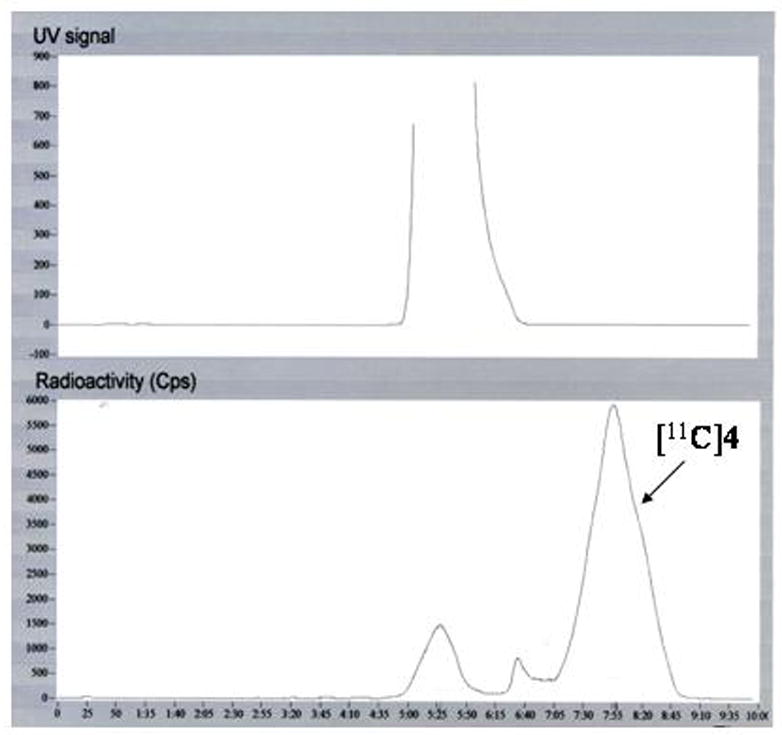
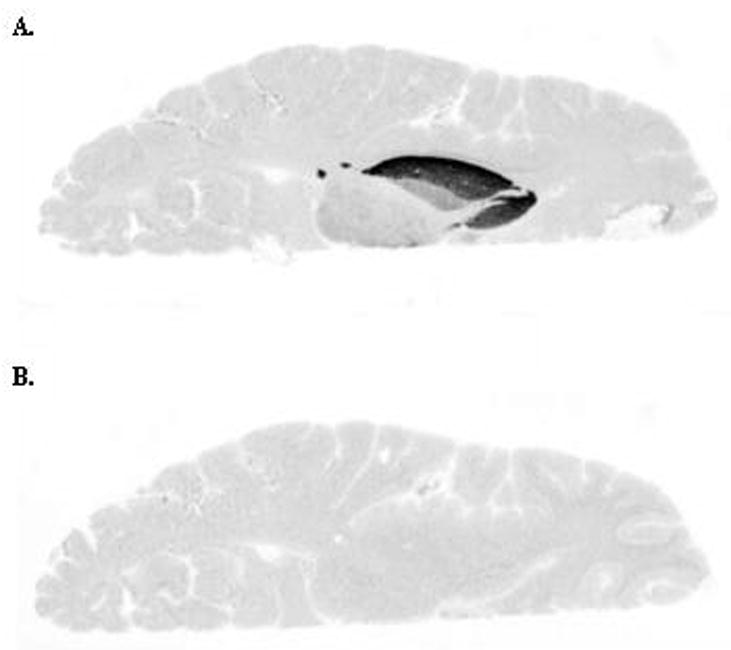
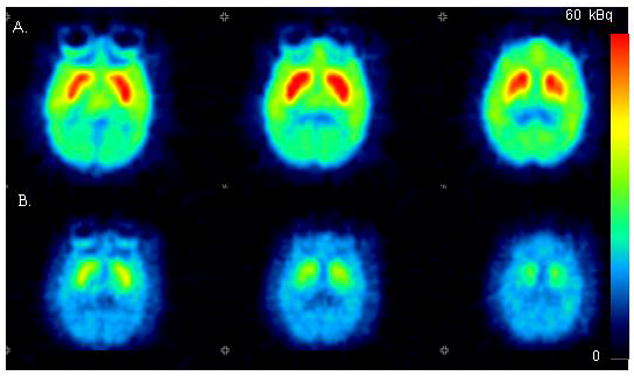
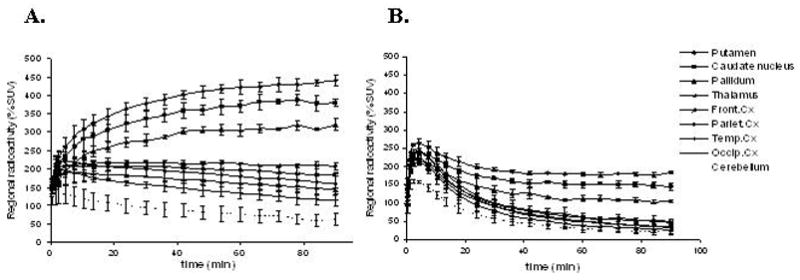
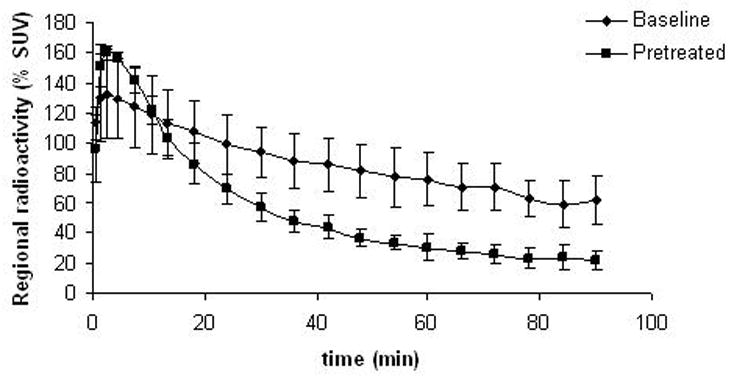
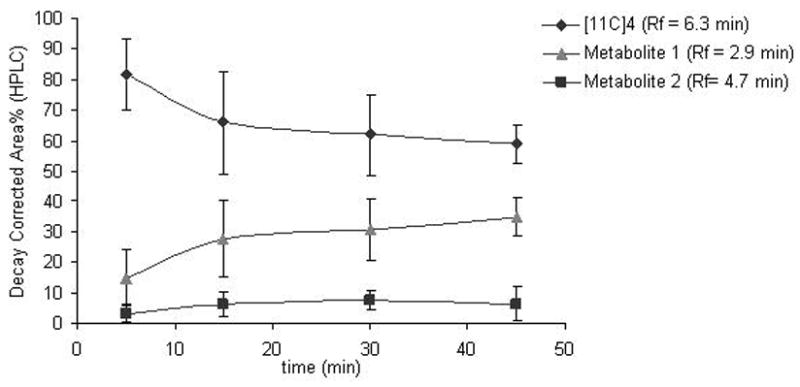
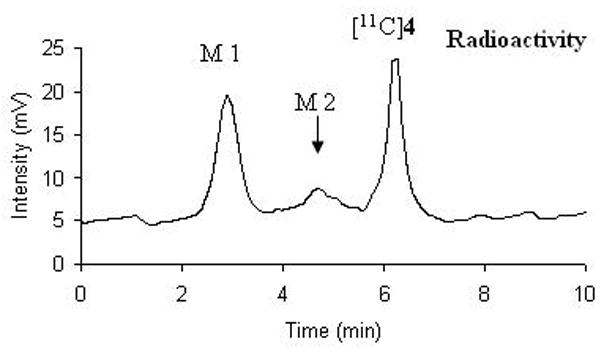
(S)-5-bromo-N-[(1-cyclopropylmethyl-2-pyrrolidinyl)methyl]-2,3-dimethoxybenzamide (4) has pico-molar in vitro binding affinity to D(2) receptor (K(i) (D(2))=0.003 nM) with lower affinity to D(3) receptor (K(i) (D(3))=0.22 nM). In this study, we describe radiosynthesis of [(11)C]4 and evaluation of its binding characteristics in post-mortem human brain autoradiography and with PET in cynomolgus monkeys. The (11)C labelled 4 was synthesized by using [(11)C]methyltriflate in a methylation reaction with its phenolic precursor with good incorporation yield (64+/-11%, DCY) and high specific radioactivity >370 GBq/micromol (>10,000 Ci/mmol). In post-mortem human brain autoradiography [(11)C]4 exhibited high specific binding in brain regions enriched with dopamine D(2)/D(3) receptors and low level of non-specific binding. In cynomolgus monkeys [(11)C]4 exhibited high brain uptake reaching 4.4% ID at 7.5 min. The binding in the extrastriatal low density D(2)-receptor regions; thalamus and frontal, parietal, temporal, and occipital cortex, was clearly visible. Pre-treatment with raclopride (1 mg/kg as tartrate) caused high reduction of binding in extrastriatal regions, including cerebellum. [(11)C]4 is a promising radioligand for imaging D(2) receptors in low density regions in brain.
(S)-5-溴-N-[(1-环丙基甲基-2-吡咯烷基)甲基]-2,3-二甲氧基苯甲酰胺(4)对D(2)受体具有皮摩尔级的体外结合亲和力(K(i)(D(2)) = 0.003 nM),对D(3)受体的亲和力较低(K(i)(D(3)) = 0.22 nM)。在本研究中,我们描述了[(11)C]4的放射性合成及其在人死后脑放射自显影和食蟹猴PET成像中的结合特性评估。通过使用[(11)C]甲基三氟甲磺酸酯与其酚类前体进行甲基化反应合成了(11)C标记的4,具有良好的掺入产率(64±11%,衰变校正产率)和高比活度>370 GBq/μmol(>10,000 Ci/mmol)。在人死后脑放射自显影中,[(11)C]4在富含多巴胺D(2)/D(3)受体的脑区表现出高特异性结合,非特异性结合水平较低。在食蟹猴中,[(11)C]4在7.5分钟时脑摄取率高达4.4% ID。在纹状体外低密度D(2)受体区域;丘脑以及额叶、顶叶、颞叶和枕叶皮质中的结合清晰可见。用雷氯必利(1 mg/kg酒石酸盐)预处理导致纹状体外区域,包括小脑的结合显著降低。[(11)C]4是一种有前景的放射性配体,可用于脑低密度区域D(2)受体的成像。