Hong Sun Pyo, Ji Seung Il, Rhee Hwanseok, Shin Soo Kyeong, Hwang Sun Young, Lee Seung Hwan, Lee Soong Deok, Oh Heung-Bum, Yoo Wangdon, Kim Soo-Ok
Research & Development Center, GeneMatrix, Inc., Yongin, 446-913, South Korea.
BMC Genomics. 2008 Jun 9;9:276. doi: 10.1186/1471-2164-9-276.
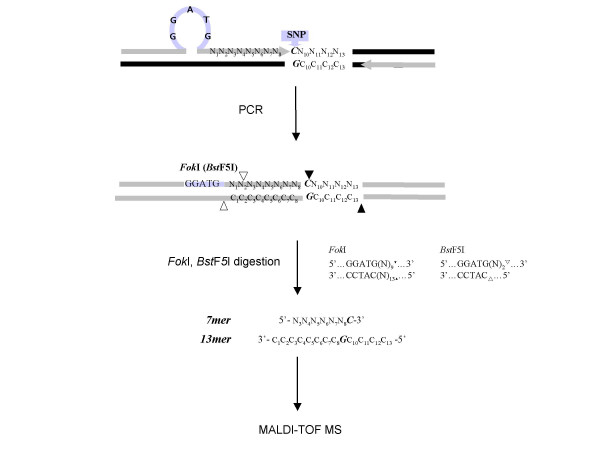
We describe the development of a novel matrix-assisted laser desorption ionization time-of-flight (MALDI-TOF)-based single nucleotide polymorphism (SNP) scoring strategy, termed Restriction Fragment Mass Polymorphism (RFMP) that is suitable for genotyping variations in a simple, accurate, and high-throughput manner. The assay is based on polymerase chain reaction (PCR) amplification and mass measurement of oligonucleotides containing a polymorphic base, to which a typeIIS restriction endonuclease recognition was introduced by PCR amplification. Enzymatic cleavage of the products leads to excision of oligonucleotide fragments representing base variation of the polymorphic site whose masses were determined by MALDI-TOF MS.
The assay represents an improvement over previous methods because it relies on the direct mass determination of PCR products rather than on an indirect analysis, where a base-extended or fluorescent report tag is interpreted. The RFMP strategy is simple and straightforward, requiring one restriction digestion reaction following target amplification in a single vessel. With this technology, genotypes are generated with a high call rate (99.6%) and high accuracy (99.8%) as determined by independent sequencing.
The simplicity, accuracy and amenability to high-throughput screening analysis should make the RFMP assay suitable for large-scale genotype association study as well as clinical genotyping in laboratories.
我们描述了一种基于基质辅助激光解吸电离飞行时间(MALDI-TOF)的单核苷酸多态性(SNP)评分策略的开发,称为限制性片段质量多态性(RFMP),它适用于以简单、准确和高通量的方式对变异进行基因分型。该检测基于聚合酶链反应(PCR)扩增和对含有多态性碱基的寡核苷酸的质量测量,通过PCR扩增引入IIS型限制性内切酶识别位点。产物的酶切导致代表多态性位点碱基变异的寡核苷酸片段的切除,其质量由MALDI-TOF MS测定。
该检测方法是对先前方法的改进,因为它依赖于对PCR产物的直接质量测定,而不是依赖于对碱基延伸或荧光报告标签进行解释的间接分析。RFMP策略简单直接,在单个容器中进行目标扩增后只需进行一次限制性消化反应。通过该技术,经独立测序确定,基因分型的检出率高(99.6%)且准确性高(99.8%)。
RFMP检测方法的简单性、准确性和适用于高通量筛选分析的特性,使其适用于大规模基因分型关联研究以及实验室中的临床基因分型。