Zhang Jingxian, Addepalli Balasubramanyam, Yun Kil-Young, Hunt Arthur G, Xu Ruqiang, Rao Suryadevara, Li Qingshun Q, Falcone Deane L
Kentucky Tobacco Research and Development Center, University of Kentucky, Lexington, Kentucky, United States of America.
PLoS One. 2008 Jun 11;3(6):e2410. doi: 10.1371/journal.pone.0002410.
Plants respond to many unfavorable environmental conditions via signaling mediated by altered levels of various reactive oxygen species (ROS). To gain additional insight into oxidative signaling responses, Arabidopsis mutants that exhibited tolerance to oxidative stress were isolated. We describe herein the isolation and characterization of one such mutant, oxt6.
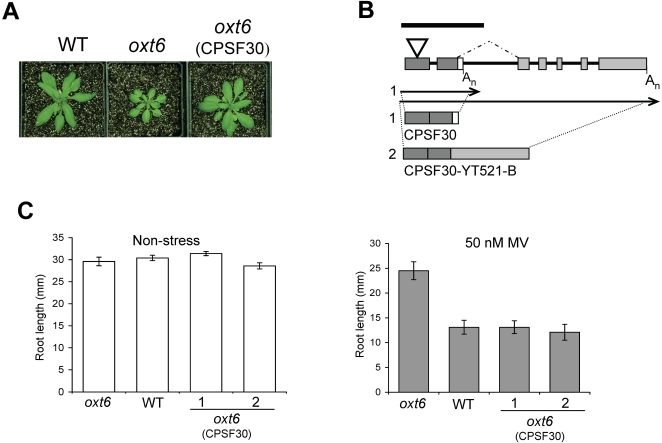
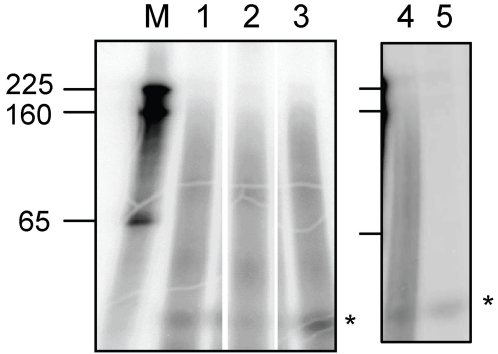
METHODOLOGY/PRINCIPAL FINDINGS: The oxt6 mutation is due to the disruption of a complex gene (At1g30460) that encodes the Arabidopsis ortholog of the 30-kD subunit of the cleavage and polyadenylation specificity factor (CPSF30) as well as a larger, related 65-kD protein. Expression of mRNAs encoding Arabidopsis CPSF30 alone was able to restore wild-type growth and stress susceptibility to the oxt6 mutant. Transcriptional profiling and single gene expression studies show elevated constitutive expression of a subset of genes that encode proteins containing thioredoxin- and glutaredoxin-related domains in the oxt6 mutant, suggesting that stress can be ameliorated by these gene classes. Bulk poly(A) tail length was not seemingly affected in the oxt6 mutant, but poly(A) site selection was different, indicating a subtle effect on polyadenylation in the mutant.
CONCLUSIONS/SIGNIFICANCE: These results implicate the Arabidopsis CPSF30 protein in the posttranscriptional control of the responses of plants to stress, and in particular to the expression of a set of genes that suffices to confer tolerance to oxidative stress.
植物通过由各种活性氧(ROS)水平改变介导的信号传导来应对许多不利的环境条件。为了更深入了解氧化信号反应,分离出了对氧化应激表现出耐受性的拟南芥突变体。我们在此描述其中一个这样的突变体oxt6的分离和特征。
方法/主要发现:oxt6突变是由于一个复杂基因(At1g30460)的破坏,该基因编码拟南芥中切割和聚腺苷酸化特异性因子(CPSF30)30-kD亚基的直系同源物以及一个更大的相关65-kD蛋白。单独编码拟南芥CPSF30的mRNA的表达能够恢复oxt6突变体的野生型生长和应激敏感性。转录谱分析和单基因表达研究表明,oxt6突变体中编码含有硫氧还蛋白和谷氧还蛋白相关结构域的蛋白质的一组基因的组成型表达升高,这表明这些基因类别可以减轻应激。oxt6突变体中的大量聚(A)尾长度似乎没有受到影响,但聚(A)位点选择不同,表明该突变体对聚腺苷酸化有微妙的影响。
结论/意义:这些结果表明拟南芥CPSF30蛋白参与植物对胁迫反应的转录后调控,特别是参与一组足以赋予氧化应激耐受性的基因的表达。