Ford Matthew M, Yoneyama Naomi, Strong Moriah N, Fretwell Andrea, Tanchuck Michelle, Finn Deborah A
Department of Behavioral Neuroscience, Oregon Health and Science University, Portland, OR 97239-3098, USA.
Alcohol Clin Exp Res. 2008 Aug;32(8):1408-16. doi: 10.1111/j.1530-0277.2008.00718.x. Epub 2008 Jun 28.
Allopregnanolone (ALLO) is a physiologically relevant neurosteroid modulator of GABA(A) receptors, and it exhibits a psychopharmacological profile that closely resembles the post-ingestive effects of ethanol. The 5alpha-reductase inhibitor finasteride (FIN), which inhibits biosynthesis of ALLO and structurally related neurosteroids, was previously demonstrated to reduce the maintenance of limited-access ethanol consumption. The primary aim of the current work was to determine whether FIN would reduce the acquisition of drinking in ethanol-naïve mice.
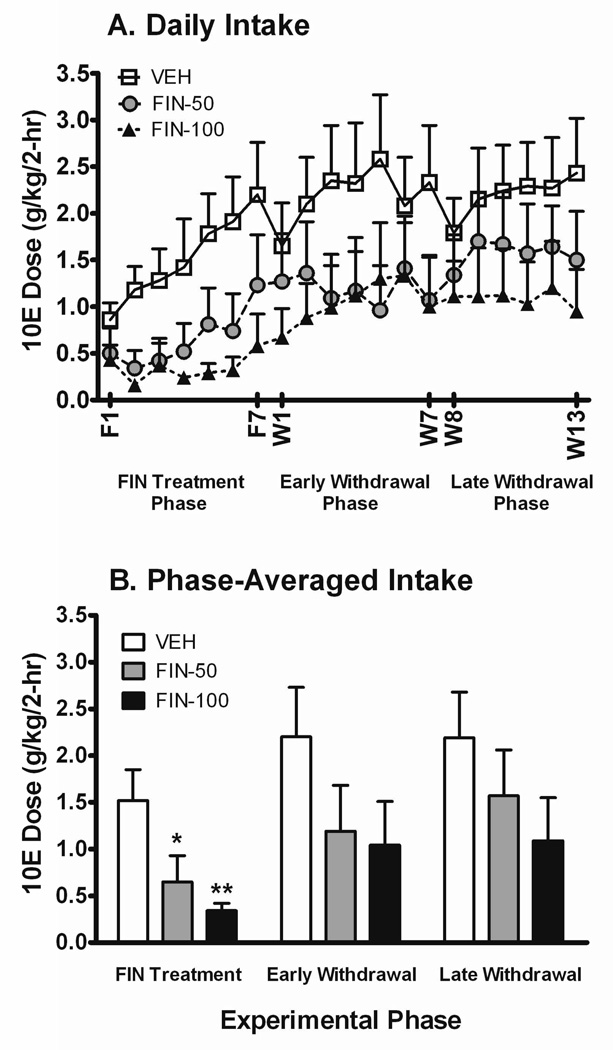
Male C57BL/6J (B6) mice were acclimated to a reverse light/dark schedule, and were provided ad libitum access to chow and water. Following habituation to vehicle injections (VEH; 20% w/v beta-cyclodextrin; i.p.) administered 22-hour prior to drinking sessions with water only, mice were divided into 3 treatment groups: vehicle control (VEH), 50 mg/kg FIN (FIN-50), and 100 mg/kg FIN (FIN-100). Twenty-two hours after the first treatment, mice were permitted the inaugural 2-hour limited access to a 10% v/v ethanol solution (10E) and water. The acquisition of 10E consumption and underlying drinking patterns were assessed during FIN treatment (7 days) and subsequent FIN withdrawal (13 days) phases.
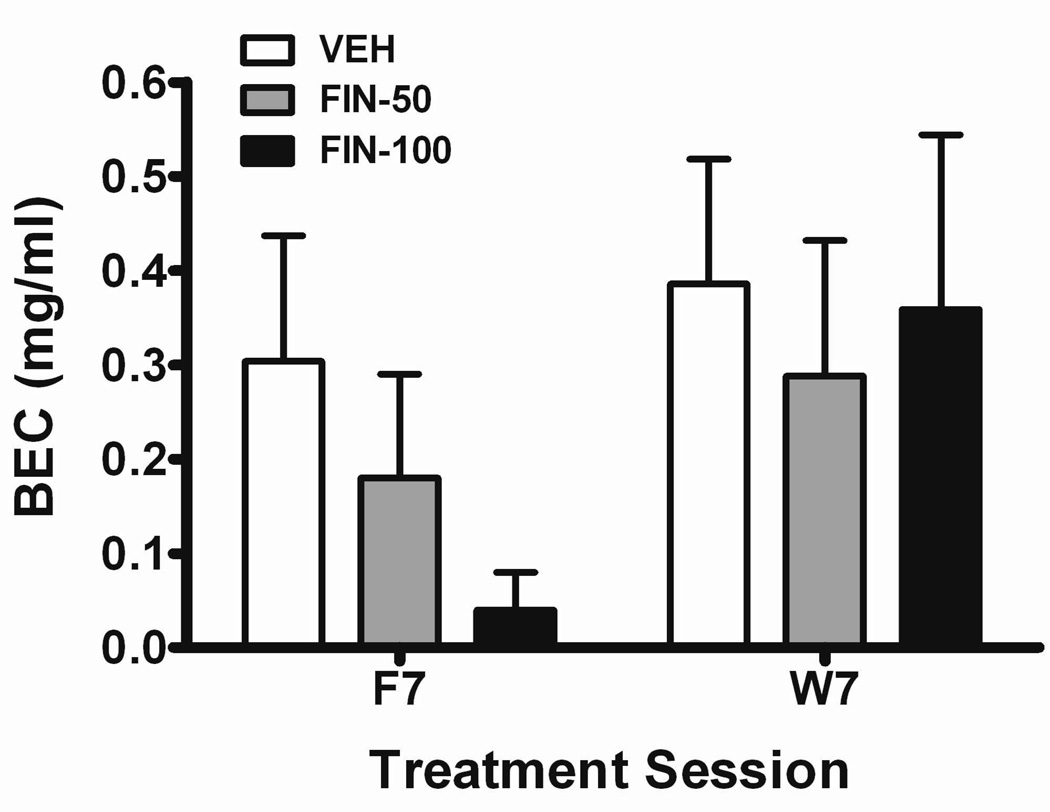
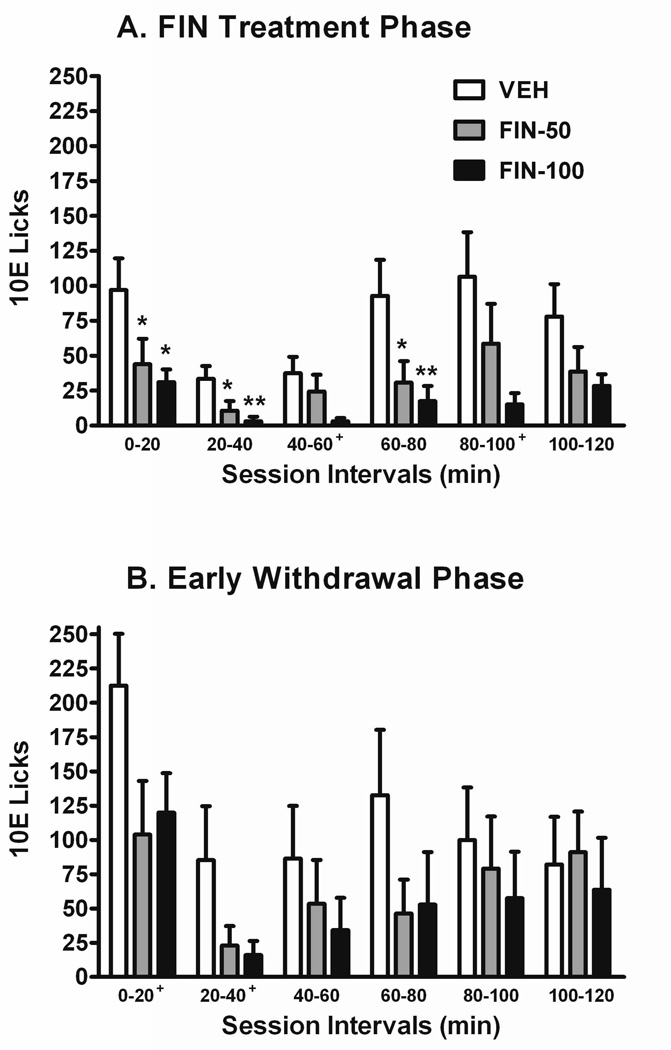
FIN dose-dependently blocked the acquisition of 10E drinking and prevented the development of ethanol preference, thereby suggesting that the GABAergic neurosteroids may be important in the establishment of stable drinking patterns. FIN-elicited reductions in 10E intake were primarily attributable to selective and marked reductions in bout frequency, as no changes were observed in bout size, duration, or lick rates following FIN treatment. FIN-treated mice continued to exhibit attenuated ethanol consumption after 2 weeks post-treatment, despite a full recovery in brain ALLO levels. A second study confirmed the rightward and downward shift in the acquisition of ethanol intake following 7 daily FIN injections. While there were no significant group differences in brain ALLO levels following the seventh day of ethanol drinking, ALLO levels were decreased by 28% in the FIN-50 group.
Although the exact mechanism is unclear, FIN and other pharmacological interventions that modulate the GABAergic system may prove useful in curbing ethanol intake acquisition in at-risk individuals.
别孕烯醇酮(ALLO)是一种对γ-氨基丁酸A(GABA(A))受体具有生理相关性的神经甾体调节剂,其表现出的精神药理学特征与乙醇摄入后的效应极为相似。5α-还原酶抑制剂非那雄胺(FIN)可抑制ALLO及结构相关神经甾体的生物合成,此前已证实其能减少限量摄入乙醇的维持量。当前研究的主要目的是确定FIN是否会减少初次接触乙醇的小鼠的饮酒行为习得。
雄性C57BL/6J(B6)小鼠适应反向明暗周期,可自由获取食物和水。在仅给予水的饮水试验前22小时习惯化腹腔注射溶剂(VEH;20% w/vβ-环糊精)后,将小鼠分为3个治疗组:溶剂对照组(VEH)、50 mg/kg FIN(FIN-50)和100 mg/kg FIN(FIN-100)。首次治疗22小时后,允许小鼠首次有2小时的限量接触10% v/v乙醇溶液(10E)和水的机会。在FIN治疗期(7天)和随后的FIN撤药期(13天)评估10E摄入量的习得及潜在的饮酒模式。
FIN剂量依赖性地阻断了10E饮酒行为的习得,并阻止了乙醇偏好的形成,这表明GABA能神经甾体可能在稳定饮酒模式的建立中起重要作用。FIN引起的10E摄入量减少主要归因于发作频率的选择性和显著降低,因为FIN治疗后发作大小、持续时间或舔舐速率均未观察到变化。尽管脑内ALLO水平已完全恢复,但FIN治疗的小鼠在治疗后两周仍表现出乙醇摄入量减少。第二项研究证实了每日注射7次FIN后乙醇摄入量习得的右移和下移。虽然在乙醇饮用第7天后脑内ALLO水平无显著组间差异,但FIN-50组的ALLO水平下降了28%。
虽然确切机制尚不清楚,但FIN和其他调节GABA能系统的药理学干预措施可能被证明对抑制高危个体的乙醇摄入量习得有用。