Corcoran Kelly E, Trzaska Katarzyna A, Fernandes Helen, Bryan Margarette, Taborga Marcelo, Srinivas Venkatesh, Packman Kathryn, Patel Prem S, Rameshwar Pranela
Department of Medicine, New Jersey Medical School-UMDNJ, Newark, New Jersey, United States of America.
PLoS One. 2008 Jun 25;3(6):e2563. doi: 10.1371/journal.pone.0002563.
An understanding of BC cell (BCC) entry into bone marrow (BM) at low tumor burden is limited when compared to highly metastatic events during heavy tumor burden. BCCs can achieve quiescence, without interfering with hematopoiesis. This occurs partly through the generation of gap junctions with BM stroma, located close to the endosteum. These events are partly mediated by the evolutionary conserved gene, Tac1.
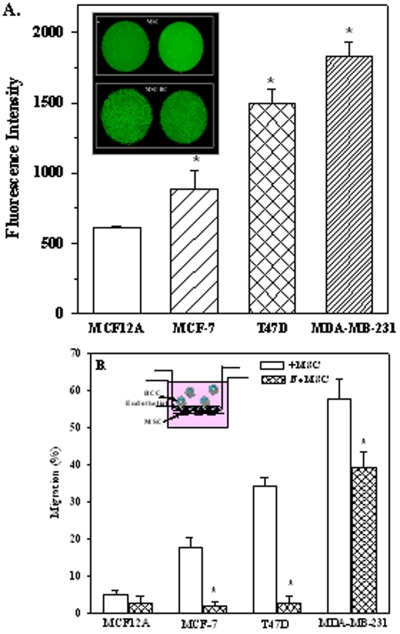
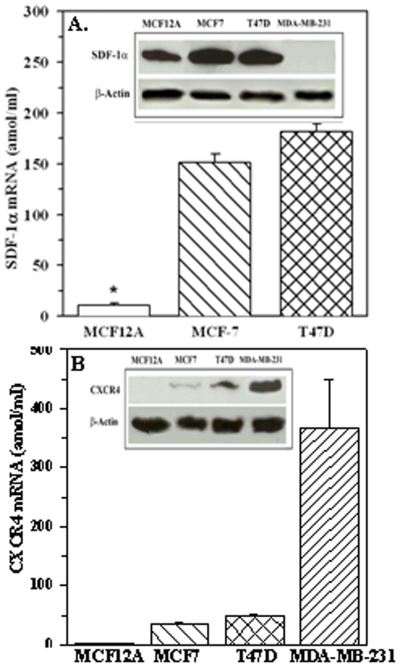
METHODOLOGY/PRINCIPAL FINDINGS: This study focuses on the role of mesenchymal stem cells (MSCs), Tac1, SDF-1 and CXCR4 in BCC entry into BM. The model is established in studies with low numbers of tumor cells, and focuses on cancer cells with low metastatic and invasion potential. This allowed us to recapitulate early event, and to study cancer cells with low invasive potential, even when they are part of larger numbers of highly metastatic cells. A novel migration assay showed a facilitating role of MSCs in BCC migration across BM endothelial cells. siRNA and ectopic expression studies showed a central role for Tac1 and secondary roles for SDF-1alpha and CXCR4. We also observed differences in the mechanisms between low invasive and highly metastatic cells. The in vitro studies were verified in xenogeneic mouse models that showed a preference for low invasive BCCs to BM, but comparable movement to lung and BM by highly metastatic BCCs. The expressions of Tac1 and production of SDF-1alpha were verified in primary BCCs from paired samples of BM aspirates and peripheral blood.
CONCLUSIONS/SIGNIFICANCE: MSC facilitate BCC entry into BM, partly through Tac1-mediated regulation of SDF-1alpha and CXCR4. We propose a particular population of BCC with preference for BM could be isolated for characterization. This population might be the subset that enter BM at an early time period, and could be responsible for cancer resurgence and resistance to current therapies.
与肿瘤负荷高时的高转移事件相比,我们对低肿瘤负荷下乳腺癌细胞(BCC)进入骨髓(BM)的了解有限。BCC可以进入静止状态,而不干扰造血功能。这部分是通过与靠近骨内膜的BM基质形成间隙连接来实现的。这些事件部分由进化保守基因Tac1介导。
方法/主要发现:本研究聚焦于间充质干细胞(MSC)、Tac1、SDF-1和CXCR4在BCC进入BM过程中的作用。该模型是在低数量肿瘤细胞的研究中建立的,重点关注具有低转移和侵袭潜力的癌细胞。这使我们能够重现早期事件,并研究具有低侵袭潜力的癌细胞,即使它们是大量高转移细胞的一部分。一种新型迁移试验表明,MSC在BCC跨BM内皮细胞迁移中起促进作用。siRNA和异位表达研究表明,Tac1起核心作用,而SDF-1α和CXCR4起次要作用。我们还观察到低侵袭性和高转移性细胞之间机制的差异。体外研究在异种小鼠模型中得到验证,该模型显示低侵袭性BCC更倾向于进入BM,但高转移性BCC向肺和BM的迁移能力相当。在来自BM抽吸物和外周血配对样本的原发性BCC中验证了Tac1的表达和SDF-1α的产生。
结论/意义:MSC促进BCC进入BM,部分是通过Tac1介导的对SDF-1α和CXCR4的调节。我们建议可以分离出特别倾向于进入BM的BCC群体进行表征。该群体可能是在早期进入BM的子集,可能是癌症复发和对当前疗法产生耐药性的原因。