Cheng Xiaodong, Ji Zhenyu, Tsalkova Tamara, Mei Fang
Department of Pharmacology and Toxicology, Sealy Center for Cancer Cell Biology, University of Texas Medical Branch, Galveston, Texas 77555-1031, USA.
Acta Biochim Biophys Sin (Shanghai). 2008 Jul;40(7):651-62. doi: 10.1111/j.1745-7270.2008.00438.x.
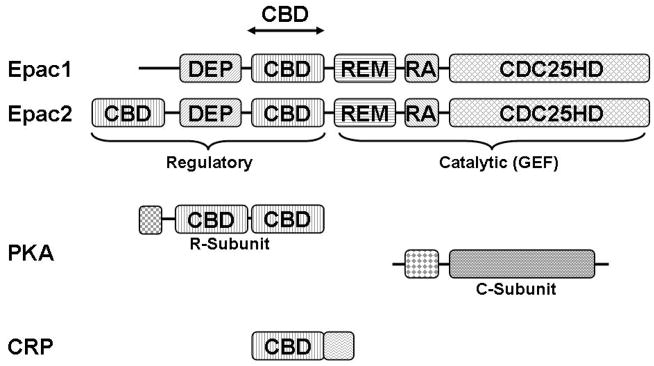
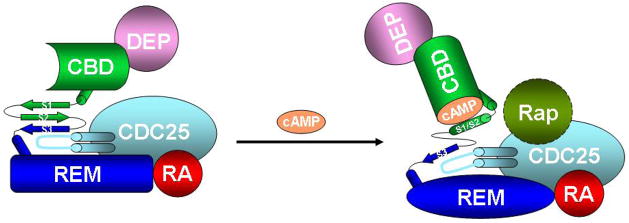
cAMP-mediated signaling pathways regulate a multitude of important biological processes under both physiological and pathological conditions, including diabetes, heart failure and cancer. In eukaryotic cells, the effects of cAMP are mediated by two ubiquitously expressed intracellular cAMP receptors, the classic protein kinase A (PKA)/cAMP-dependent protein kinase and the recently discovered exchange protein directly activated by camp (Epac)/cAMP-regulated guanine nucleotide exchange factors. Like PKA, Epac contains an evolutionally conserved cAMP binding domain that acts as a molecular switch for sensing intracellular second messenger cAMP levels to control diverse biological functions. The existence of two families of cAMP effectors provides a mechanism for a more precise and integrated control of the cAMP signaling pathways in a spatial and temporal manner. Depending upon the specific cellular environments as well as their relative abundance, distribution and localization, Epac and PKA may act independently, converge synergistically or oppose each other in regulating a specific cellular function.
环磷酸腺苷(cAMP)介导的信号通路在生理和病理条件下调节众多重要的生物学过程,包括糖尿病、心力衰竭和癌症。在真核细胞中,cAMP的作用由两种普遍表达的细胞内cAMP受体介导,即经典的蛋白激酶A(PKA)/cAMP依赖性蛋白激酶和最近发现的直接由cAMP激活的交换蛋白(Epac)/cAMP调节的鸟嘌呤核苷酸交换因子。与PKA一样,Epac含有一个进化上保守的cAMP结合结构域,该结构域作为一个分子开关,用于感知细胞内第二信使cAMP水平,以控制多种生物学功能。两类cAMP效应器的存在提供了一种机制,能够以空间和时间的方式对cAMP信号通路进行更精确和综合的控制。根据特定的细胞环境以及它们的相对丰度、分布和定位,Epac和PKA在调节特定细胞功能时可能独立发挥作用、协同作用或相互拮抗。