Marcu Mariana, Trivin Christine, Souberbielle Jean-Claude, Brauner Raja
Université Paris Descartes and Assistance Publique Hôpitaux de Paris, Hôpital Bicêtre, Unité d'Endocrinologie Pédiatrique, 94270 Le Kremlin Bicêtre, France.
BMC Endocr Disord. 2008 Jul 11;8:7. doi: 10.1186/1472-6823-8-7.
The diagnostic criteria for growth hormone (GH) deficiency (GHD) in adolescents and young adults are not yet clearly established.We evaluated the factors influencing the GH peak and plasma insulin-like growth factor (IGF) I in order to determine the cut-off limits for the diagnosis of GHD during the transition period.
21 patients treated for GHD due to pituitary stalk interruption syndrome at 5.7 +/- 4.1 years were reevaluated at 16.0 +/- 1.8 years, 0.6 +/- 0.6 years after the end of GH treatment. Group 1 had isolated GHD (n = 9) and group 2 had multiple pituitary deficiencies (n = 12), including deficiencies of thyroid stimulating (n = 12), adrenocorticotropin (n = 8) and gonadotropin (n = 9) hormones.
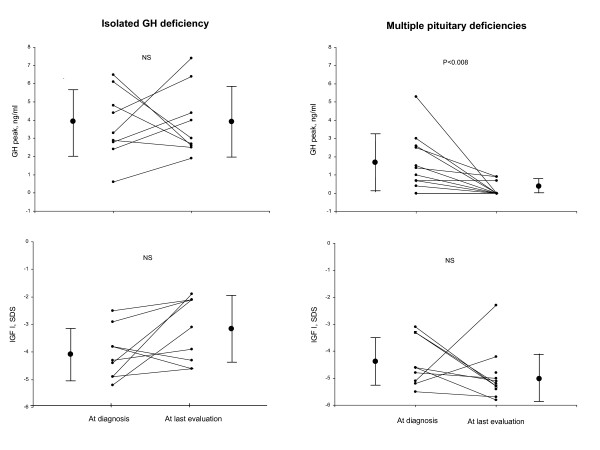
At diagnosis, group 1 had a greater pituitary height (2.8 +/- 1.2 vs 1.6 +/- 1.1 mm, P = 0.03) and GH peak (3.8 +/- 1.9 vs 1.6 +/- 1.5 ng/ml, P < 0.02) than did group 2.At last evaluation, group 1 had greater GH peak (3.9 +/- 1.9 vs 0.2 +/- 0.4 ng/ml, P = 0.0001) and plasma IGF I (211 +/- 88 vs 78 +/- 69 ng/ml, P < 0.002) than did group 2. No group 1 and 9 group 2 patients had an undetectable GH peak, while the 3 others had GH peak below 1 ng/ml.The GH peak decreased between diagnosis and last evaluation only in group 2 (P < 0.008).
The GH peak response to pharmacological stimulation and the plasma IGF I concentration in young adults with GHD of childhood onset depend on the presence of additional pituitary deficiencies, reflecting a more severe defect of the hypothalamic-pituitary axis. The sex steroids cannot increase the IGF I if the GH secretion is zero.
青少年和青年成人生长激素(GH)缺乏症(GHD)的诊断标准尚未明确确立。我们评估了影响GH峰值和血浆胰岛素样生长因子(IGF)I的因素,以确定过渡期GHD诊断的临界值。
21例因垂体柄中断综合征在5.7±4.1岁时接受GHD治疗的患者,在GH治疗结束后0.6±0.6年、16.0±1.8岁时进行重新评估。第1组为孤立性GHD(n = 9),第2组为多种垂体激素缺乏(n = 12),包括促甲状腺激素(n = 12)、促肾上腺皮质激素(n = 8)和促性腺激素(n = 9)缺乏。
诊断时,第1组的垂体高度(2.8±1.2对1.6±1.1 mm,P = 0.03)和GH峰值(3.8±1.9对1.6±1.5 ng/ml,P < 0.02)高于第2组。在最后评估时,第1组的GH峰值(3.9±1.9对0.2±0.4 ng/ml,P = 0.0001)和血浆IGF I(211±88对78±69 ng/ml,P < 0.002)高于第2组。第1组无患者和第2组9例患者的GH峰值不可测,而其他3例患者的GH峰值低于1 ng/ml。仅第2组在诊断和最后评估之间GH峰值下降(P < 0.008)。
儿童期起病的GHD青年成人对药物刺激的GH峰值反应和血浆IGF I浓度取决于是否存在其他垂体激素缺乏,反映了下丘脑 - 垂体轴更严重的缺陷。如果GH分泌为零,性类固醇不能增加IGF I。