Department of Cancer Immunology and AIDS, Dana-Farber Cancer Institute, Boston, Massachusetts, United States of America.
PLoS Negl Trop Dis. 2008 Jul 23;2(7):e265. doi: 10.1371/journal.pntd.0000265.
Individuals living in sub-Saharan Africa represent 10% of the world's population but almost 2/3 of all HIV-1/AIDS cases. The disproportionate HIV-1 infection rates in this region may be linked to helminthic parasite infections that affect many individuals in the developing world. However, the hypothesis that parasite infection increases an individual's susceptibility to HIV-1 has never been prospectively tested in a relevant in vivo model.
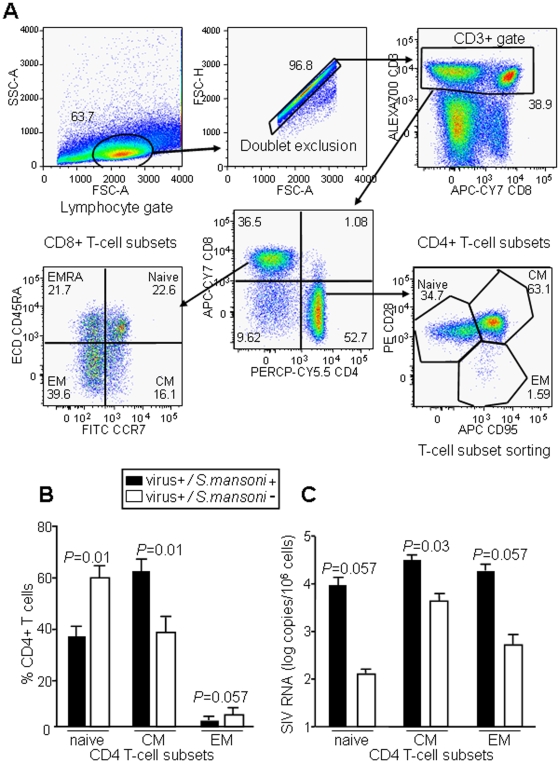
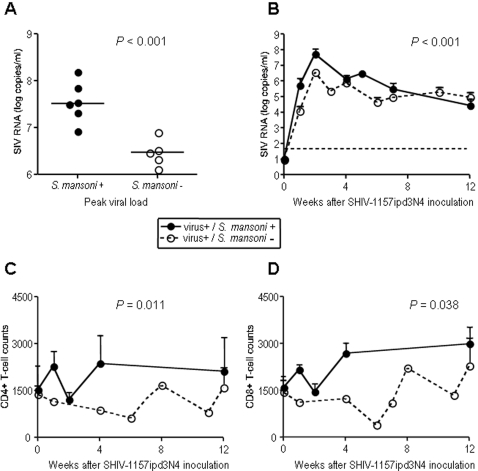
METHODOLOGY/PRINCIPAL FINDINGS: We measured whether pre-existing infection of rhesus monkeys with a parasitic worm would facilitate systemic infection after mucosal AIDS virus exposure. Two groups of animals, one consisting of normal monkeys and the other harboring Schistosoma mansoni, were challenged intrarectally with decreasing doses of R5-tropic clade C simian-human immunodeficiency virus (SHIV-C). Systemic infection occurred in parasitized monkeys at viral doses that remained sub-infectious in normal hosts. In fact, the 50% animal infectious (AID(50)) SHIV-C dose was 17-fold lower in parasitized animals compared to controls (P<0.001). Coinfected animals also had significantly higher peak viral RNA loads than controls (P<0.001), as well as increased viral replication in CD4(+) central memory cells (P = 0.03).
CONCLUSIONS/SIGNIFICANCE: Our data provide the first direct evidence that acute schistosomiasis significantly increases the risk of de novo AIDS virus acquisition, and the magnitude of the effect suggests that control of helminth infections may be a useful public health intervention to help decrease the spread of HIV-1.
生活在撒哈拉以南非洲的个人占世界人口的 10%,但几乎占所有 HIV-1/艾滋病病例的 2/3。该地区不成比例的 HIV-1 感染率可能与影响发展中国家许多人的寄生虫感染有关。然而,寄生虫感染是否会增加个体感染 HIV-1 的易感性这一假说从未在相关的体内模型中得到前瞻性检验。
方法/主要发现:我们测量了是否先前感染过寄生虫蠕虫的恒河猴在粘膜艾滋病病毒暴露后会更容易全身感染。两组动物,一组由正常猴子组成,另一组携带曼氏血吸虫,经直肠内用递减剂量的 R5 嗜性 clade C 猿猴-人类免疫缺陷病毒(SHIV-C)进行挑战。在寄生虫感染的猴子中,全身感染发生在病毒剂量仍低于正常宿主的情况下。事实上,与对照组相比,寄生虫感染动物的 50%动物感染(AID(50))SHIV-C 剂量低 17 倍(P<0.001)。合并感染的动物的峰值病毒 RNA 载量也明显高于对照组(P<0.001),并且 CD4(+)中央记忆细胞中的病毒复制增加(P = 0.03)。
结论/意义:我们的数据提供了寄生虫急性感染显著增加新发艾滋病病毒感染风险的直接证据,而且影响的幅度表明控制寄生虫感染可能是减少 HIV-1 传播的有用公共卫生干预措施。