Burnier Yannis, Dorier Julien, Stasiak Andrzej
Center for Integrative Genomics, University of Lausanne, CH-1015 Lausanne, Switzerland.
Nucleic Acids Res. 2008 Sep;36(15):4956-63. doi: 10.1093/nar/gkn467. Epub 2008 Jul 25.
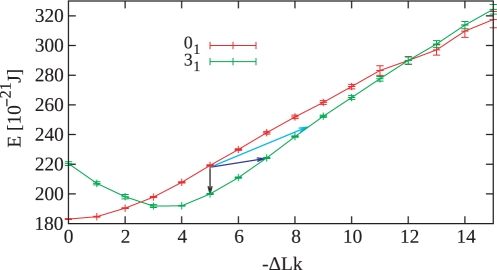
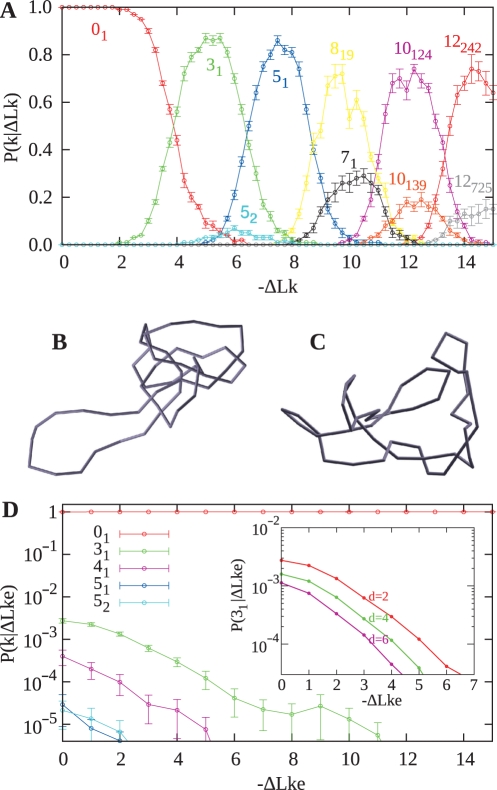
Despite the fact that in living cells DNA molecules are long and highly crowded, they are rarely knotted. DNA knotting interferes with the normal functioning of the DNA and, therefore, molecular mechanisms evolved that maintain the knotting and catenation level below that which would be achieved if the DNA segments could pass randomly through each other. Biochemical experiments with torsionally relaxed DNA demonstrated earlier that type II DNA topoisomerases that permit inter- and intramolecular passages between segments of DNA molecules use the energy of ATP hydrolysis to select passages that lead to unknotting rather than to the formation of knots. Using numerical simulations, we identify here another mechanism by which topoisomerases can keep the knotting level low. We observe that DNA supercoiling, such as found in bacterial cells, creates a situation where intramolecular passages leading to knotting are opposed by the free-energy change connected to transitions from unknotted to knotted circular DNA molecules.
尽管在活细胞中DNA分子很长且高度拥挤,但它们很少打结。DNA打结会干扰DNA的正常功能,因此进化出了分子机制,将打结和连环化水平维持在低于DNA片段可随机相互穿过时所能达到的水平。早期对扭转松弛DNA进行的生化实验表明,允许DNA分子片段之间进行分子间和分子内通道的II型DNA拓扑异构酶利用ATP水解的能量来选择导致解结而非打结的通道。通过数值模拟,我们在此确定了拓扑异构酶可将打结水平保持在较低水平的另一种机制。我们观察到,如在细菌细胞中发现的DNA超螺旋,会造成一种情况,即导致打结的分子内通道会受到与从无结环状DNA分子转变为有结环状DNA分子相关的自由能变化的阻碍。