Rosso Lia, Marques Ana C, Reichert Andreas S, Kaessmann Henrik
Center for Integrative Genomics, University of Lausanne, Lausanne, Switzerland.
PLoS Genet. 2008 Aug 8;4(8):e1000150. doi: 10.1371/journal.pgen.1000150.
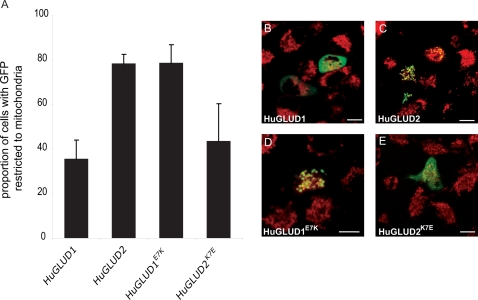
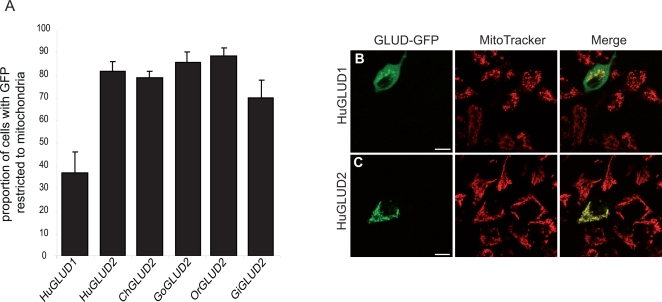
Many new gene copies emerged by gene duplication in hominoids, but little is known with respect to their functional evolution. Glutamate dehydrogenase (GLUD) is an enzyme central to the glutamate and energy metabolism of the cell. In addition to the single, GLUD-encoding gene present in all mammals (GLUD1), humans and apes acquired a second GLUD gene (GLUD2) through retroduplication of GLUD1, which codes for an enzyme with unique, potentially brain-adapted properties. Here we show that whereas the GLUD1 parental protein localizes to mitochondria and the cytoplasm, GLUD2 is specifically targeted to mitochondria. Using evolutionary analysis and resurrected ancestral protein variants, we demonstrate that the enhanced mitochondrial targeting specificity of GLUD2 is due to a single positively selected glutamic acid-to-lysine substitution, which was fixed in the N-terminal mitochondrial targeting sequence (MTS) of GLUD2 soon after the duplication event in the hominoid ancestor approximately 18-25 million years ago. This MTS substitution arose in parallel with two crucial adaptive amino acid changes in the enzyme and likely contributed to the functional adaptation of GLUD2 to the glutamate metabolism of the hominoid brain and other tissues. We suggest that rapid, selectively driven subcellular adaptation, as exemplified by GLUD2, represents a common route underlying the emergence of new gene functions.
在类人猿中,许多新的基因拷贝通过基因复制产生,但关于它们的功能进化却知之甚少。谷氨酸脱氢酶(GLUD)是细胞谷氨酸和能量代谢的核心酶。除了所有哺乳动物都存在的单个编码GLUD的基因(GLUD1)外,人类和猿类通过GLUD1的反转录复制获得了第二个GLUD基因(GLUD2),该基因编码一种具有独特的、可能适应大脑特性的酶。在这里,我们表明,虽然GLUD1亲本蛋白定位于线粒体和细胞质,但GLUD2则特异性地靶向线粒体。通过进化分析和复活的祖先蛋白变体,我们证明GLUD2增强的线粒体靶向特异性是由于一个单一的正选择谷氨酸到赖氨酸的取代,该取代在大约1800万至2500万年前类人猿祖先的复制事件后不久就固定在GLUD2的N端线粒体靶向序列(MTS)中。这种MTS取代与该酶的两个关键适应性氨基酸变化同时出现,可能有助于GLUD2在类人猿大脑和其他组织的谷氨酸代谢中发挥功能适应作用。我们认为,以GLUD2为例的快速、选择性驱动的亚细胞适应代表了新基因功能出现的常见途径。