Jacobson Isabel G, Ryan Margaret A K, Hooper Tomoko I, Smith Tyler C, Amoroso Paul J, Boyko Edward J, Gackstetter Gary D, Wells Timothy S, Bell Nicole S
DoD Center for Deployment Health Research, Naval Health Research Center, 140 Sylvester Road, San Diego, CA 92106-3521, USA.
JAMA. 2008 Aug 13;300(6):663-75. doi: 10.1001/jama.300.6.663.
High rates of alcohol misuse after deployment have been reported among personnel returning from past conflicts, yet investigations of alcohol misuse after return from the current wars in Iraq and Afghanistan are lacking.
To determine whether deployment with combat exposures was associated with new-onset or continued alcohol consumption, binge drinking, and alcohol-related problems.
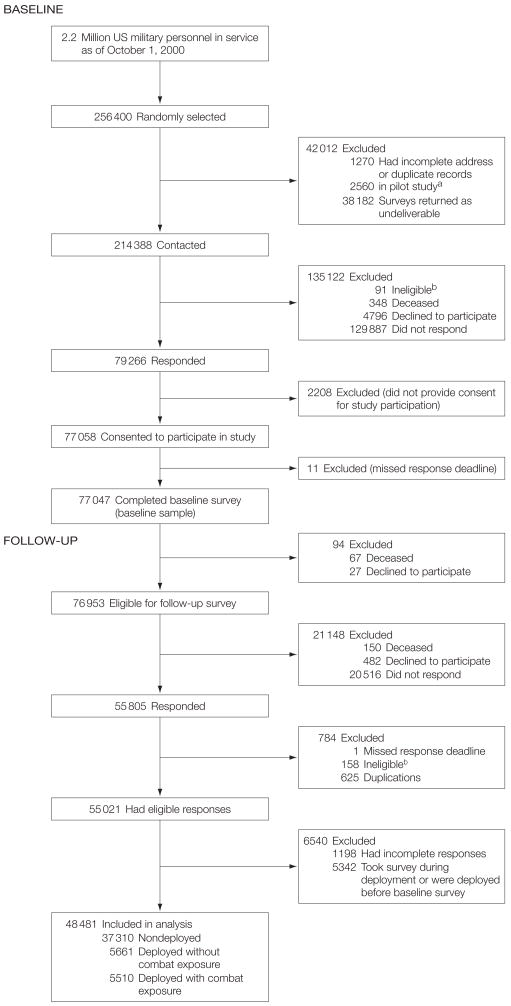
DESIGN, SETTING, AND PARTICIPANTS: Data were from Millennium Cohort Study participants who completed both a baseline (July 2001 to June 2003; n=77,047) and follow-up (June 2004 to February 2006; n=55,021) questionnaire (follow-up response rate = 71.4%). After we applied exclusion criteria, our analyses included 48,481 participants (active duty, n = 26,613; Reserve or National Guard, n = 21,868). Of these, 5510 deployed with combat exposures, 5661 deployed without combat exposures, and 37 310 did not deploy.
New-onset and continued heavy weekly drinking, binge drinking, and alcohol-related problems at follow-up.
Baseline prevalence of heavy weekly drinking, binge drinking, and alcohol-related problems among Reserve or National Guard personnel who deployed with combat exposures was 9.0%, 53.6%, and 15.2%, respectively; follow-up prevalence was 12.5%, 53.0%, and 11.9%, respectively; and new-onset rates were 8.8%, 25.6%, and 7.1%, respectively. Among active-duty personnel, new-onset rates were 6.0%, 26.6%, and 4.8%, respectively. Reserve and National Guard personnel who deployed and reported combat exposures were significantly more likely to experience new-onset heavy weekly drinking (odds ratio [OR], 1.63; 95% confidence interval [CI], 1.36-1.96), binge drinking (OR, 1.46; 95% CI, 1.24-1.71), and alcohol-related problems (OR, 1.63; 95% CI, 1.33-2.01) compared with nondeployed personnel. The youngest members of the cohort were at highest risk for all alcohol-related outcomes.
Reserve and National Guard personnel and younger service members who deploy with reported combat exposures are at increased risk of new-onset heavy weekly drinking, binge drinking, and alcohol-related problems.
据报道,从以往冲突地区返回的人员中酒精滥用率很高,但目前从伊拉克和阿富汗战争返回后酒精滥用情况的调查尚属缺乏。
确定经历战斗性部署是否与新出现或持续的酒精消费、暴饮以及与酒精相关的问题有关。
设计、地点和参与者:数据来自千禧队列研究的参与者,他们完成了基线调查问卷(2001年7月至2003年6月;n = 77,047)和随访调查问卷(2004年6月至2006年2月;n = 55,021)(随访应答率 = 71.4%)。在应用排除标准后,我们的分析纳入了48,481名参与者(现役人员,n = 26,613;预备役或国民警卫队,n = 21,868)。其中,5510人经历了战斗性部署,5661人经历了非战斗性部署,37310人未部署。
随访时新出现和持续的每周大量饮酒、暴饮以及与酒精相关的问题。
经历战斗性部署的预备役或国民警卫队人员中,基线时每周大量饮酒、暴饮以及与酒精相关问题的患病率分别为9.0%、53.6%和15.2%;随访时患病率分别为12.5%、53.0%和11.9%;新出现率分别为8.8%、25.6%和7.1%。现役人员中的新出现率分别为6.0%、26.6%和4.8%。与未部署人员相比,经历战斗性部署并报告有战斗经历的预备役和国民警卫队人员更有可能出现新的每周大量饮酒(优势比[OR],1.63;95%置信区间[CI],1.36 - 1.96)、暴饮(OR,1.46;95% CI,1.24 - 1.71)以及与酒精相关的问题(OR,1.63;95% CI,1.33 - 2.01)。该队列中最年轻的成员出现所有与酒精相关结局的风险最高。
经历战斗性部署并报告有战斗经历的预备役和国民警卫队人员以及年轻军人出现新的每周大量饮酒、暴饮以及与酒精相关问题的风险增加。