Savani Bipin N, Stratton Pamela, Shenoy Aarthi, Kozanas Eleftheria, Goodman Stacey, Barrett A John
Stem Cell Transplantation Section, Hematology Branch, NHLBI, National Institutes of Health, Bethesda, Maryland; Veterans Affairs Medical Center and Vanderbilt University Transplant Program, Nashville, Tennessee.
Reproductive Biology and Medicine Branch, National Institute of Child Health and Human Development, National Institutes of Health, Bethesda, Maryland.
Biol Blood Marrow Transplant. 2008 Sep;14(9):1072-1075. doi: 10.1016/j.bbmt.2008.07.005.
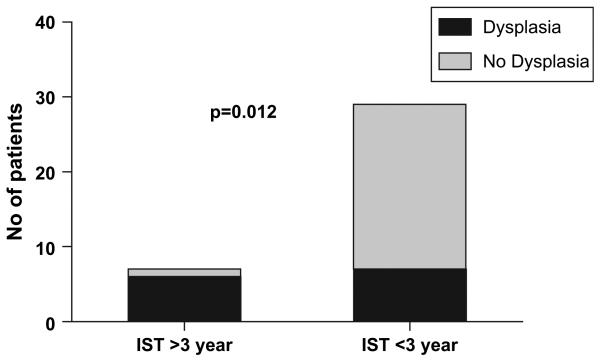
As more women survive allogeneic stem cell transplantation (SCT), the development of genital human papilloma virus (HPV)-related squamous intraepithelial lesions (SIL) warrants study. Thirty-five of 38 females followed prospectively long-term after SCT for hematological malignancies (median: 7 years posttransplant) were adults and had cervical cytology testing. Acute graft-versus-host-disease (aGVHD) occurred in 9 and chronic (cGVHD) in 34 patients. Six (17%) continued receiving systemic immunosuppressive therapy (IST) for cGVHD >3 years after SCT. Of 15 (43%) with abnormal cytology, 12 (34%) patients had HPV-related SIL (median time to SIL 51 months, range: 22-108) including high-grade SIL in 7 (20%). Patients requiring continued IST had the highest risk (odds ratio [OR] 4.6, 95% confidence interval [CI] 1.1-16.4; P = .019). This high incidence of SIL in long-term SCT survivors underscores the importance of gynecologic assessment after transplantation, especially in those requiring IST. This may portend an increased risk of genital or other HPV-related malignancies.
随着越来越多的女性在异基因干细胞移植(SCT)后存活下来,生殖器人乳头瘤病毒(HPV)相关的鳞状上皮内病变(SIL)的发展值得研究。38例接受血液系统恶性肿瘤SCT后长期随访的女性中,35例为成年人并进行了宫颈细胞学检查。9例发生急性移植物抗宿主病(aGVHD),34例发生慢性移植物抗宿主病(cGVHD)。6例(17%)在SCT后>3年因cGVHD继续接受全身免疫抑制治疗(IST)。15例(43%)细胞学异常的患者中,12例(34%)患有HPV相关的SIL(SIL的中位时间为51个月,范围:22-108个月),其中7例(20%)为高级别SIL。需要持续IST治疗的患者风险最高(比值比[OR]4.6,95%置信区间[CI]1.1-16.4;P=0.019)。长期SCT幸存者中SIL的高发病率凸显了移植后妇科评估的重要性,尤其是在那些需要IST的患者中。这可能预示着生殖器或其他HPV相关恶性肿瘤的风险增加。