Peters Jorieke H, Preijers Frank W, Woestenenk Rob, Hilbrands Luuk B, Koenen Hans J P M, Joosten Irma
Department of Bloodtransfusion and Transplantation Immunology, Radboud University Nijmegen Medical Centre, Nijmegen, The Netherlands.
PLoS One. 2008 Sep 8;3(9):e3161. doi: 10.1371/journal.pone.0003161.
Treg based immunotherapy is of great interest to facilitate tolerance in autoimmunity and transplantation. For clinical trials, it is essential to have a clinical grade Treg isolation protocol in accordance with Good Manufacturing Practice (GMP) guidelines. To obtain sufficient Treg for immunotherapy, subsequent ex vivo expansion might be needed.
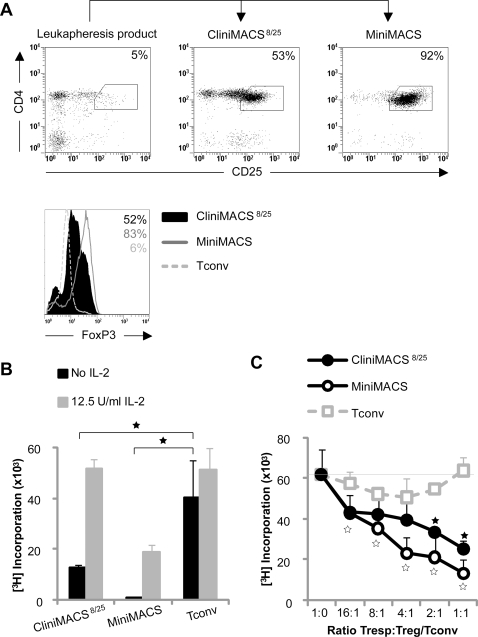
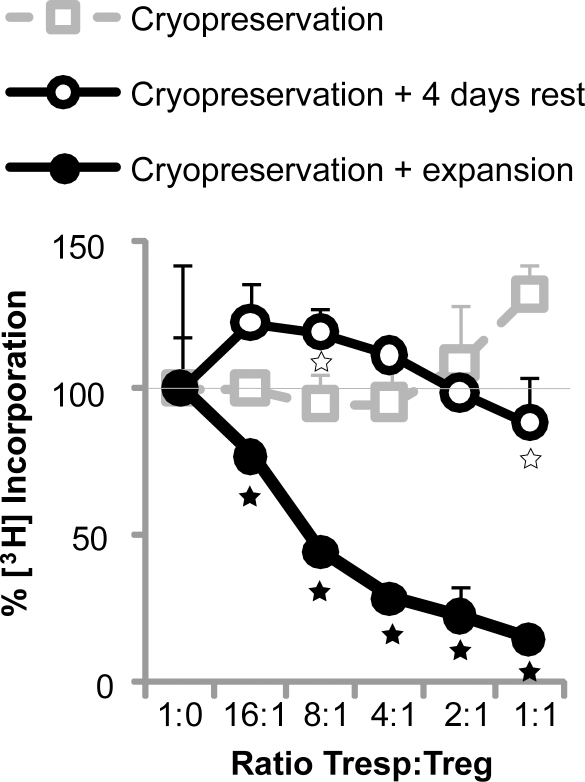
METHODOLOGY/PRINCIPAL FINDINGS: Treg were isolated from leukapheresis products by CliniMACS based GMP isolation strategies, using anti-CD25, anti-CD8 and anti-CD19 coated microbeads. CliniMACS isolation procedures led to 40-60% pure CD4(pos)CD25(high)FoxP3(pos) Treg populations that were anergic and had moderate suppressive activity. Such CliniMACS isolated Treg populations could be expanded with maintenance of suppressive function. Alloantigen stimulated expansion caused an enrichment of alloantigen-specific Treg. Depletion of unwanted CD19(pos) cells during CliniMACS Treg isolation proved necessary to prevent B-cell outgrowth during expansion. CD4(pos)CD127(pos) conventional T cells were the major contaminating cell type in CliniMACS isolated Treg populations. Depletion of CD127(pos) cells improved the purity of CD4(pos)CD25(high)FoxP3(pos) Treg in CliniMACS isolated cell populations to approximately 90%. Expanded CD127(neg) CliniMACS isolated Treg populations showed very potent suppressive capacity and high FoxP3 expression. Furthermore, our data show that cryopreservation of CliniMACS isolated Treg is feasible, but that activation after thawing is necessary to restore suppressive potential.
CONCLUSIONS/SIGNIFICANCE: The feasibility of Treg based therapy is widely accepted, provided that tailor-made clinical grade procedures for isolation and ex vivo cell handling are available. We here provide further support for this approach by showing that a high Treg purity can be reached, and that isolated cells can be cryopreserved and expanded successfully.
基于调节性T细胞(Treg)的免疫疗法对于促进自身免疫和移植中的耐受性具有重要意义。对于临床试验而言,拥有符合药品生产质量管理规范(GMP)指南的临床级Treg分离方案至关重要。为了获得足够用于免疫疗法的Treg,可能需要进行后续的体外扩增。
方法/主要发现:采用基于CliniMACS的GMP分离策略,使用抗CD25、抗CD8和抗CD19包被的微珠从白细胞分离产品中分离Treg。CliniMACS分离程序可获得纯度为40%-60%的CD4阳性CD25高表达FoxP3阳性Treg群体,这些细胞呈无反应性且具有中等抑制活性。此类经CliniMACS分离的Treg群体可在维持抑制功能的情况下进行扩增。同种异体抗原刺激的扩增导致同种异体抗原特异性Treg富集。在CliniMACS Treg分离过程中去除不需要的CD19阳性细胞被证明对于防止扩增过程中B细胞生长是必要的。CD4阳性CD127阳性常规T细胞是CliniMACS分离的Treg群体中的主要污染细胞类型。去除CD127阳性细胞可将CliniMACS分离细胞群体中CD4阳性CD25高表达FoxP3阳性Treg的纯度提高至约90%。经扩增的CD127阴性CliniMACS分离Treg群体表现出非常强的抑制能力和高FoxP3表达。此外,我们的数据表明,CliniMACS分离的Treg的冷冻保存是可行的,但解冻后需要激活以恢复抑制潜能。
结论/意义:只要有定制的临床级分离和体外细胞处理程序,基于Treg的疗法的可行性已被广泛接受。我们在此通过表明可以达到高Treg纯度,并且分离的细胞可以成功冷冻保存和扩增,为这种方法提供了进一步的支持。