Zelinski Adam C, Wald Lawrence L, Setsompop Kawin, Goyal Vivek K, Adalsteinsson Elfar
Research Laboratory of Electronics, Department of Electrical Engineering and Computer Science, Massachusetts Institute of Technology, Cambridge, MA 02139, USA
IEEE Trans Med Imaging. 2008 Sep;27(9):1213-29. doi: 10.1109/TMI.2008.920605.
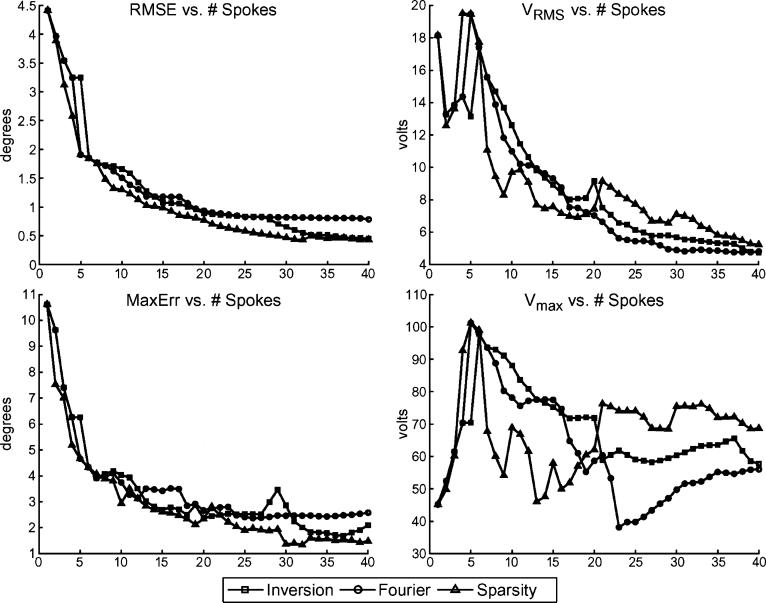
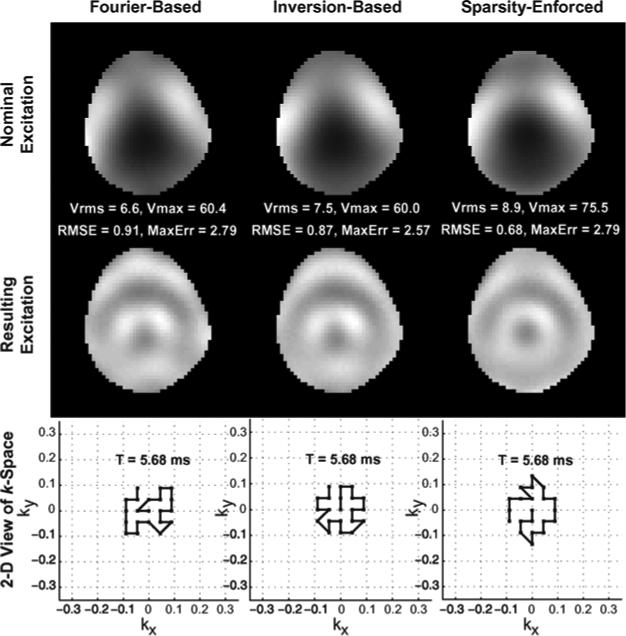
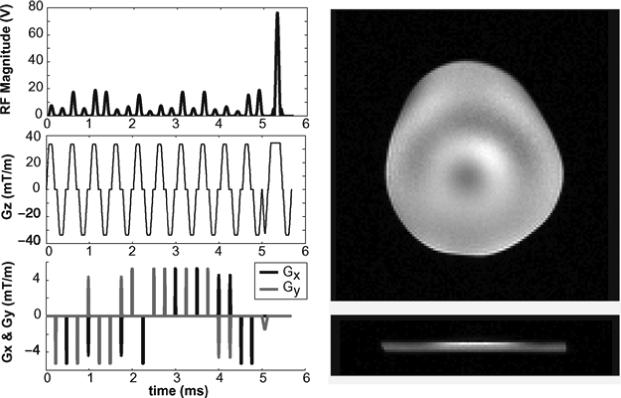
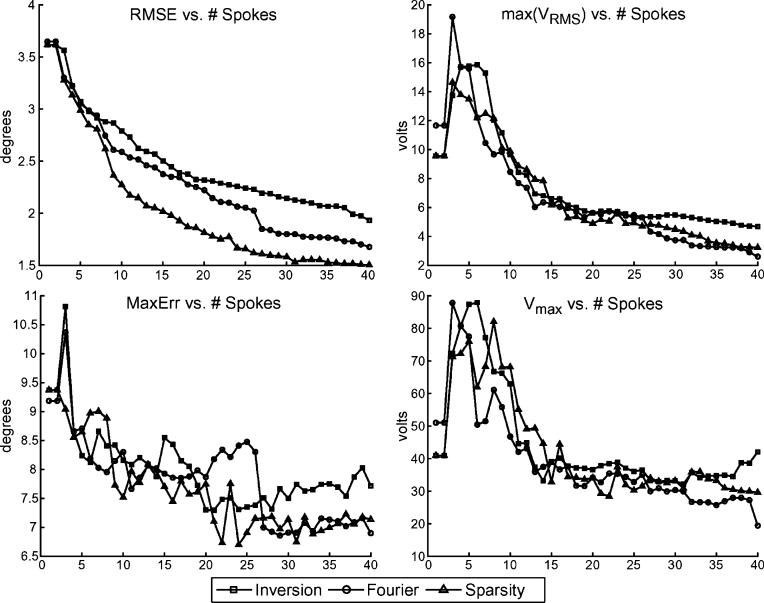
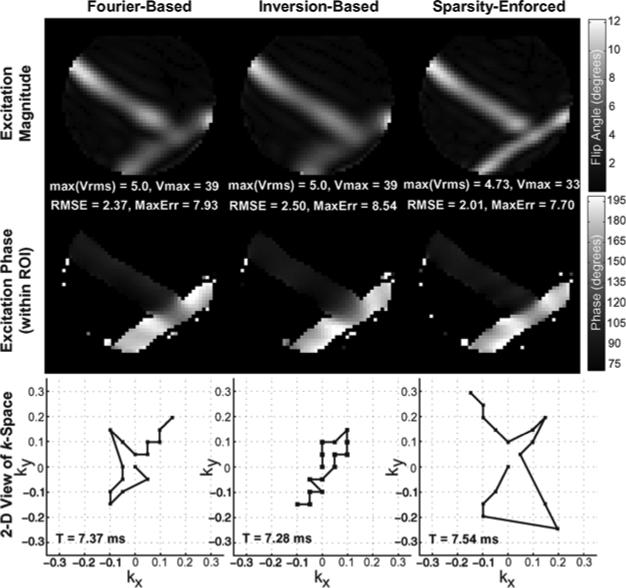
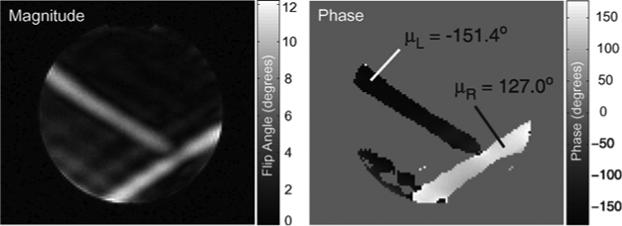
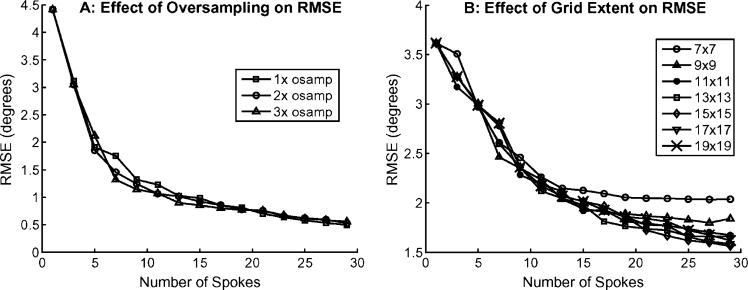
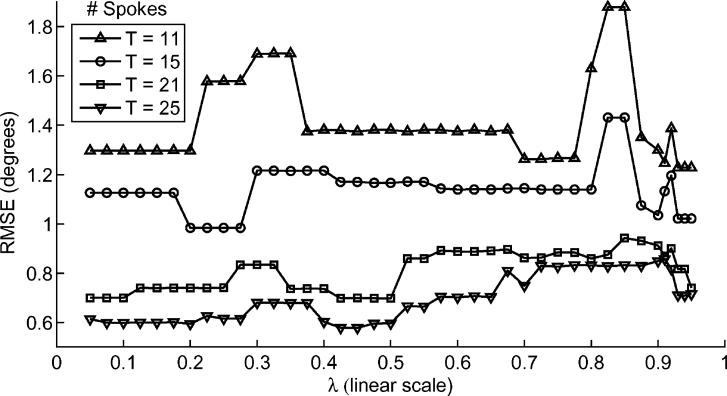
We introduce a novel algorithm for the design of fast slice-selective spatially-tailored magnetic resonance imaging (MRI) excitation pulses. This method, based on sparse approximation theory, uses a second-order cone optimization to place and modulate a small number of slice-selective sinc-like radio-frequency (RF) pulse segments ("spokes") in excitation k-space, enforcing sparsity on the number of spokes allowed while simultaneously encouraging those that remain to be placed and modulated in a way that best forms a user-defined in-plane target magnetization. Pulses are designed to mitigate B(1) inhomogeneity in a water phantom at 7 T and to produce highly-structured excitations in an oil phantom on an eight-channel parallel excitation system at 3 T. In each experiment, pulses generated by the sparsity-enforced method outperform those created via conventional Fourier-based techniques, e.g., when attempting to produce a uniform magnetization in the presence of severe B(1) inhomogeneity, a 5.7-ms 15-spoke pulse generated by the sparsity-enforced method produces an excitation with 1.28 times lower root mean square error than conventionally-designed 15-spoke pulses. To achieve this same level of uniformity, the conventional methods need to use 29-spoke pulses that are 7.8 ms long.
我们介绍了一种用于设计快速切片选择性空间定制磁共振成像(MRI)激发脉冲的新颖算法。该方法基于稀疏近似理论,使用二阶锥优化在激发k空间中放置和调制少量切片选择性 sinc 样射频(RF)脉冲段(“辐条”),在允许的辐条数量上强制稀疏性,同时鼓励剩余的辐条以最佳方式放置和调制,以形成用户定义的平面内目标磁化。所设计的脉冲可减轻7 T水模中的B(1)不均匀性,并在3 T的八通道并行激发系统上的油模中产生高度结构化的激发。在每个实验中,通过稀疏性强制方法生成的脉冲优于通过传统傅里叶技术创建的脉冲,例如,在存在严重B(1)不均匀性的情况下试图产生均匀磁化时,由稀疏性强制方法生成的5.7毫秒15辐条脉冲产生的激发的均方根误差比传统设计的15辐条脉冲低1.28倍。为了达到相同的均匀度水平,传统方法需要使用29辐条、7.8毫秒长的脉冲。