Delaurier April, Burton Nicholas, Bennett Michael, Baldock Richard, Davidson Duncan, Mohun Timothy J, Logan Malcolm Po
Division of Developmental Biology, National Institute for Medical Research, The Ridgeway, Mill Hill, London, UK.
BMC Dev Biol. 2008 Sep 15;8:83. doi: 10.1186/1471-213X-8-83.
The developing mouse limb is widely used as a model system for studying tissue patterning. Despite this, few references are available that can be used for the correct identification of developing limb structures, such as muscles and tendons. Existing textual references consist of two-dimensional (2D) illustrations of the adult rat or mouse limb that can be difficult to apply when attempting to describe the complex three-dimensional (3D) relationship between tissues.
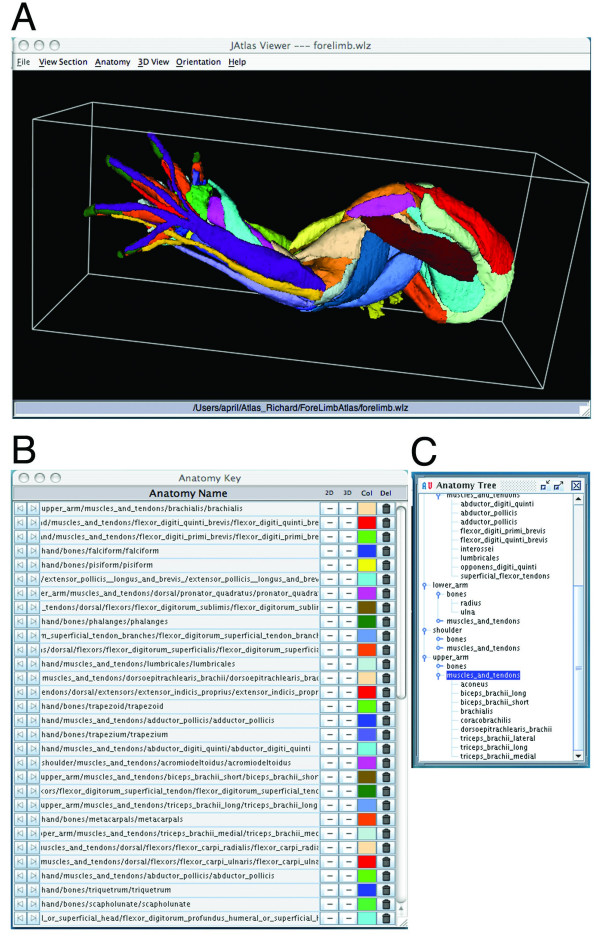
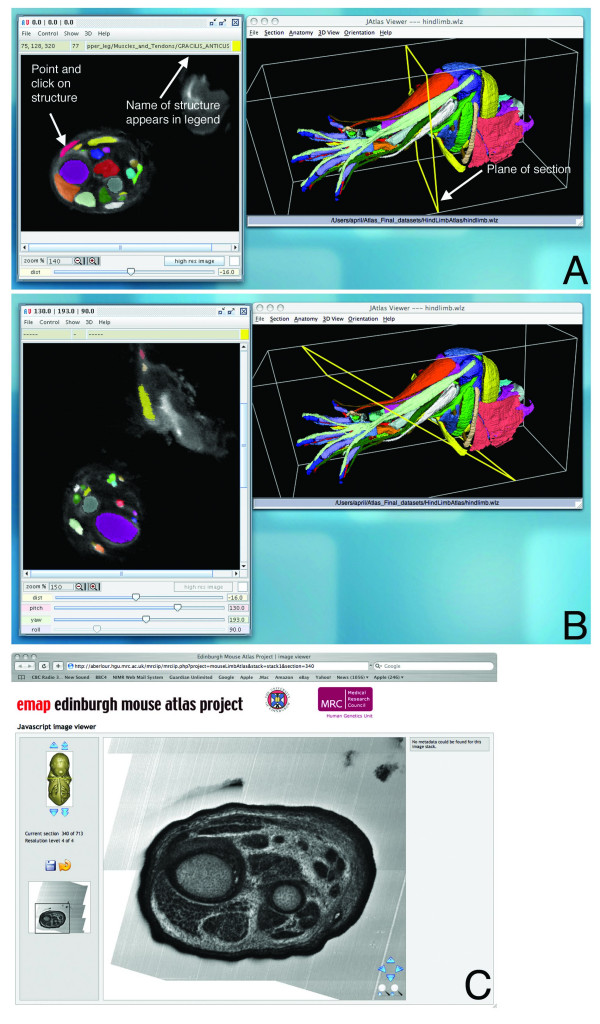
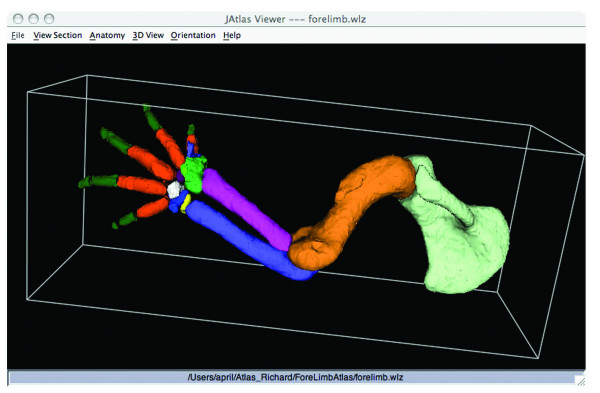
To improve the resources available in the mouse model, we have generated a free, web-based, interactive reference of limb muscle, tendon, and skeletal structures at embryonic day (E) 14.5 http://www.nimr.mrc.ac.uk/3dlimb/. The Atlas was generated using mouse forelimb and hindlimb specimens stained using immunohistochemistry to detect muscle and tendon. Limbs were scanned using Optical Projection Tomography (OPT), reconstructed to make 3D models and annotated using computer-assisted segmentation tools in Amira 3D Visualisation software. The annotated dataset is visualised using Java, JAtlasView software. Users click on the names of structures and view their shape, position and relationship with other structures within the 3D model and also in 2D virtual sections.
The Mouse Limb Anatomy Atlas provides a novel and valuable tool for researchers studying limb development and can be applied to a range of research areas, including the identification of abnormal limb patterning in transgenic lines and studies of models of congenital limb abnormalities. By using the Atlas for "virtual" dissection, this resource offers an alternative to animal dissection. The techniques we have developed and employed are also applicable to many other model systems and anatomical structures.
发育中的小鼠肢体被广泛用作研究组织模式形成的模型系统。尽管如此,可用于正确识别发育中的肢体结构(如肌肉和肌腱)的参考文献却很少。现有的文字参考文献包括成年大鼠或小鼠肢体的二维(2D)插图,在试图描述组织之间复杂的三维(3D)关系时可能难以应用。
为了改进小鼠模型中的可用资源,我们生成了一个免费的、基于网络的、关于胚胎第14.5天(E14.5)肢体肌肉、肌腱和骨骼结构的交互式参考文献http://www.nimr.mrc.ac.uk/3dlimb/。该图谱是使用免疫组织化学染色以检测肌肉和肌腱的小鼠前肢和后肢标本生成的。使用光学投影断层扫描(OPT)对肢体进行扫描,重建以制作3D模型,并在Amira 3D可视化软件中使用计算机辅助分割工具进行注释。注释后的数据集使用Java、JAtlasView软件进行可视化。用户点击结构名称,可在3D模型以及2D虚拟切片中查看其形状、位置以及与其他结构的关系。
小鼠肢体解剖图谱为研究肢体发育的研究人员提供了一种新颖且有价值的工具,可应用于一系列研究领域,包括鉴定转基因品系中的异常肢体模式以及先天性肢体异常模型的研究。通过使用该图谱进行“虚拟”解剖,此资源提供了一种替代动物解剖的方法。我们开发和采用的技术也适用于许多其他模型系统和解剖结构。