Kallergi Galatea, Agelaki Sofia, Kalykaki Antonia, Stournaras Christos, Mavroudis Dimitris, Georgoulias Vassilis
Laboratory of Tumor Cell Biology, School of Medicine, University of Crete, Voutes, Heraklion, Greece.
Breast Cancer Res. 2008;10(5):R80. doi: 10.1186/bcr2149. Epub 2008 Sep 29.
The phosphoinositide-3 kinase (PI3K)/Akt pathway, operating downstream of epidermal growth factor receptor (EGFR) and human epidermal growth factor receptor (HER)2, is implicated in cell migration and survival. EGFR and HER2 are expressed in circulating tumor cells, but the activation status of downstream signaling molecules has not yet been reported.
To investigate expression levels of EGFR, HER2, PI3K, and Akt in circulating tumor cells, we used peripheral blood mononuclear cells from 32 cytokeratin-19 mRNA-positive patients with early (n = 16) and metastatic (n = 16) breast cancer.Peripheral blood mononuclear cell cytospins were double stained with cytokeratin antibody along with one of the following: EGFR, phospho-EGFR, HER2, phospho-PI3K, or phospho-Akt antibodies.
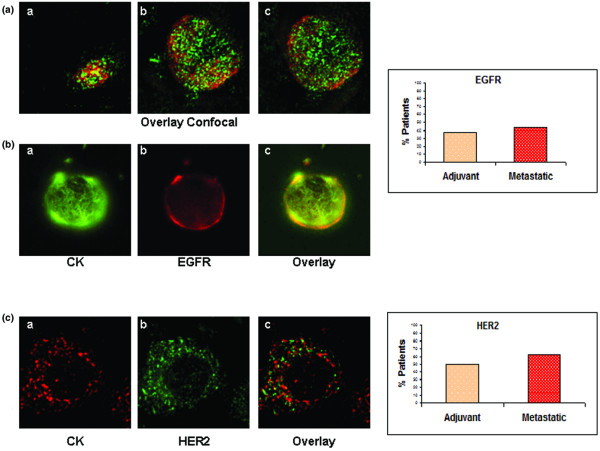
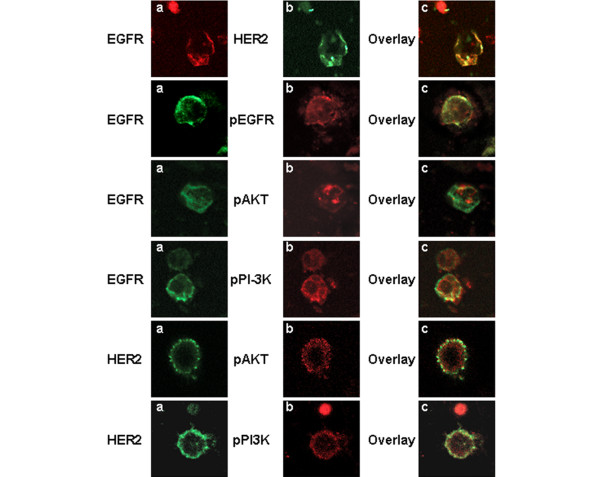
EGFR and HER2 were expressed in circulating tumor cells of 38% and 50% patients with early and 44% and 63% patients with metastatic disease, respectively. Interestingly, phospho-PI3K and phospho-Akt expression levels were similar at 88% (14 out of 16) and 81% (13 out of 16), respectively, in circulating tumor cells of patients with early and metastatic disease. Phospho-EGFR was observed in circulating tumor cells of two (33%) early and six (86%) metastatic EGFR-positive patients. Immunomagnetic separation of peripheral blood mononuclear cells, using EpCAM antibody, and subsequent double-staining experiments of circulating tumor cells showed that EGFR was co-expressed with HER2, phospho-Akt and phospho-PI3K kinases, indicating activation of the corresponding survival signaling pathway.
Our findings demonstrate that circulating tumor cells express receptors and activated signaling kinases of the EGFR/HER2/PI3K/Akt pathway, which could be used as targets for their effective elimination.
磷酸肌醇-3激酶(PI3K)/Akt信号通路在表皮生长因子受体(EGFR)和人表皮生长因子受体(HER)2的下游发挥作用,与细胞迁移和存活有关。EGFR和HER2在循环肿瘤细胞中表达,但下游信号分子的激活状态尚未见报道。
为了研究循环肿瘤细胞中EGFR、HER2、PI3K和Akt的表达水平,我们使用了32例细胞角蛋白-19 mRNA阳性的早期(n = 16)和转移性(n = 16)乳腺癌患者的外周血单个核细胞。外周血单个核细胞涂片用细胞角蛋白抗体与以下抗体之一进行双重染色:EGFR、磷酸化EGFR、HER2、磷酸化PI3K或磷酸化Akt抗体。
EGFR和HER2分别在38%的早期患者和44%的转移性疾病患者的循环肿瘤细胞中表达,在50%的早期患者和63%的转移性疾病患者的循环肿瘤细胞中表达。有趣的是,在早期和转移性疾病患者的循环肿瘤细胞中,磷酸化PI3K和磷酸化Akt的表达水平相似,分别为88%(16例中的14例)和81%(16例中的13例)。在2例(33%)早期和6例(86%)转移性EGFR阳性患者的循环肿瘤细胞中观察到磷酸化EGFR。使用EpCAM抗体对外周血单个核细胞进行免疫磁珠分离,随后对循环肿瘤细胞进行双重染色实验表明,EGFR与HER2、磷酸化Akt和磷酸化PI3K激酶共表达,表明相应的生存信号通路被激活。
我们的研究结果表明,循环肿瘤细胞表达EGFR/HER2/PI3K/Akt信号通路的受体和激活的信号激酶,这可作为有效清除它们的靶点。