
雌激素诱导的绝经后无冠心病女性在心房起搏期间冠状动脉血流反应的改善与内皮素-1水平的关系。
Estrogen-induced improvement in coronary flow responses during atrial pacing in relation to endothelin-1 levels in postmenopausal women without coronary disease.
作者信息
Kallikazaros Ioannis, Tsioufis Costas, Zambaras Panagiotis, Skiadas Ioannis, Toutouza Marina, Tousoulis Dimitrios, Stefanadis Christodoulos, Toutouzas Pavlos
机构信息
Cardiology Department and University Cardiology Clinic, Hippokration Hospital of Athens, Greece.
出版信息
Vasc Health Risk Manag. 2008;4(3):705-14. doi: 10.2147/vhrm.s2409.
BACKGROUND
The cardioprotective role of hormonal replacement therapy remains in doubt, but interest is increasing in the vascular effects of estrogens especially in coronary circulation.
METHODS
Coronary blood flow (CBF) was measured in 24 postmenopausal women (age 55+/-3 years), whose coronary arteries appeared angiographically normal, during incremental atrial pacing (AP) before and 20 minutes after intracoronary administration of either 75 ng/mL 17-beta estradiol (treated group, n=18) or 0.9% saline (controls, n=6).
RESULTS
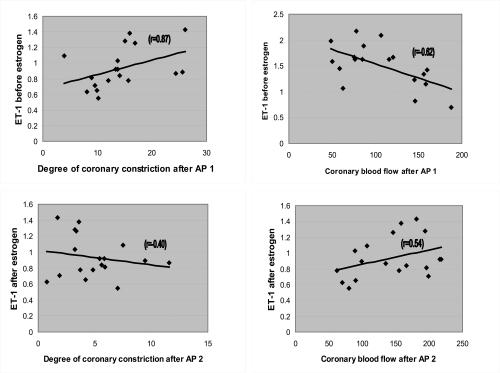
Before estrogen, no differences in the coronary vasomotor responses at AP between the two groups (p=NS) could be detected. After estrogen, in the treated group, at the peak of the second AP, the coronary artery diameter decreased by 0.17 mm (p<0.005) while the CBF increased by 61 mL/min (p<0.05). These changes differed significantly from those observed at the peak of first AP (p<0.001 for both cases). In contrast, in the control group no such changes were observed. The endothelin-1 (ET-1) levels in the coronary sinus were significantly reduced after estrogen infusion, which was negatively correlated with the degree of coronary artery constriction (r= -0.40, p=0.03) and positively correlated with the increase in CBF (r=0.54, p=0.01).
CONCLUSIONS
In postmenopausal women without coronary artery disease, the intracoronary estrogen infusion mediates a greater increase in CBF and is positively correlated with the reduction of the coronary sinus ET-1 levels at the peak of AP.
背景
激素替代疗法的心脏保护作用仍存疑问,但雌激素对血管的影响,尤其是对冠状动脉循环的影响,正受到越来越多的关注。
方法
对24名绝经后女性(年龄55±3岁)进行研究,这些女性冠状动脉造影显示正常。在冠状动脉内注射75 ng/mL 17-β雌二醇(治疗组,n = 18)或0.9%生理盐水(对照组,n = 6)之前及之后20分钟,在递增心房起搏(AP)期间测量冠状动脉血流量(CBF)。
结果
在注射雌激素之前,两组在AP时的冠状动脉血管运动反应无差异(p = 无显著性差异)。注射雌激素后,治疗组在第二次AP峰值时,冠状动脉直径减少0.17 mm(p < 0.005),而CBF增加61 mL/min(p < 0.05)。这些变化与第一次AP峰值时观察到的变化有显著差异(两种情况p均 < 0.001)。相比之下,对照组未观察到此类变化。冠状动脉内注射雌激素后,冠状窦内皮素-1(ET-1)水平显著降低,其与冠状动脉收缩程度呈负相关(r = -0.40,p = 0.03),与CBF增加呈正相关(r = 0.54,p = 0.01)。
结论
在无冠状动脉疾病的绝经后女性中,冠状动脉内注射雌激素可使CBF有更大增加,且与AP峰值时冠状窦ET-1水平降低呈正相关。


 Zotero 插件