Horzempa Joseph, Carlson Paul E, O'Dee Dawn M, Shanks Robert M Q, Nau Gerard J
Department of Microbiology and Molecular Genetics, University of Pittsburgh School of Medicine, Pittsburgh, PA 15261, USA
BMC Microbiol. 2008 Oct 8;8:172. doi: 10.1186/1471-2180-8-172.
After infecting a mammalian host, the facultative intracellular bacterium, Francisella tularensis, encounters an elevated environmental temperature. We hypothesized that this temperature change may regulate genes essential for infection.
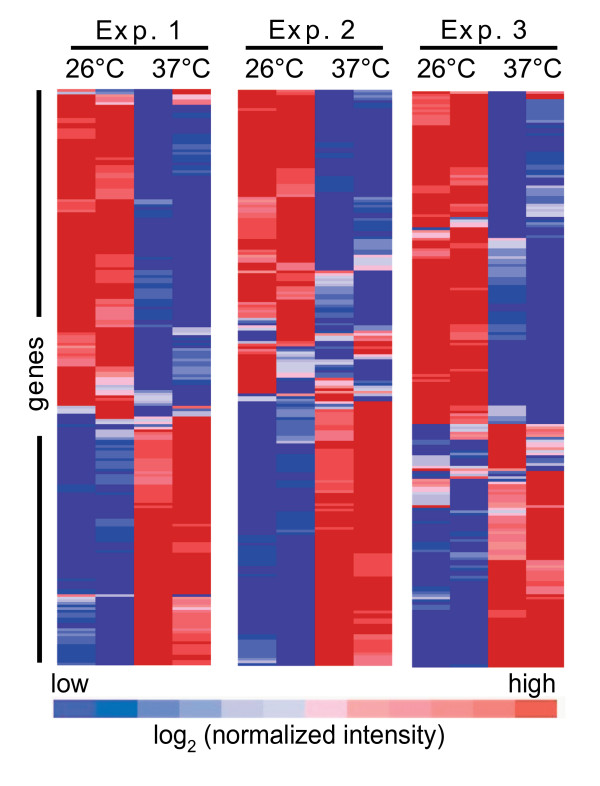
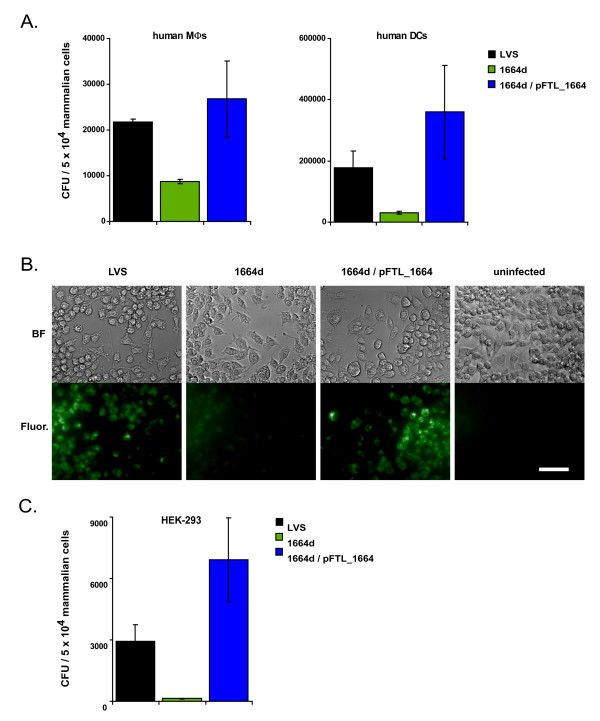
Microarray analysis of F. tularensis LVS shifted from 26 degrees C (environmental) to 37 degrees C (mammalian) showed approximately 11% of this bacterium's genes were differentially-regulated. Importantly, 40% of the protein-coding genes that were induced at 37 degrees C have been previously implicated in virulence or intracellular growth of Francisella in other studies, associating the bacterial response to this temperature shift with pathogenesis. Forty-four percent of the genes induced at 37 degrees C encode proteins of unknown function, suggesting novel Francisella virulence traits are regulated by mammalian temperature. To explore this possibility, we generated two mutants of loci induced at 37 degrees C [FTL_1581 and FTL_1664 (deoB)]. The FTL_1581 mutant was attenuated in a chicken embryo infection model, which was likely attributable to a defect in survival within macrophages. FTL_1581 encodes a novel hypothetical protein that we suggest naming temperature-induced, virulence-associated locus A, tivA. Interestingly, the deoB mutant showed diminished entry into mammalian cells compared to wild-type LVS, including primary human macrophages and dendritic cells, the macrophage-like RAW 264.7 line, and non-phagocytic HEK-293 cells. This is the first study identifying a Francisella gene that contributes to uptake into both phagocytic and non-phagocytic host cells.
Our results provide new insight into mechanisms of Francisella virulence regulation and pathogenesis. F. tularensis LVS undergoes considerable gene expression changes in response to mammalian body temperature. This temperature shift is important for the regulation of genes that are critical for the pathogenesis of Francisella. Importantly, the compilation of temperature-regulated genes also defines a rich collection of novel candidate virulence determinants, including tivA (FTL_1581). An analysis of tivA and deoB (FTL_1664) revealed that these genes contribute to intracellular survival and entry into mammalian cells, respectively.
兼性胞内菌土拉弗朗西斯菌感染哺乳动物宿主后,会遇到环境温度升高的情况。我们推测这种温度变化可能会调节感染所必需的基因。
对从26℃(环境温度)转移至37℃(哺乳动物体温)的土拉弗朗西斯菌LVS进行微阵列分析,结果显示该细菌约11%的基因存在差异调节。重要的是,在37℃诱导表达的蛋白质编码基因中,40%在其他研究中曾被认为与土拉弗朗西斯菌的毒力或胞内生长有关,这表明细菌对这种温度变化的反应与致病机制相关。在37℃诱导表达的基因中,44%编码功能未知的蛋白质,这表明土拉弗朗西斯菌的新毒力特性受哺乳动物体温调节。为探究这种可能性,我们构建了在37℃诱导表达的两个基因座[FTL_1581和FTL_1664(deoB)]的突变体。FTL_1581突变体在鸡胚感染模型中毒力减弱,这可能归因于其在巨噬细胞内存活存在缺陷。FTL_1581编码一种新的假定蛋白,我们建议将其命名为温度诱导的毒力相关基因座A,即tivA。有趣的是,与野生型LVS相比,deoB突变体进入哺乳动物细胞(包括原代人巨噬细胞和树突状细胞、巨噬细胞样RAW 264.7细胞系以及非吞噬性HEK - 293细胞)的能力减弱。这是首次鉴定出土拉弗朗西斯菌中一个有助于其进入吞噬性和非吞噬性宿主细胞的基因。
我们的研究结果为土拉弗朗西斯菌毒力调节机制和致病机制提供了新的见解。土拉弗朗西斯菌LVS在应对哺乳动物体温时会发生相当大的基因表达变化。这种温度变化对于调节土拉弗朗西斯菌致病过程中关键的基因非常重要。重要的是,温度调节基因的汇总还定义了一系列丰富的新型候选毒力决定因素,包括tivA(FTL_1581)。对tivA和deoB(FTL_1664)的分析表明,这些基因分别有助于胞内存活和进入哺乳动物细胞。