Groysman Maya, Shoval Irit, Kalcheim Chaya
Department of Anatomy and Cell Biology, Hebrew University-Hadassah Medical School, Jerusalem 91120, Israel.
Neural Dev. 2008 Oct 22;3:27. doi: 10.1186/1749-8104-3-27.
Neural crest progenitors arise as epithelial cells and then undergo a process of epithelial to mesenchymal transition that precedes the generation of cellular motility and subsequent migration. We aim at understanding the underlying molecular network. Along this line, possible roles of Rho GTPases that act as molecular switches to control a variety of signal transduction pathways remain virtually unexplored, as are putative interactions between Rho proteins and additional known components of this cascade.
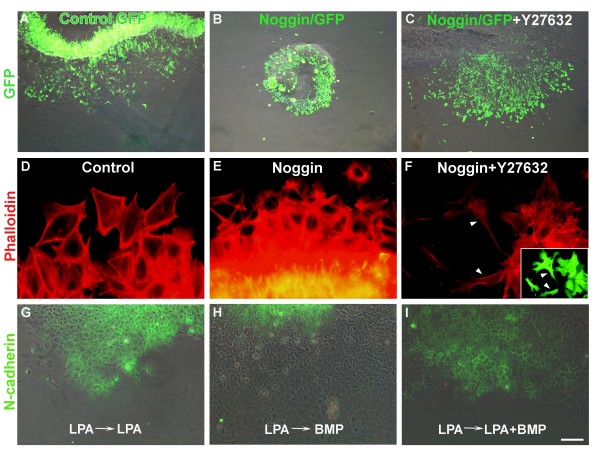
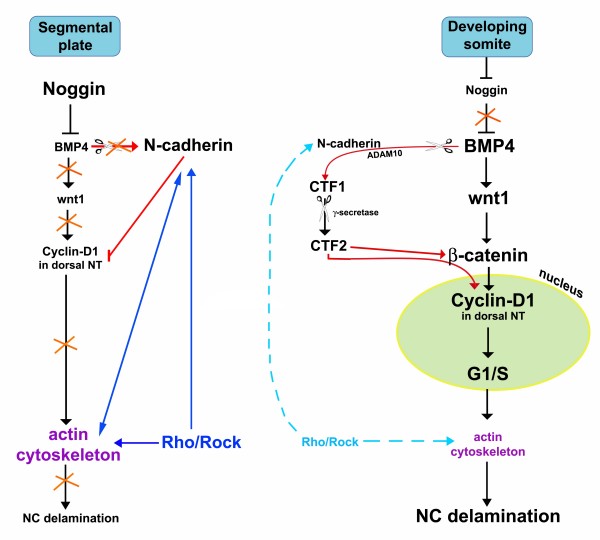
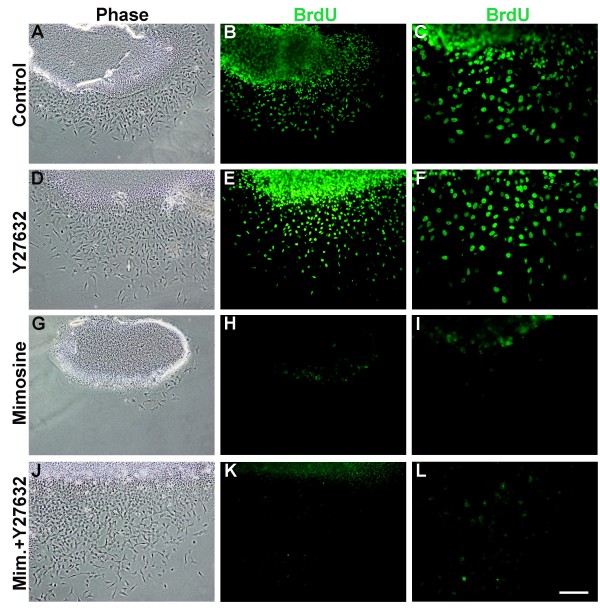
We investigated the role of Rho/Rock signaling in neural crest delamination. Active RhoA and RhoB are expressed in the membrane of epithelial progenitors and are downregulated upon delamination. In vivo loss-of-function of RhoA or RhoB or of overall Rho signaling by C3 transferase enhanced and/or triggered premature crest delamination yet had no effect on cell specification. Consistently, treatment of explanted neural primordia with membrane-permeable C3 or with the Rock inhibitor Y27632 both accelerated and enhanced crest emigration without affecting cell proliferation. These treatments altered neural crest morphology by reducing stress fibers, focal adhesions and downregulating membrane-bound N-cadherin. Reciprocally, activation of endogenous Rho by lysophosphatidic acid inhibited emigration while enhancing the above. Since delamination is triggered by BMP and requires G1/S transition, we examined their relationship with Rho. Blocking Rho/Rock function rescued crest emigration upon treatment with noggin or with the G1/S inhibitor mimosine. In the latter condition, cells emigrated while arrested at G1. Conversely, BMP4 was unable to rescue cell emigration when endogenous Rho activity was enhanced by lysophosphatidic acid.
Rho-GTPases, through Rock, act downstream of BMP and of G1/S transition to negatively regulate crest delamination by modifying cytoskeleton assembly and intercellular adhesion.
神经嵴祖细胞起源于上皮细胞,随后经历上皮-间充质转化过程,该过程先于细胞运动性的产生及随后的迁移。我们旨在了解其潜在的分子网络。在此方面,作为分子开关控制多种信号转导途径的Rho GTP酶的可能作用实际上仍未被探索,Rho蛋白与该级联反应其他已知组分之间的假定相互作用亦是如此。
我们研究了Rho/Rock信号在神经嵴脱层中的作用。活性RhoA和RhoB在上皮祖细胞膜中表达,并在脱层时下调。通过C3转移酶对RhoA或RhoB或整体Rho信号进行体内功能缺失增强和/或触发了嵴的过早脱层,但对细胞特化没有影响。同样,用膜通透性C3或Rock抑制剂Y27632处理外植的神经原基均加速并增强了嵴的迁出,而不影响细胞增殖。这些处理通过减少应力纤维、粘着斑和下调膜结合的N-钙粘蛋白改变了神经嵴的形态。相反,溶血磷脂酸激活内源性Rho抑制了迁出,同时增强了上述变化。由于脱层由骨形态发生蛋白(BMP)触发且需要G1/S期转换,我们研究了它们与Rho的关系。用头蛋白或G1/S抑制剂含羞草碱处理时,阻断Rho/Rock功能可挽救嵴的迁出。在后一种情况下,细胞在G1期停滞时迁出。相反,当溶血磷脂酸增强内源性Rho活性时,BMP4无法挽救细胞迁出。
Rho-GTP酶通过Rock在BMP和G1/S期转换的下游起作用,通过改变细胞骨架组装和细胞间粘附来负向调节嵴的脱层。