Rujescu Dan, Ingason Andres, Cichon Sven, Pietiläinen Olli P H, Barnes Michael R, Toulopoulou Timothea, Picchioni Marco, Vassos Evangelos, Ettinger Ulrich, Bramon Elvira, Murray Robin, Ruggeri Mirella, Tosato Sarah, Bonetto Chiara, Steinberg Stacy, Sigurdsson Engilbert, Sigmundsson Thordur, Petursson Hannes, Gylfason Arnaldur, Olason Pall I, Hardarsson Gudmundur, Jonsdottir Gudrun A, Gustafsson Omar, Fossdal Ragnheidur, Giegling Ina, Möller Hans-Jürgen, Hartmann Annette M, Hoffmann Per, Crombie Caroline, Fraser Gillian, Walker Nicholas, Lonnqvist Jouko, Suvisaari Jaana, Tuulio-Henriksson Annamari, Djurovic Srdjan, Melle Ingrid, Andreassen Ole A, Hansen Thomas, Werge Thomas, Kiemeney Lambertus A, Franke Barbara, Veltman Joris, Buizer-Voskamp Jacobine E, Sabatti Chiara, Ophoff Roel A, Rietschel Marcella, Nöthen Markus M, Stefansson Kari, Peltonen Leena, St Clair David, Stefansson Hreinn, Collier David A
Division of Molecular and Clinical Neurobiology, Department of Psychiatry, Ludwig- Maximilians University, Munich, Germany.
Hum Mol Genet. 2009 Mar 1;18(5):988-96. doi: 10.1093/hmg/ddn351. Epub 2008 Oct 22.
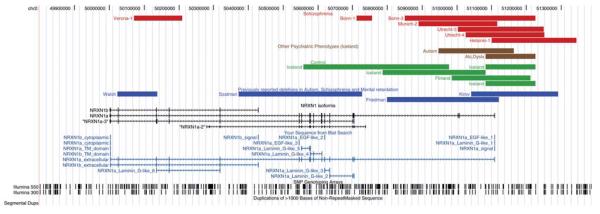
Deletions within the neurexin 1 gene (NRXN1; 2p16.3) are associated with autism and have also been reported in two families with schizophrenia. We examined NRXN1, and the closely related NRXN2 and NRXN3 genes, for copy number variants (CNVs) in 2977 schizophrenia patients and 33 746 controls from seven European populations (Iceland, Finland, Norway, Germany, The Netherlands, Italy and UK) using microarray data. We found 66 deletions and 5 duplications in NRXN1, including a de novo deletion: 12 deletions and 2 duplications occurred in schizophrenia cases (0.47%) compared to 49 and 3 (0.15%) in controls. There was no common breakpoint and the CNVs varied from 18 to 420 kb. No CNVs were found in NRXN2 or NRXN3. We performed a Cochran-Mantel-Haenszel exact test to estimate association between all CNVs and schizophrenia (P = 0.13; OR = 1.73; 95% CI 0.81-3.50). Because the penetrance of NRXN1 CNVs may vary according to the level of functional impact on the gene, we next restricted the association analysis to CNVs that disrupt exons (0.24% of cases and 0.015% of controls). These were significantly associated with a high odds ratio (P = 0.0027; OR 8.97, 95% CI 1.8-51.9). We conclude that NRXN1 deletions affecting exons confer risk of schizophrenia.
神经连接蛋白1基因(NRXN1;2p16.3)内的缺失与自闭症有关,并且在两个精神分裂症家族中也有报道。我们利用微阵列数据,在来自七个欧洲人群(冰岛、芬兰、挪威、德国、荷兰、意大利和英国)的2977例精神分裂症患者和33746例对照中,检测了NRXN1以及与之密切相关的NRXN2和NRXN3基因的拷贝数变异(CNV)。我们在NRXN1中发现了66个缺失和5个重复,包括一个新生缺失:精神分裂症病例中出现了12个缺失和2个重复(0.47%),而对照中为49个和3个(0.15%)。没有共同的断点,CNV的大小从18 kb到420 kb不等。在NRXN2或NRXN3中未发现CNV。我们进行了 Cochr an-Mantel-Haenszel精确检验,以估计所有CNV与精神分裂症之间的关联(P = 0.13;OR = 1.73;95% CI 0.81 - 3.50)。由于NRXN1 CNV的外显率可能因对基因的功能影响水平而异,接下来我们将关联分析限制在破坏外显子的CNV上(病例的0.24%和对照的0.015%)。这些与高比值比显著相关(P = 0.0027;OR 8.97,95% CI 1.8 - 51.9)。我们得出结论,影响外显子的NRXN1缺失会增加精神分裂症的风险。