Department of Plant Cellular and Molecular Biology, The Ohio State University, Columbus, OH 43210, USA.
Plant Methods. 2008 Oct 27;4:25. doi: 10.1186/1746-4811-4-25.
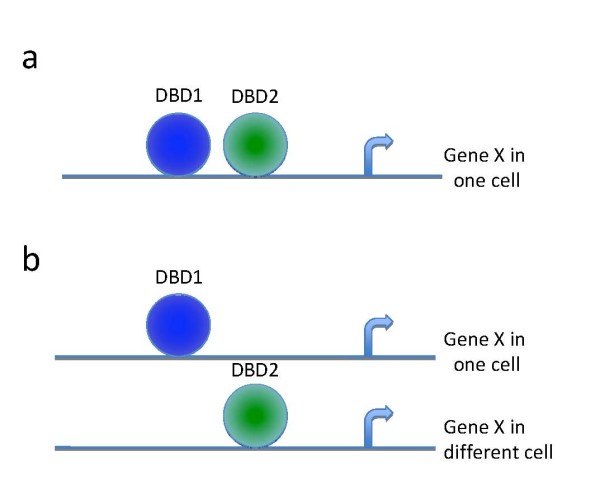
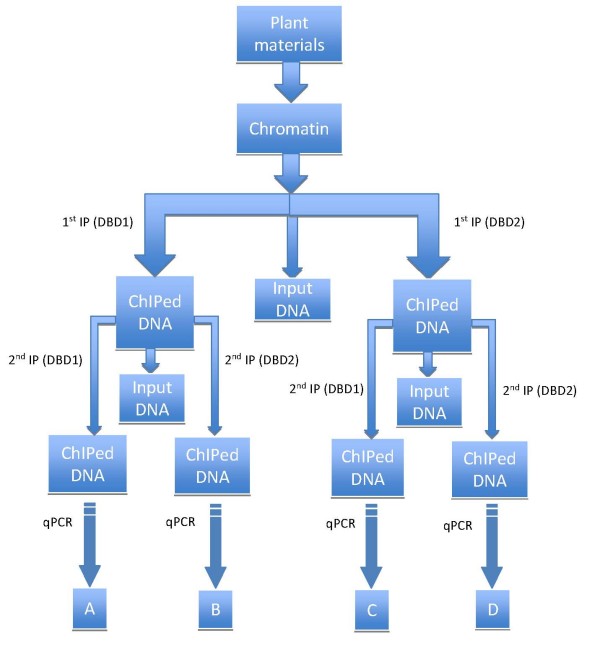
Establishing transcriptional regulatory networks that include protein-protein and protein-DNA interactions has become a key component to better understanding many fundamental biological processes. Although a variety of techniques are available to expose protein-protein and protein-DNA interactions, unequivocally establishing whether two proteins are targeted together to the same promoter or DNA molecule poses a very challenging endeavour. Yet, the recruitment of multiple regulatory proteins simultaneously to the same promoter provides the basis for combinatorial transcriptional regulation, central to the transcriptional regulatory network of eukaryotes. The serial ChIP (sChIP) technology was developed to fill this gap in our knowledge, and we illustrate here its application in plants.
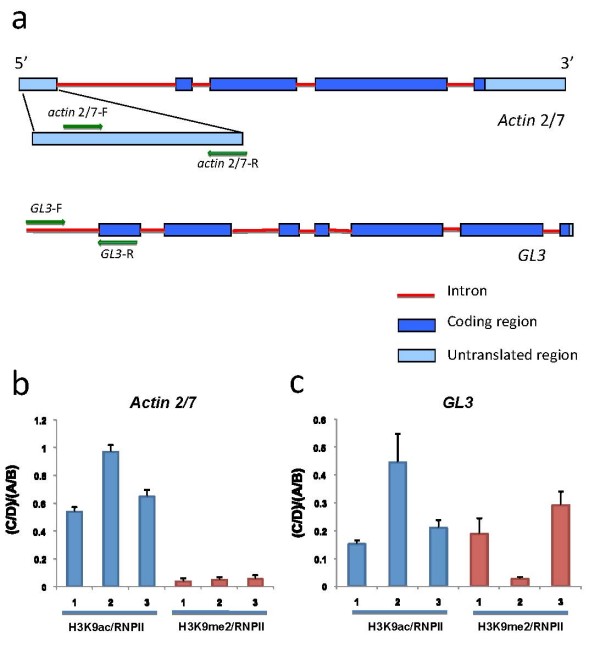
Here we describe a modified sChIP protocol that provides robust and quantitative information on the co-association or exclusion of DNA-binding proteins on particular promoters. As a proof of principle, we investigated the association of histone H3 protein variants with modified tails (H3K9ac and H3K9me2) with Arabidopsis RNA polymerase II (RNPII) on the promoter of the constitutively expressed actin gene (At5g09810), and the trichome-expressed GLABRA3 (GL3) gene. As anticipated, our results show a strong positive correlation between H3K9ac and RNPII and a negative correlation between H3K9me2 and RNPII on the actin gene promoter. Our findings also establish a weak positive correlation between both H3K9ac and H3K9me2 and RNPII on the GL3 gene promoter, whose expression is restricted to a discrete number of cell types. We also describe mathematical tools that allow the easy interpretation of sChIP results.
The sChIP method described here provides a reliable tool to determine whether the tethering of two proteins to the same DNA molecule is positively or negatively correlated. With the increasing need for establishing transcriptional regulatory networks, this modified sChIP method is anticipated to provide an excellent way to explore combinatorial gene regulation in eukaryotes.
建立包括蛋白质-蛋白质和蛋白质-DNA 相互作用的转录调控网络已成为更好地理解许多基本生物过程的关键组成部分。虽然有多种技术可用于揭示蛋白质-蛋白质和蛋白质-DNA 相互作用,但明确确定两个蛋白质是否被同时靶向到同一个启动子或 DNA 分子是一项极具挑战性的工作。然而,多个调节蛋白同时被招募到同一个启动子为组合转录调控提供了基础,这对真核生物的转录调控网络至关重要。串联 ChIP(sChIP)技术的发展就是为了填补我们知识中的这一空白,我们在这里展示了它在植物中的应用。
我们在这里描述了一种改良的 sChIP 方案,该方案可提供有关特定启动子上 DNA 结合蛋白的共关联或排除的稳健和定量信息。作为原理验证,我们研究了组蛋白 H3 变体与经修饰尾部(H3K9ac 和 H3K9me2)与拟南芥 RNA 聚合酶 II(RNPII)在组成型表达的肌动蛋白基因(At5g09810)和毛状体表达的 GLABRA3(GL3)基因启动子上的关联。不出所料,我们的结果显示 H3K9ac 和 RNPII 之间存在强烈的正相关,而 H3K9me2 和 RNPII 之间存在负相关在肌动蛋白基因启动子上。我们的研究结果还确定了 H3K9ac 和 H3K9me2 与 GL3 基因启动子上的 RNPII 之间的弱正相关,而 GL3 基因的表达仅限于少数几种细胞类型。我们还描述了允许轻松解释 sChIP 结果的数学工具。
这里描述的 sChIP 方法提供了一种可靠的工具,可用于确定将两个蛋白质固定到同一个 DNA 分子上是否呈正相关或负相关。随着建立转录调控网络的需求不断增加,这种改良的 sChIP 方法有望成为探索真核生物组合基因调控的绝佳方法。