Department of Medicine, Division of Allergy, Immunology, and Rheumatology, Buffalo General Hospital, Kaleida Health System and Center for Computational Research, New York State Center of Excellence in Bioinformatics and Life Sciences and Department of Biostatistics, University at Buffalo, State University of New York (SUNY), New York State Center of Excellence, Buffalo, NY 14203, USA.
Evid Based Complement Alternat Med. 2010 Jun;7(2):177-87. doi: 10.1093/ecam/nem184. Epub 2008 Jan 10.
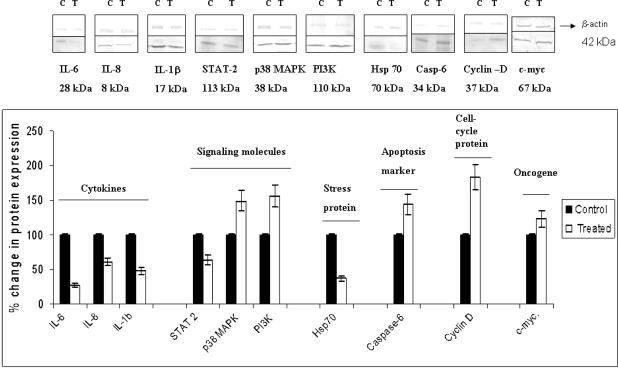
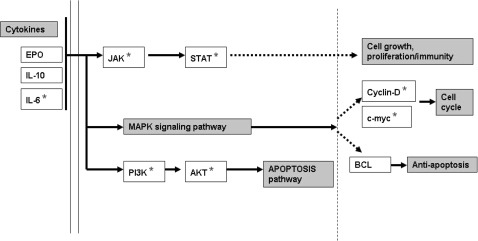
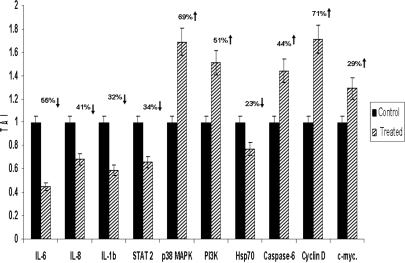
Phytochemicals are dietary phytoestrogens that may play a role in prostate cancer prevention. Forty percent of Americans use complementary and alternative medicines (CAM) for disease prevention and therapy. Ashwagandha (Withania somnifera) contains flavonoids and active ingredients like alkaloids and steroidal lactones which are called 'Withanolides'. We hypothesize that the immunomodulatory and anti-inflammatory properties of Ashwagandha might contribute to its overall effectiveness as an anti-carcinogenic agent. The goal of our study was gain insight into the general biological and molecular functions and immunomodulatory processes that are altered as a result of Ashwagandha treatment in prostate cancer cells, and to identify the key signaling mechanisms that are involved in the regulation of these physiological effects using genomic microarray analysis in conjunction with quantitative real-time PCR and western blot analysis. Ashwagandha treatment significantly downregulated the gene and protein expression of proinflammatory cytokines IL-6, IL-1β, chemokine IL-8, Hsp70 and STAT-2, while a reciprocal upregulation was observed in gene and protein expression of p38 MAPK, PI3K, caspase 6, Cyclin D and c-myc. Furthermore, Ashwagandha treatment significantly modulated the JAK-STAT pathway which regulates both the apoptosis process as well as the MAP kinase signaling. These studies outline several functionally important classes of genes, which are associated with immune response, signal transduction, cell signaling, transcriptional regulation, apoptosis and cell cycle regulation and provide insight into the molecular signaling mechanisms that are modulated by Ashwagandha, thereby highlighting the use of this bioflavanoid as effective chemopreventive agent relevant to prostate cancer progression.
植物化学物质是饮食中的植物雌激素,可能在预防前列腺癌中发挥作用。40%的美国人使用补充和替代医学(CAM)来预防和治疗疾病。南非醉茄(Withania somnifera)含有类黄酮和活性成分,如生物碱和甾体内酯,被称为“醉茄内酯”。我们假设南非醉茄的免疫调节和抗炎特性可能有助于其作为抗癌剂的整体功效。我们的研究目的是深入了解南非醉茄处理前列腺癌细胞后改变的一般生物学和分子功能以及免疫调节过程,并通过基因组微阵列分析结合定量实时 PCR 和 Western blot 分析,确定参与调节这些生理效应的关键信号机制。南非醉茄处理显著下调了促炎细胞因子 IL-6、IL-1β、趋化因子 IL-8、Hsp70 和 STAT-2 的基因和蛋白表达,而 p38 MAPK、PI3K、caspase 6、Cyclin D 和 c-myc 的基因和蛋白表达则呈相反的上调。此外,南非醉茄处理还显著调节了 JAK-STAT 通路,该通路调节细胞凋亡过程以及 MAP 激酶信号转导。这些研究概述了与免疫反应、信号转导、细胞信号转导、转录调节、细胞凋亡和细胞周期调节相关的几个功能重要的基因类别,并深入了解了被南非醉茄调节的分子信号机制,从而突出了这种生物类黄酮作为与前列腺癌进展相关的有效化学预防剂的用途。