Nemec Kathleen N, Khaled Annette R
Biomolecular Science Center, Burnett School of Biomedical Sciences, University of Central Florida, 12722 Research Parkway, Orlando, FL 32826, USA.
Yonsei Med J. 2008 Oct 31;49(5):689-97. doi: 10.3349/ymj.2008.49.5.689.
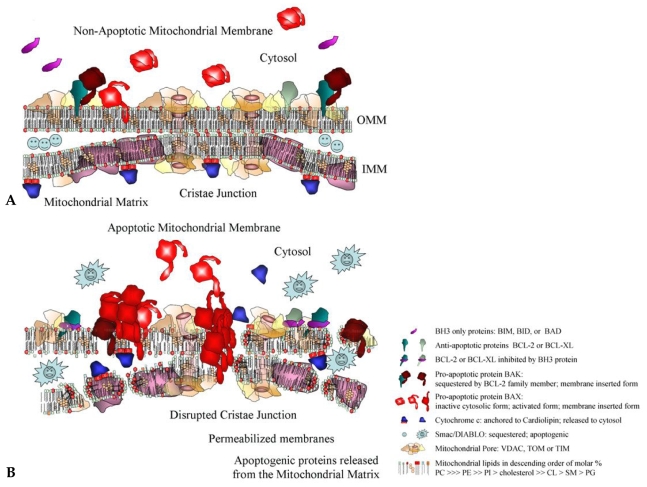
A vast portion of human disease results when the process of apoptosis is defective. Disorders resulting from inappropriate cell death range from autoimmune and neurodegenerative conditions to heart disease. Conversely, prevention of apoptosis is the hallmark of cancer and confounds the efficacy of cancer therapeutics. In the search for optimal targets that would enable the control of apoptosis, members of the BCL-2 family of anti- and pro-apoptotic factors have figured prominently. Development of BCL-2 antisense approaches, small molecules, and BH3 peptidomimetics has met with both success and failure. Success-because BCL-2 proteins play essential roles in apoptosis. Failure-because single targets for drug development have limited scope. By examining the activity of the BCL-2 proteins in relation to the mitochondrial landscape and drawing attention to the significant mitochondrial membrane alterations that ensue during apoptosis, we demonstrate the need for a broader based multi-disciplinary approach for the design of novel apoptosis-modulating compounds in the treatment of human disease.
当细胞凋亡过程出现缺陷时,会导致很大一部分人类疾病。由不适当的细胞死亡引起的疾病范围从自身免疫性疾病、神经退行性疾病到心脏病。相反,细胞凋亡的抑制是癌症的标志,并且会影响癌症治疗的疗效。在寻找能够控制细胞凋亡的最佳靶点的过程中,抗凋亡和促凋亡的BCL-2家族成员备受关注。BCL-2反义方法、小分子和BH3肽模拟物的开发既有成功也有失败。成功是因为BCL-2蛋白在细胞凋亡中起重要作用。失败是因为药物开发的单一靶点范围有限。通过研究BCL-2蛋白与线粒体格局相关的活性,并关注细胞凋亡过程中随之发生的显著线粒体膜改变,我们证明在治疗人类疾病时,需要一种更广泛的多学科方法来设计新型的细胞凋亡调节化合物。