Chen Jindong, Futami Kunihiko, Petillo David, Peng Jun, Wang Pengfei, Knol Jared, Li Yan, Khoo Sok-Kean, Huang Dan, Qian Chao-Nan, Zhao Ping, Dykema Karl, Zhang Racheal, Cao Brian, Yang Ximing J, Furge Kyle, Williams Bart O, Teh Bin Tean
Laboratory of Cancer Genetics, Van Andel Research Institute, Grand Rapids, Michigan, USA.
PLoS One. 2008;3(10):e3581. doi: 10.1371/journal.pone.0003581. Epub 2008 Oct 30.
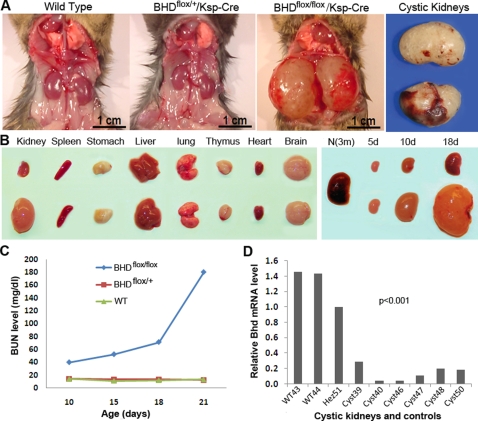
The Birt-Hogg-Dubé (BHD) disease is a genetic cancer syndrome. The responsible gene, BHD, has been identified by positional cloning and thought to be a novel tumor suppressor gene. BHD mutations cause many types of diseases including renal cell carcinomas, fibrofolliculomas, spontaneous pneumothorax, lung cysts, and colonic polyps/cancers. By combining Gateway Technology with the Ksp-Cre gene knockout system, we have developed a kidney-specific BHD knockout mouse model. BHD(flox/flox)/Ksp-Cre mice developed enlarged kidneys characterized by polycystic kidneys, hyperplasia, and cystic renal cell carcinoma. The affected BHD(flox/flox)/Ksp-Cre mice died of renal failure at approximate three weeks of age, having blood urea nitrogen levels over tenfold higher than those of BHD (flox/+)/Ksp-Cre and wild-type littermate controls. We further demonstrated that these phenotypes were caused by inactivation of BHD and subsequent activation of the mTOR pathway. Application of rapamycin, which inhibits mTOR activity, to the affected mice led to extended survival and inhibited further progression of cystogenesis. These results provide a correlation of kidney-targeted gene inactivation with renal carcinoma, and they suggest that the BHD product FLCN, functioning as a cyst and tumor suppressor, like other hamartoma syndrome-related proteins such as PTEN, LKB1, and TSC1/2, is a component of the mTOR pathway, constituting a novel FLCN-mTOR signaling branch that regulates cell growth/proliferation.
Birt-Hogg-Dubé(BHD)病是一种遗传性癌症综合征。致病基因BHD已通过定位克隆得以确定,被认为是一种新型肿瘤抑制基因。BHD突变会引发多种疾病,包括肾细胞癌、纤维毛囊瘤、自发性气胸、肺囊肿以及结肠息肉/癌症。通过将Gateway技术与Ksp-Cre基因敲除系统相结合,我们构建了一种肾脏特异性BHD敲除小鼠模型。BHD(flox/flox)/Ksp-Cre小鼠出现肾脏增大,其特征为多囊肾、增生以及囊性肾细胞癌。受影响的BHD(flox/flox)/Ksp-Cre小鼠在大约三周龄时死于肾衰竭,其血尿素氮水平比BHD(flox/+)/Ksp-Cre和野生型同窝对照小鼠高出十倍以上。我们进一步证明,这些表型是由BHD失活以及随后mTOR通路的激活所致。对受影响小鼠应用抑制mTOR活性的雷帕霉素,可延长其生存期并抑制囊肿形成的进一步发展。这些结果揭示了肾脏靶向基因失活与肾癌之间的关联,并且表明BHD产物FLCN作为囊肿和肿瘤抑制因子,与其他错构瘤综合征相关蛋白如PTEN、LKB1和TSC1/2一样,是mTOR通路的一个组成部分,构成了一个调节细胞生长/增殖的新型FLCN-mTOR信号分支。