Lam Gabrielle C, Hill Doug L, Le Lawrence H, Raso Jim V, Lou Edmond H
Department of Surgery, University of Alberta, Edmonton, T6G 2B7, Canada.
Scoliosis. 2008 Nov 2;3:16. doi: 10.1186/1748-7161-3-16.
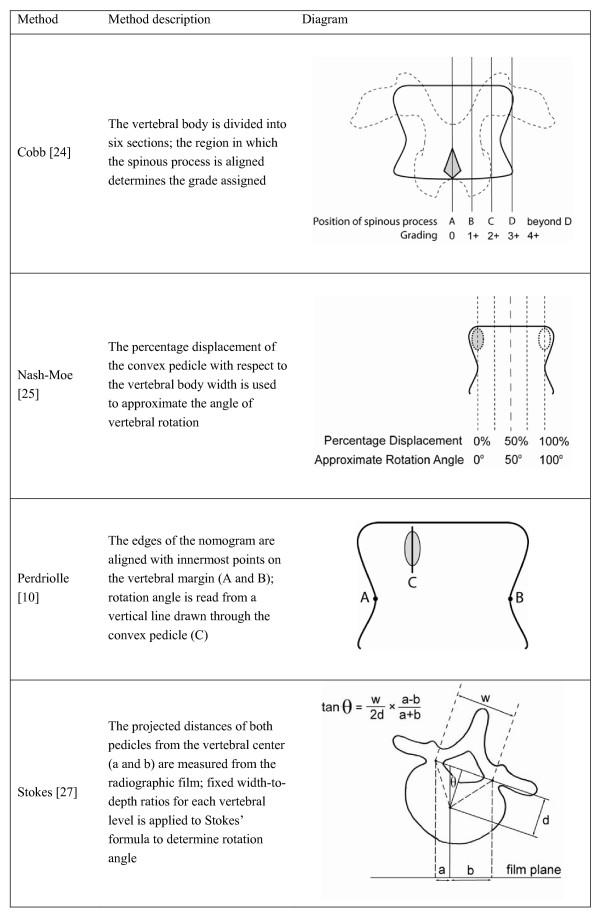
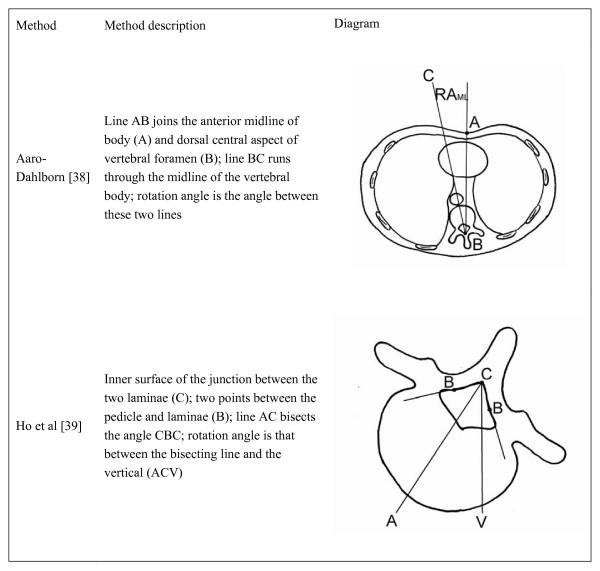
Current research has provided a more comprehensive understanding of Adolescent Idiopathic Scoliosis (AIS) as a three-dimensional spinal deformity, encompassing both lateral and rotational components. Apart from quantifying curve severity using the Cobb angle, vertebral rotation has become increasingly prominent in the study of scoliosis. It demonstrates significance in both preoperative and postoperative assessment, providing better appreciation of the impact of bracing or surgical interventions. In the past, the need for computer resources, digitizers and custom software limited studies of rotation to research performed after a patient left the scoliosis clinic. With advanced technology, however, rotation measurements are now more feasible. While numerous vertebral rotation measurement methods have been developed and tested, thorough comparisons of these are still relatively unexplored. This review discusses the advantages and disadvantages of six common measurement techniques based on technology most pertinent in clinical settings: radiography (Cobb, Nash-Moe, Perdriolle and Stokes' method) and computer tomography (CT) imaging (Aaro-Dahlborn and Ho's method). Better insight into the clinical suitability of rotation measurement methods currently available is presented, along with a discussion of critical concerns that should be addressed in future studies and development of new methods.
当前的研究对青少年特发性脊柱侧凸(AIS)作为一种三维脊柱畸形有了更全面的理解,它包括侧方和旋转成分。除了使用Cobb角量化侧弯严重程度外,椎体旋转在脊柱侧凸研究中变得越来越重要。它在术前和术后评估中都具有重要意义,能更好地评估支具或手术干预的影响。过去,由于需要计算机资源、数字化仪和定制软件,旋转研究仅限于患者离开脊柱侧凸诊所后进行的研究。然而,随着技术的进步,现在旋转测量更加可行。虽然已经开发并测试了许多椎体旋转测量方法,但对这些方法的全面比较仍相对较少。本综述基于临床环境中最相关的技术,讨论了六种常见测量技术的优缺点:放射摄影(Cobb法、Nash-Moe法、Perdriolle法和Stokes法)和计算机断层扫描(CT)成像(Aaro-Dahlborn法和Ho法)。本文深入探讨了当前可用旋转测量方法的临床适用性,并讨论了未来研究和新方法开发中应解决的关键问题。