Varelmann Dirk, Muders Thomas, Zinserling Jörg, Guenther Ulf, Magnusson Anders, Hedenstierna Göran, Putensen Christian, Wrigge Hermann
Department of Anesthesiology and Intensive Care Medicine, University of Bonn, Sigmund-Freud-Strasse 25, D-53105 Bonn, Germany.
Crit Care. 2008;12(6):R135. doi: 10.1186/cc7108. Epub 2008 Nov 4.
Acute lung injury (ALI) can result from various insults to the pulmonary tissue. Experimental and clinical data suggest that spontaneous breathing (SB) during pressure-controlled ventilation (PCV) in ALI results in better lung aeration and improved oxygenation. Our objective was to evaluate whether the addition of SB has different effects in two different models of ALI.
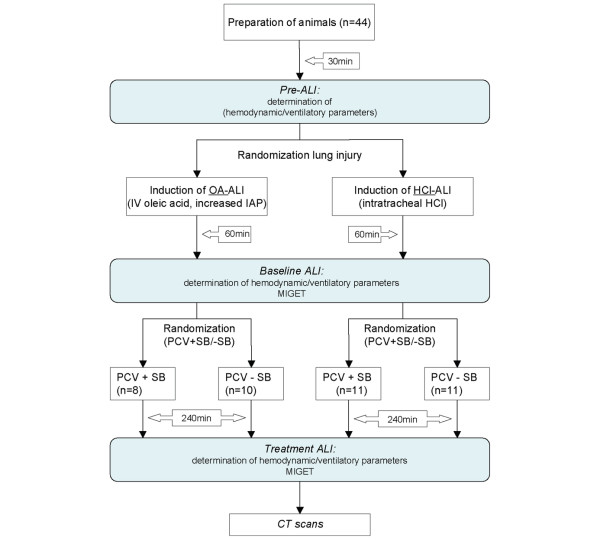
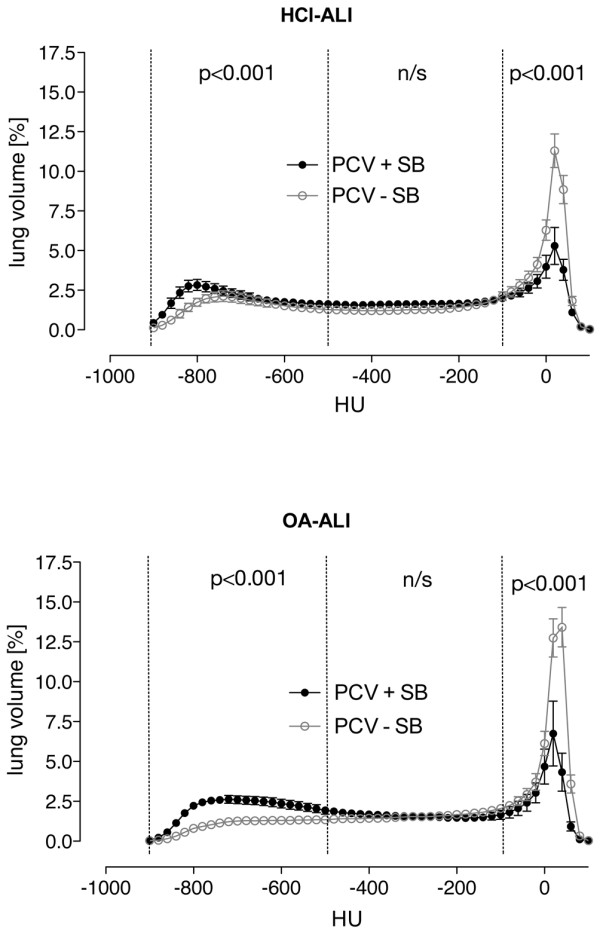
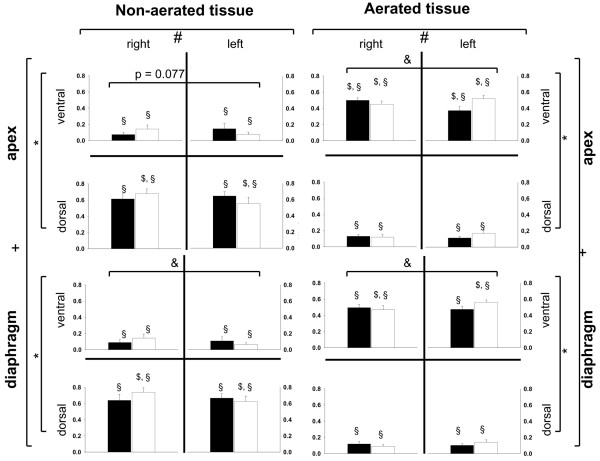
Forty-four pigs were randomly assigned to ALI resulting either from hydrochloric acid aspiration (HCl-ALI) or from increased intra-abdominal pressure plus intravenous oleic acid injections (OA-ALI) and were ventilated in PCV mode either with SB (PCV + SB) or without SB (PCV - SB). Cardiorespiratory variables were measured at baseline after induction of ALI and after 4 hours of treatment (PCV + SB or PCV - SB). Finally, density distributions and end-expiratory lung volume (EELV) were assessed by thoracic spiral computed tomography.
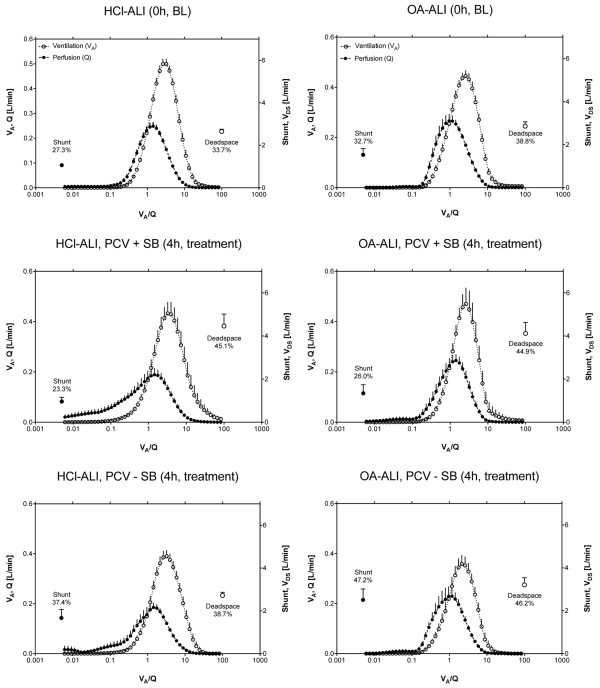
PCV + SB improved arterial partial pressure of oxygen/inspiratory fraction of oxygen (PaO2/FiO2) by a reduction in intrapulmonary shunt fraction in HCl-ALI from 27% +/- 6% to 23% +/- 13% and in OA-ALI from 33% +/- 19% to 26% +/- 18%, whereas during PCV - SB PaO2/FiO2 deteriorated and shunt fraction increased in the HCl group from 28% +/- 8% to 37% +/- 17% and in the OA group from 32% +/- 12% to 47% +/- 17% (P < 0.05 for interaction time and treatment, but not ALI type). PCV + SB also resulted in higher EELV (HCl-ALI: 606 +/- 171 mL, OA-ALI: 439 +/- 90 mL) as compared with PCV - SB (HCl-ALI: 372 +/- 130 mL, OA-ALI: 192 +/- 51 mL, with P < 0.05 for interaction of time, treatment, and ALI type).
SB improves oxygenation, reduces shunt fraction, and increases EELV in both models of ALI.
急性肺损伤(ALI)可由多种对肺组织的损伤引起。实验和临床数据表明,在ALI患者进行压力控制通气(PCV)时自主呼吸(SB)可改善肺通气和氧合。我们的目的是评估在两种不同的ALI模型中增加SB是否有不同的效果。
44头猪被随机分配至因吸入盐酸(HCl-ALI)或腹腔内压力升高加静脉注射油酸(OA-ALI)导致的ALI组,并在PCV模式下进行通气,一组采用自主呼吸(PCV+SB),另一组不采用自主呼吸(PCV-SB)。在诱导ALI后及治疗4小时后(PCV+SB或PCV-SB)测量心肺变量。最后,通过胸部螺旋计算机断层扫描评估密度分布和呼气末肺容积(EELV)。
在HCl-ALI中,PCV+SB通过降低肺内分流率使动脉血氧分压/吸入氧分数(PaO2/FiO2)得到改善,肺内分流率从27%±6%降至23%±13%;在OA-ALI中,从33%±19%降至26%±18%。而在PCV-SB期间,HCl组的PaO2/FiO2恶化,分流率从28%±8%增至37%±17%,OA组从32%±12%增至47%±17%(时间和治疗的交互作用P<0.05,但ALI类型之间无差异)。与PCV-SB相比,PCV+SB还导致更高的EELV(HCl-ALI:606±171 mL,OA-ALI:439±90 mL),而PCV-SB为(HCl-ALI:372±130 mL,OA-ALI:192±51 mL,时间、治疗和ALI类型的交互作用P<0.05)。
在两种ALI模型中,自主呼吸均可改善氧合、降低分流率并增加呼气末肺容积。