Watanabe Mari A, Bhalodia Rajeshkumar, Lundequam Eric J, Domitrovich Peter P, Steinmeyer Brian C, Stein Phyllis K, Freedland Kenneth E, Duntley Stephen P, Carney Robert M
Internal Medicine Department, St. Louis University, USA.
Indian Pacing Electrophysiol J. 2008;8(4):258-67. Epub 2008 Nov 1.
Patients with obstructive sleep apnea are reported to have a peak of sudden cardiac death at night, in contrast to patients without apnea whose peak is in the morning. We hypothesized that ventricular premature contraction (VPC) frequency would correlate with measures of apnea and sympathetic activity.
Electrocardiograms from a sleep study of 125 patients with coronary artery disease were evaluated. Patients were categorized by apnea-hypopnea index (AHI) into Moderate (AHI <15) or Severe (AHI>15) apnea groups. Sleep stages studied were Wake, S1, S2, S34, and rapid eye movement (REM). Parameters of a potent autonomically-based risk predictor for sudden cardiac death called heart rate turbulence were calculated.
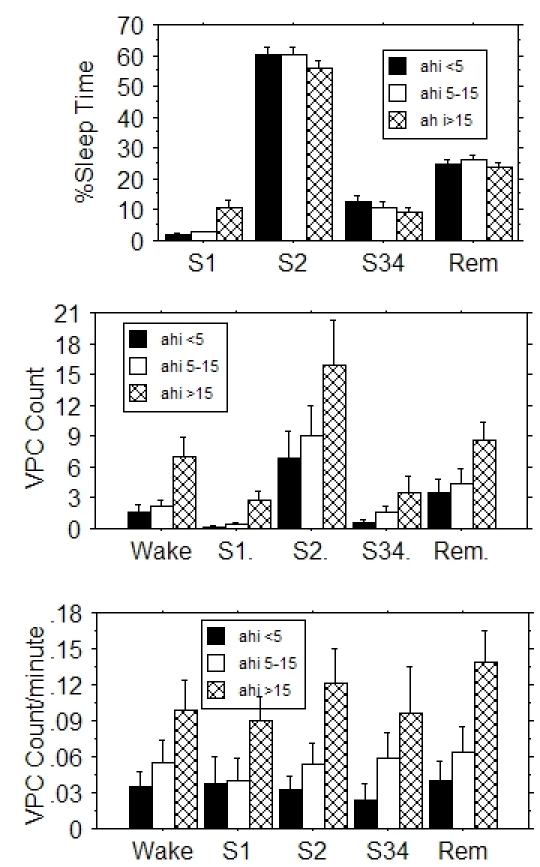
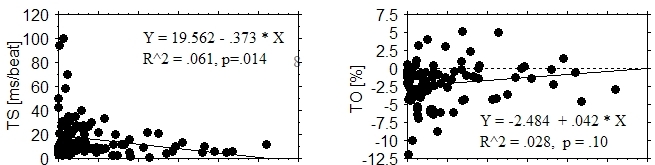
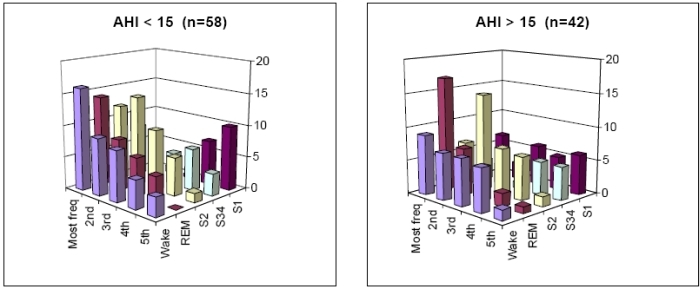
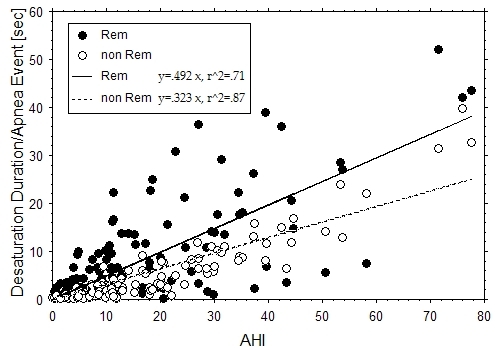
There were 74 Moderate and 51 Severe obstructive sleep apnea patients. VPC frequency was affected significantly by sleep stage (Wake, S2 and REM, F=5.8, p<.005) and by AHI (F=8.7, p<.005). In Severe apnea patients, VPC frequency was higher in REM than in Wake (p=.011). In contrast, patients with Moderate apnea had fewer VPCs and exhibited no sleep stage dependence (p=.19). Oxygen desaturation duration per apnea episode correlated positively with AHI (r(2)=.71, p<.0001), and was longer in REM than in non-REM (p<.0001). The heart rate turbulence parameter TS correlated negatively with oxygen desaturation duration in REM (r(2)=.06, p=.014).
Higher VPC frequency coupled with higher sympathetic activity caused by longer apnea episodes in REM sleep may be one reason for increased nocturnal death in apneic patients.
据报道,阻塞性睡眠呼吸暂停患者夜间心脏性猝死的发生率最高,而无呼吸暂停的患者心脏性猝死发生率最高的时段是早晨。我们推测室性早搏(VPC)频率与呼吸暂停及交感神经活动指标相关。
对125例冠心病患者睡眠研究的心电图进行评估。根据呼吸暂停低通气指数(AHI)将患者分为中度(AHI<15)或重度(AHI>15)呼吸暂停组。研究的睡眠阶段包括清醒、S1、S2、S34和快速眼动(REM)。计算一种基于自主神经的心脏性猝死风险预测指标——心率震荡的参数。
有74例中度和51例重度阻塞性睡眠呼吸暂停患者。VPC频率受睡眠阶段(清醒、S2和REM,F=5.8,p<.005)和AHI(F=8.7,p<.005)的显著影响。在重度呼吸暂停患者中,REM期的VPC频率高于清醒期(p=.011)。相比之下,中度呼吸暂停患者的VPC较少,且未表现出睡眠阶段依赖性(p=.19)。每次呼吸暂停发作的氧饱和度下降持续时间与AHI呈正相关(r(2)=.71,p<.0001),且REM期比非REM期更长(p<.0001)。心率震荡参数TS与REM期的氧饱和度下降持续时间呈负相关(r(2)=.06,p=.014)。
REM睡眠中较长的呼吸暂停发作导致较高的VPC频率和较高的交感神经活动,这可能是呼吸暂停患者夜间死亡增加的原因之一。