Stem Cell Group, Bioprocessing Technology Institute, 20 Biopolis Way, #06 - 01 Centros, 138668, Singapore, Singapore,
Cytotechnology. 2006 Mar;50(1-3):181-90. doi: 10.1007/s10616-005-3862-4. Epub 2006 Jun 23.
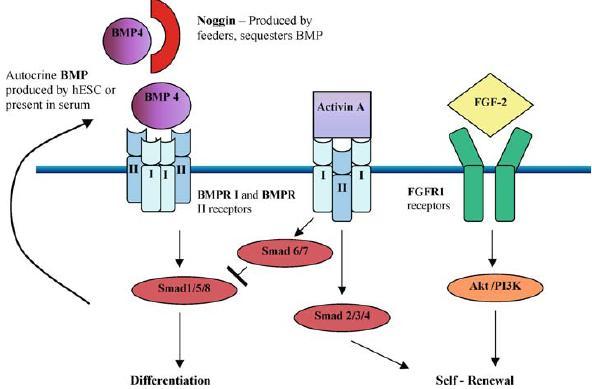
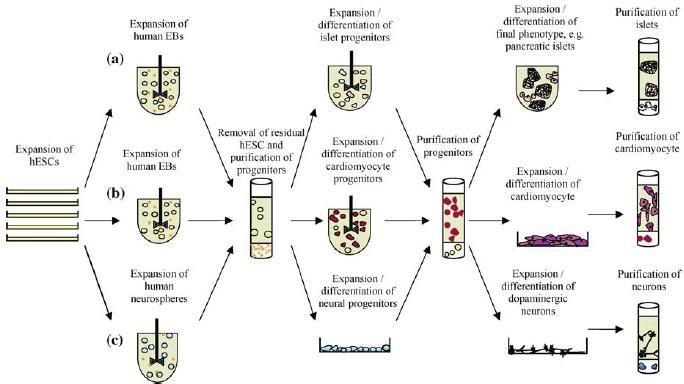
Embryonic stem cells (ESC) hold the promise of overcoming many diseases as potential sources of, for example, dopaminergic neural cells for Parkinson's Disease to pancreatic islets to relieve diabetic patients of their daily insulin injections. While an embryo has the innate capacity to develop fully functional differentiated tissues; biologists are finding that it is much more complex to derive singular, pure populations of primary cells from the highly versatile ESC from this embryonic parent. Thus, a substantial investment in developing the technologies to expand and differentiate these cells is required in the next decade to move this promise into reality. In this review we document the current standard assays for characterising human ESC (hESC), the status of 'defined' feeder-free culture conditions for undifferentiated hESC growth, examine the quality controls that will be required to be established for monitoring their growth, review current methods for expansion and differentiation, and speculate on the possible routes of scaling up the differentiation of hESC to therapeutic quantities.
胚胎干细胞(ESC)有望成为许多疾病的潜在治疗方法,例如,帕金森病的多巴胺能神经细胞、胰岛细胞以缓解糖尿病患者的日常胰岛素注射。虽然胚胎具有完全发育成功能性分化组织的内在能力;但生物学家发现,从这种胚胎来源的高度多功能 ESC 中获得单一、纯的原代细胞群体要复杂得多。因此,未来十年需要大量投资开发这些细胞的扩增和分化技术,将这一承诺变为现实。在这篇综述中,我们记录了目前用于鉴定人胚胎干细胞(hESC)的标准检测方法,探讨了无饲养层条件下用于未分化 hESC 生长的“定义明确”培养条件的现状,检查了为监测其生长而需要建立的质量控制,回顾了目前用于扩增和分化的方法,并推测了将 hESC 分化为治疗剂量的可能途径。