Lamberts Steven W J, Hofland Leo J
Department of Internal Medicine, Division of Endocrinology, Erasmus Medical Center, 3015 CE Rotterdam, The Netherlands.
Pituitary. 2009;12(3):261-4. doi: 10.1007/s11102-008-0154-y.
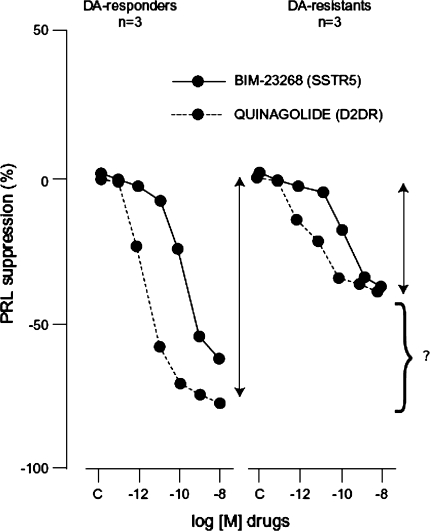
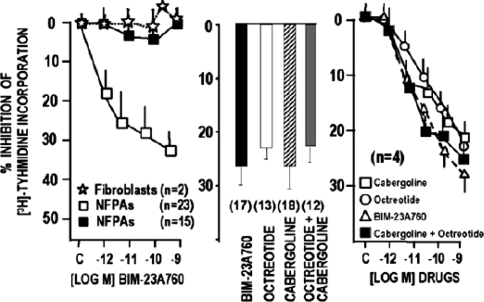
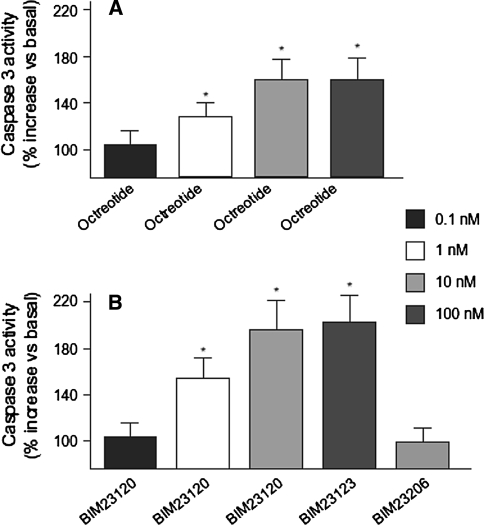
While surgery remains the first-line treatment of most aggressive pituitary adenomas, medical therapy is important as second-line or adjunctive therapy in a large proportion of patients. Dopamine agonists (DAs) are the best treatment for prolactinomas, but when DAs are not tolerated, new somatostatin receptor subtype 5 (SSTR(5)) inhibitors may offer an alternative in the future. Unfortunately, these are unlikely to be effective in DA-resistant prolactinomas. In acromegaly, the existing somatostatin analogs, octreotide and lanreotide, will remain the medical treatment of choice for the foreseeable future. There is an urgent need for medical therapies in Cushing's disease, and the SSTR(5) analogs could offer an effective treatment in a proportion of patients within the next few years. Finally, the medical management options for non-functioning pituitary adenomas are also very limited, and a new chimeric agent with activity towards dopamine receptors, SSTR(5) and SSTR(2) may help reduce adenoma recurrence in the future.
虽然手术仍然是大多数侵袭性垂体腺瘤的一线治疗方法,但在很大一部分患者中,药物治疗作为二线或辅助治疗也很重要。多巴胺激动剂(DAs)是催乳素瘤的最佳治疗方法,但当患者不耐受DAs时,新型生长抑素受体5型(SSTR(5))抑制剂未来可能提供一种替代方案。不幸的是,这些抑制剂不太可能对多巴胺抵抗性催乳素瘤有效。在肢端肥大症中,现有的生长抑素类似物奥曲肽和兰瑞肽在可预见的未来仍将是首选的药物治疗方法。库欣病迫切需要药物治疗,SSTR(5)类似物可能在未来几年为一部分患者提供有效的治疗方法。最后,无功能垂体腺瘤的药物管理选择也非常有限,一种对多巴胺受体、SSTR(5)和SSTR(2)有活性的新型嵌合剂未来可能有助于减少腺瘤复发。