Alberici Paola, Gaspar Claudia, Franken Patrick, Gorski Marcin M, de Vries Ingrid, Scott Rodney J, Ristimäki Ari, Aaltonen Lauri A, Fodde Riccardo
Department of Pathology, Josephine Nefkens Institute, Erasmus MC, Rotterdam, The Netherlands.
Pathogenetics. 2008 Nov 3;1(1):2. doi: 10.1186/1755-8417-1-2.
The inactivation of tumor suppressor genes follows Alfred Knudson's 'two-hit' model: both alleles need to be inactivated by independent mutation events to trigger tumor formation. However, in a minority of tumor suppressor genes a single hit is sufficient to initiate tumorigenesis notwithstanding the presence of the wild-type allele, a condition known as haploinsufficiency. The SMAD4 gene is an intracellular mediator of the TGF-beta and BMP signal transduction pathways and a tumor suppressor involved in pancreatic and colorectal tumorigenesis. In Smad4-mutant mouse models, haploinsufficiency characterizes the development of gastrointestinal polyps with initial retention of the wild-type allele and protein expression within the nascent tumors and in their direct microenvironment. Similarly, germline SMAD4 mutations are responsible for a subset of patients affected by juvenile polyposis syndrome, an autosomal dominant intestinal cancer syndrome. To date, the molecular and cellular consequences of SMAD4 haploinsufficiency on TGF-beta and BMP signaling and on genome-wide gene expression have not been investigated.
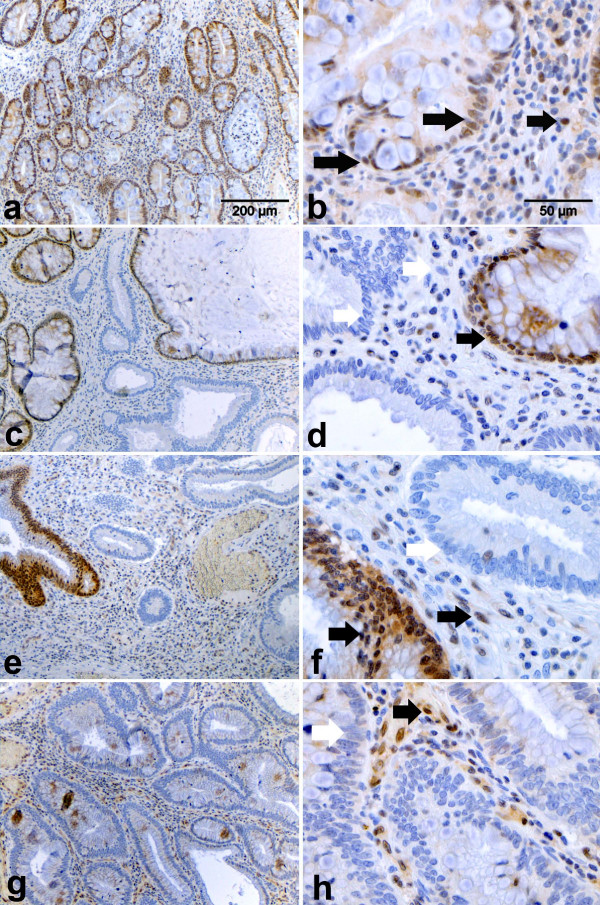
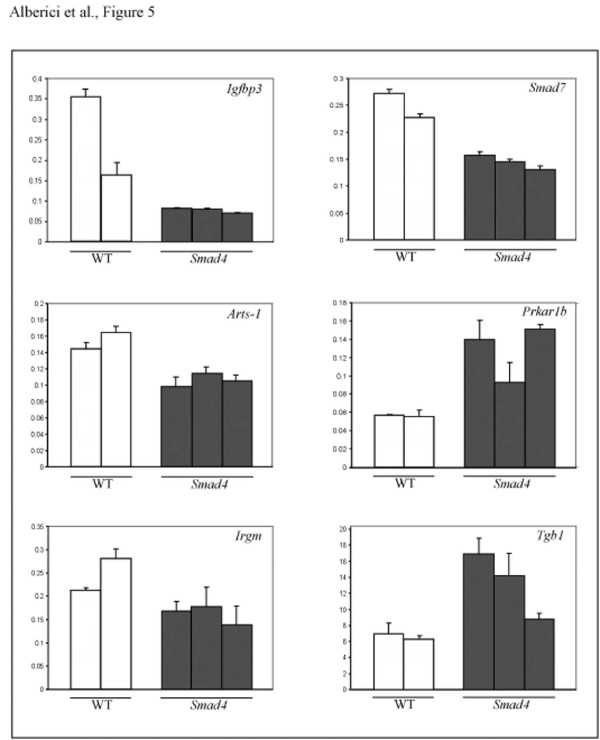
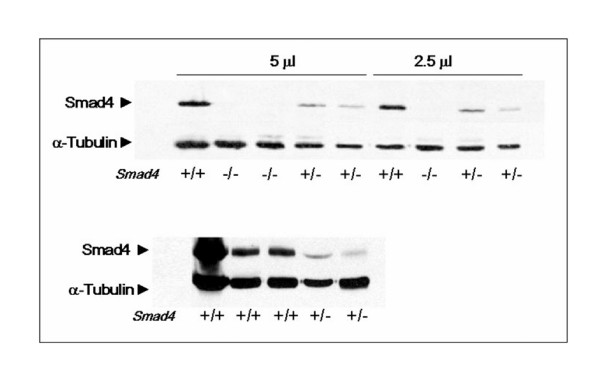
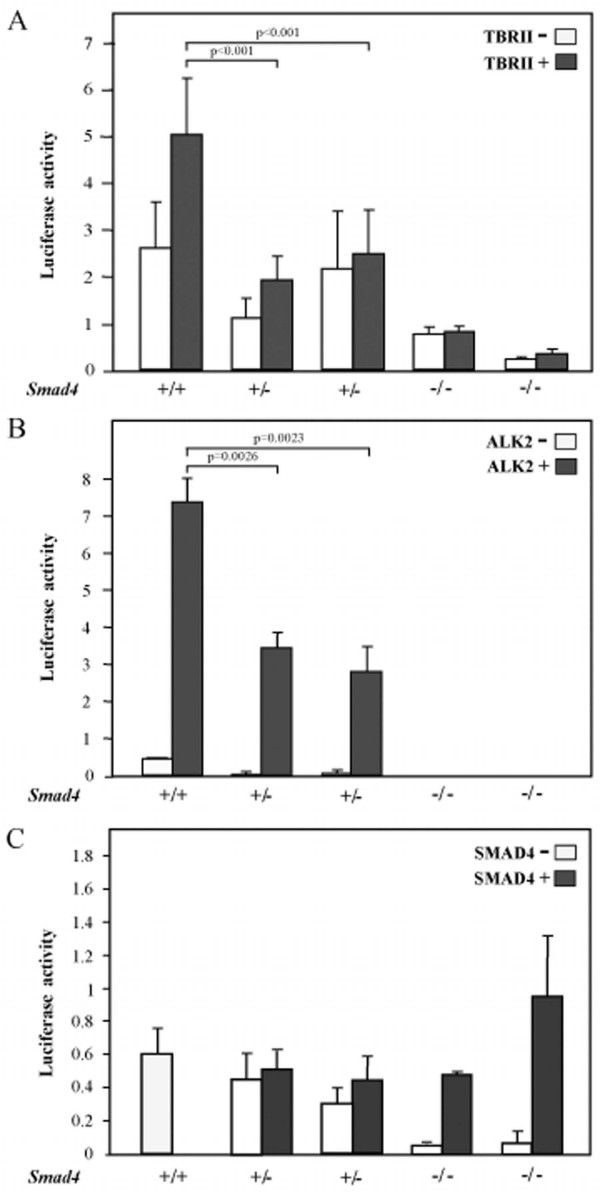
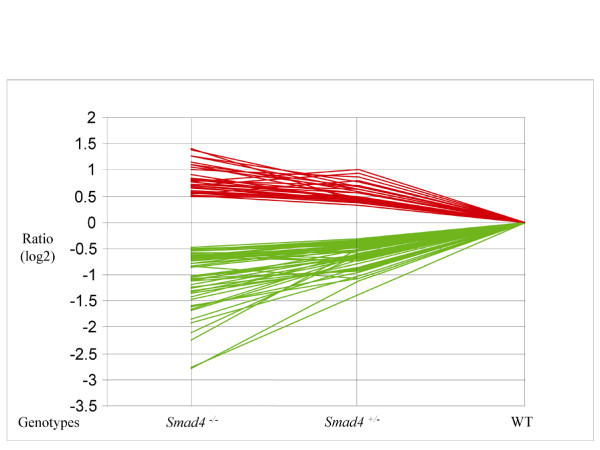
Here we show that, similar to previous observations in Smad4-mutant mouse models, haploinsufficiency characterizes a substantial fraction of the juvenile polyps arising in patients with germline SMAD4 mutations. Also, mouse embryonic and intestinal cells heterozygous for a targeted Smad4 null mutation are characterized by a corresponding 50% reduction of the Smad4 protein levels. Reporter assays revealed that mouse Smad4+/- cells exert intermediate inhibitory effects on both TGF-beta and BMP signaling. Genome-wide expression profiling analysis of Smad4+/- and Smad4-/- cells pinpointed a subset of dosage-dependent transcriptional target genes encompassing, among others, members of the TGF-beta and Wnt signaling pathways. These SMAD4 dosage-dependent transcriptional changes were confirmed and validated in a subset of target genes in intestinal tissues from juvenile polyposis syndrome patients.
Smad4 haploinsufficiency is sufficient to significantly inhibit both TGF-beta and BMP signal transduction and results in the differential expression of a broad subset of target genes likely to underlie tumor formation both from the mesenchymal and epithelial compartments. The results of our study, performed in normal rather than tumor cells where additional (epi-) genetic alterations may confound the analysis, are relevant for our understanding and elucidation of the initial steps underlying SMAD4-driven intestinal tumorigenesis.
肿瘤抑制基因的失活遵循阿尔弗雷德·克努森的“两次打击”模型:两个等位基因都需要通过独立的突变事件失活才能引发肿瘤形成。然而,在少数肿瘤抑制基因中,尽管存在野生型等位基因,但单次打击就足以启动肿瘤发生,这种情况称为单倍剂量不足。SMAD4基因是转化生长因子-β(TGF-β)和骨形态发生蛋白(BMP)信号转导途径的细胞内介质,是参与胰腺癌和结直肠癌发生的肿瘤抑制因子。在Smad4突变小鼠模型中,单倍剂量不足表现为胃肠道息肉的发展特征,即野生型等位基因以及新生肿瘤及其直接微环境中的蛋白质表达最初得以保留。同样,种系SMAD4突变是青少年息肉病综合征(一种常染色体显性遗传性肠道癌综合征)部分患者的病因。迄今为止,尚未研究SMAD4单倍剂量不足对TGF-β和BMP信号传导以及全基因组基因表达的分子和细胞影响。
我们在此表明,与之前在Smad4突变小鼠模型中的观察结果相似,单倍剂量不足是种系SMAD4突变患者中出现的大部分青少年息肉的特征。此外,靶向Smad4无效突变的杂合小鼠胚胎细胞和肠细胞的特征是Smad4蛋白水平相应降低50%。报告基因检测显示,小鼠Smad4+/-细胞对TGF-β和BMP信号传导均具有中等程度的抑制作用。对Smad4+/-和Smad4-/-细胞进行的全基因组表达谱分析确定了一组剂量依赖性转录靶基因,其中包括TGF-β和Wnt信号传导途径的成员等。这些SMAD4剂量依赖性转录变化在青少年息肉病综合征患者肠道组织的一部分靶基因中得到了证实和验证。
Smad4单倍剂量不足足以显著抑制TGF-β和BMP信号转导,并导致可能是间充质和上皮区室肿瘤形成基础的广泛靶基因子集的差异表达。我们在正常而非肿瘤细胞中进行的研究结果(在肿瘤细胞中额外的(表观)遗传改变可能会混淆分析),对于我们理解和阐明SMAD4驱动的肠道肿瘤发生的初始步骤具有重要意义。