Jiao Yuchen, Moon Seok Jun, Wang Xiaoyue, Ren Qiuting, Montell Craig
Department of Biological Chemistry, Department of Neuroscience, Center for Sensory Biology, The Johns Hopkins University School of Medicine, Baltimore, MD 21205, USA.
Curr Biol. 2008 Nov 25;18(22):1797-801. doi: 10.1016/j.cub.2008.10.009.
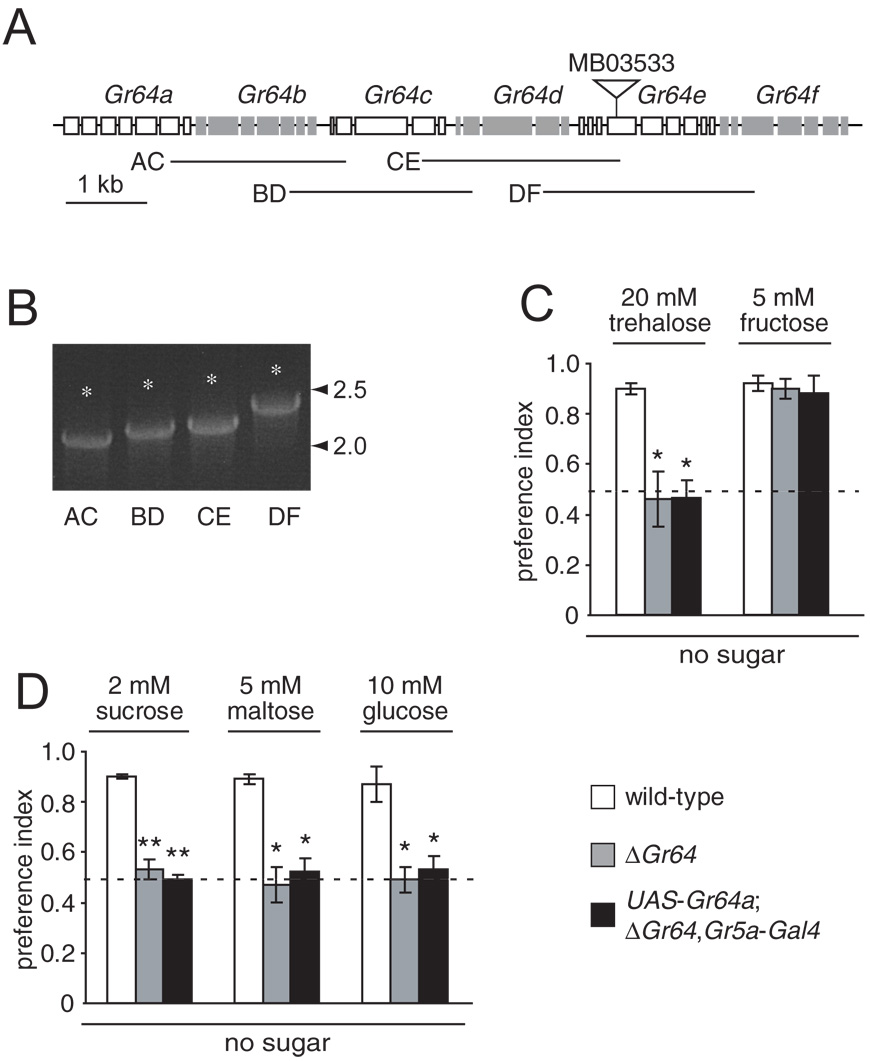
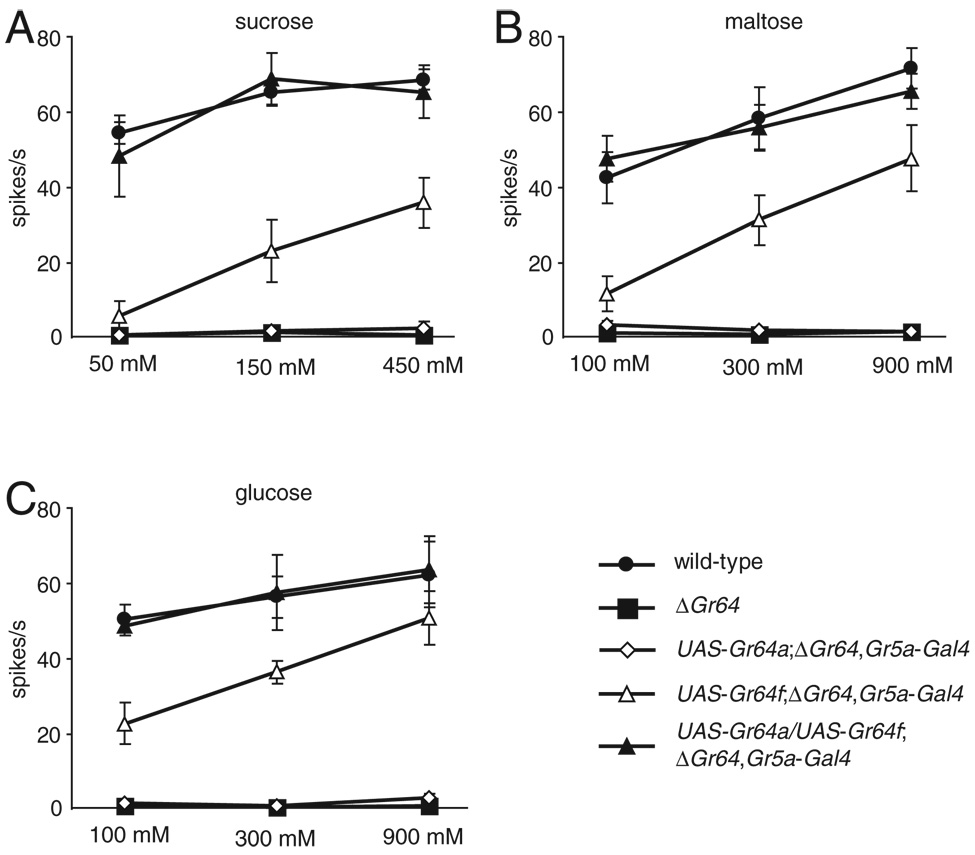
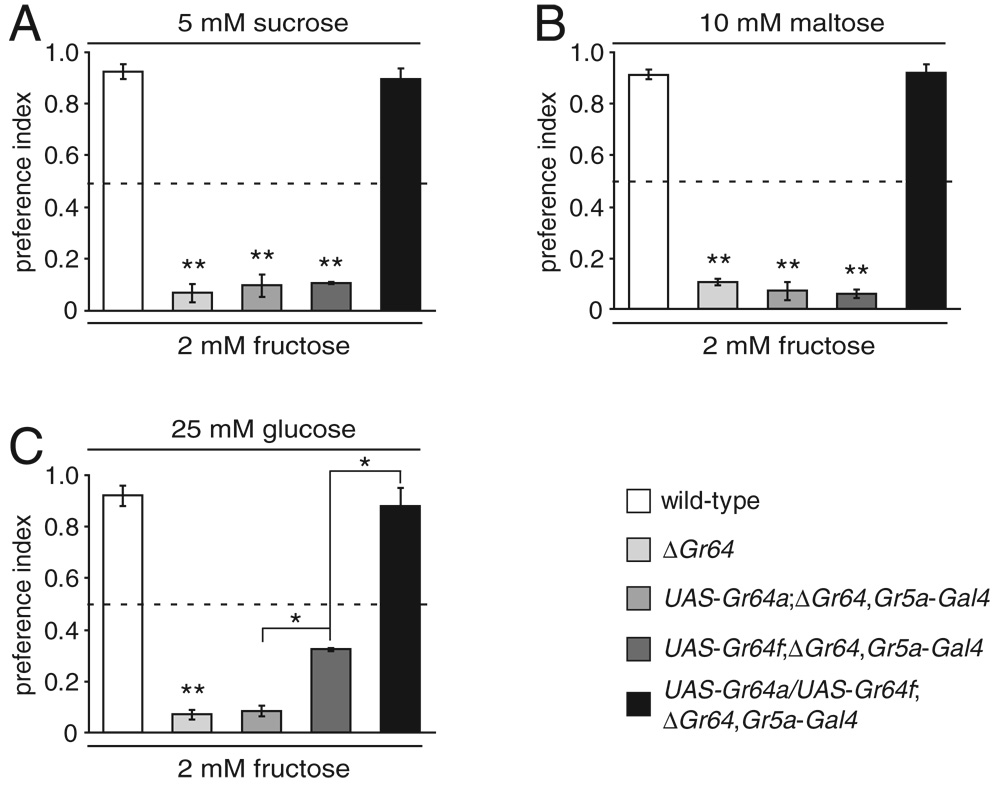
The mechanisms by which the fruit fly Drosophila melanogaster detects sweet compounds are poorly understood; however, a subset of the family of 68 gustatory receptors (Grs) has emerged as the key receptors. These seven transmembrane receptors include Gr5a and at least one member of the six genes in the Gr64 cluster (Gr64a), which are expressed in sugar-responsive neurons. Disruption of Gr5a prevents the detection of trehalose [1-3], whereas mutation of Gr64a impairs the responses to sucrose, maltose, and glucose [4, 5]. Recent studies suggest that these sugar receptors may require a coreceptor for function in vivo [4-6]; however, the identity of the putative coreceptor is not known. In the current work, we demonstrate that Gr64f is required in combination with Gr5a for the behavioral response to trehalose and for production of nerve responses to trehalose. Gr64f was also required in concert with Gr64a to rescue the defects in the sensitivities to sucrose, maltose, and glucose, resulting from deletion of the entire Gr64 cluster. These data suggest that Drosophila sugar receptors function as multimers and that Gr64f is required broadly as a coreceptor for the detection of sugars.
果蝇黑腹果蝇检测甜味化合物的机制尚不清楚;然而,68种味觉受体(Grs)家族中的一个子集已成为关键受体。这些七跨膜受体包括Gr5a和Gr64簇中六个基因中的至少一个成员(Gr64a),它们在糖反应性神经元中表达。Gr5a的破坏会阻止海藻糖的检测[1-3],而Gr64a的突变会损害对蔗糖、麦芽糖和葡萄糖的反应[4,5]。最近的研究表明,这些糖受体在体内发挥功能可能需要一个共受体[4-6];然而,假定共受体的身份尚不清楚。在当前的工作中,我们证明Gr64f与Gr5a结合对于对海藻糖的行为反应以及对海藻糖产生神经反应是必需的。Gr64f还需要与Gr64a协同作用,以挽救由于整个Gr64簇缺失而导致的对蔗糖、麦芽糖和葡萄糖敏感性的缺陷。这些数据表明果蝇糖受体作为多聚体发挥作用,并且Gr64f广泛地作为检测糖类的共受体是必需的。