Conrad Susan C, Nichols Nicole L, Ritucci Nick A, Dean Jay B, Putnam Robert W
Department of Neuroscience, Cell Biology and Physiology, Wright State University School of Medicine, 3640 Colonel Glenn Highway, Dayton, OH 45435, United States.
Respir Physiol Neurobiol. 2009 Mar 31;166(1):4-12. doi: 10.1016/j.resp.2008.11.005. Epub 2008 Nov 14.
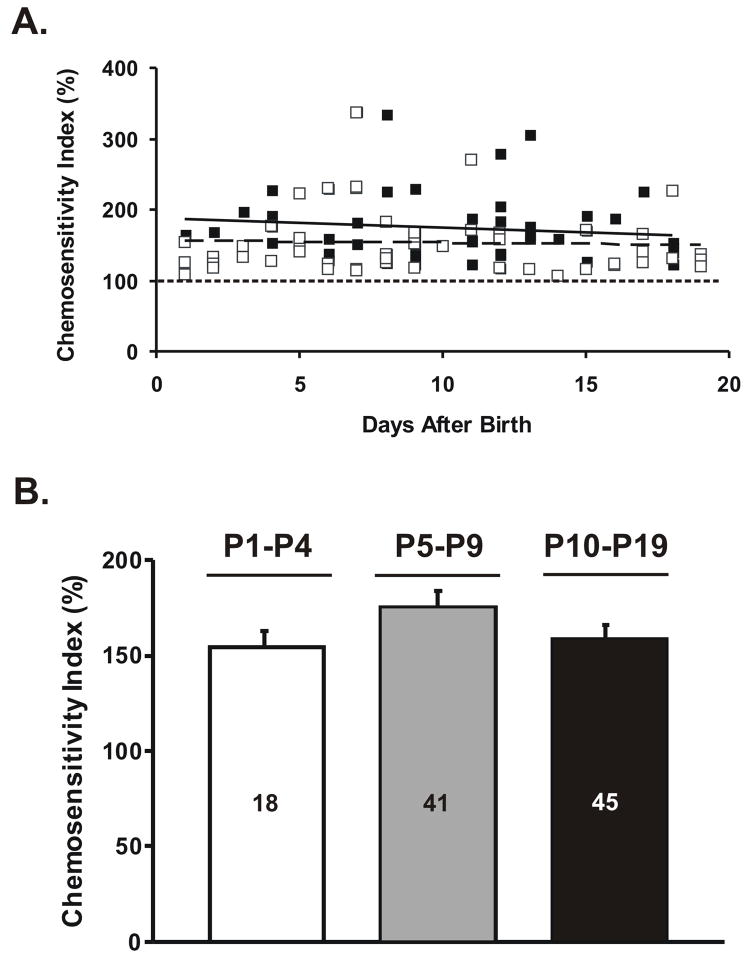
We studied the development of chemosensitivity during the neonatal period in rat nucleus tractus solitarii (NTS) neurons. We determined the percentage of neurons activated by hypercapnia (15% CO(2)) and assessed the magnitude of the response by calculating the chemosensitivity index (CI). There were no differences in the percentage of neurons that were inhibited (9%) or activated (44.8%) by hypercapnia or in the magnitude of the activated response (CI 164+/-4.9%) in NTS neurons from neonatal rats of all ages. To assess the degree of intrinsic chemosensitivity in these neurons we used chemical synaptic block medium and the gap junction blocker carbenoxolone. Chemical synaptic block medium slightly decreased basal firing rate but did not affect the percentage of NTS neurons that responded to hypercapnia at any neonatal age. However, in neonates aged <P10, but not in older neonates, chemical synaptic block medium increased CI. Carbenoxolone did not significantly alter the number of NTS neurons activated by hypercapnia in neonatal rats of any age. In summary, the response of NTS neurons from neonatal rats appears to be intrinsic and largely unchanged throughout early development. In young neonates (<P10) chemical synaptic input reduces the magnitude of the firing rate response to hypercapnia, but otherwise neither chemical synaptic input nor gap junctions significantly alter the percentage of NTS neurons that respond to hypercapnia or the magnitude of that response.
我们研究了新生大鼠孤束核(NTS)神经元在新生儿期化学敏感性的发育情况。我们确定了被高碳酸血症(15% CO₂)激活的神经元百分比,并通过计算化学敏感性指数(CI)评估反应的幅度。在所有年龄段新生大鼠的NTS神经元中,被高碳酸血症抑制(9%)或激活(44.8%)的神经元百分比,或激活反应的幅度(CI 164±4.9%)均无差异。为了评估这些神经元的内在化学敏感性程度,我们使用了化学突触阻断培养基和缝隙连接阻断剂羧苄青霉素。化学突触阻断培养基略微降低了基础放电率,但在任何新生儿年龄都不影响对高碳酸血症有反应的NTS神经元百分比。然而,在小于P10的新生儿中,而非年龄较大的新生儿中,化学突触阻断培养基增加了CI。羧苄青霉素在任何年龄新生大鼠中均未显著改变被高碳酸血症激活的NTS神经元数量。总之,新生大鼠NTS神经元的反应似乎是内在的,并且在整个早期发育过程中基本不变。在年轻新生儿(<P10)中,化学突触输入降低了对高碳酸血症放电率反应的幅度,但除此之外,化学突触输入和缝隙连接均未显著改变对高碳酸血症有反应的NTS神经元百分比或该反应的幅度。