Malone John H, Fontenot Brian E
Department of Biology, The University of Texas at Arlington, Arlington, Texas, United States of America.
PLoS One. 2008;3(12):e3900. doi: 10.1371/journal.pone.0003900. Epub 2008 Dec 9.
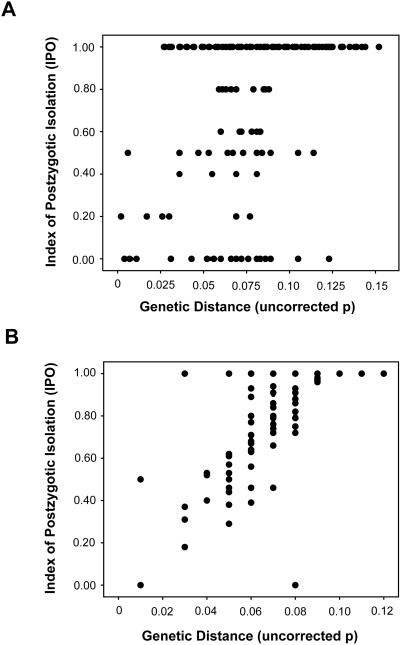
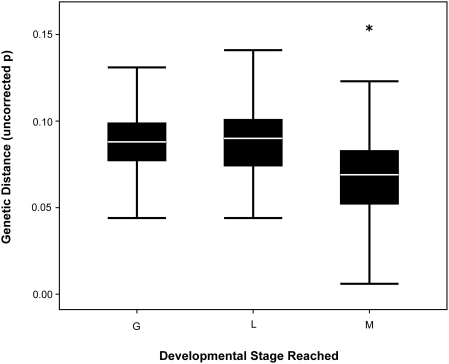
Understanding the general features of speciation is an important goal in evolutionary biology, and despite significant progress, several unresolved questions remain. We analyzed an extensive comparative dataset consisting of more than 1900 crosses between 92 species of toads to infer patterns of reproductive isolation. This unique dataset provides an opportunity to examine the strength of reproductive isolation, the development and sex ratios of hybrid offspring, patterns of fertility and infertility, and polyploidization in hybrids all in the context of genetic divergence between parental species. We found that the strength of intrinsic postzygotic isolation increases with genetic divergence, but relatively high levels of divergence are necessary before reproductive isolation is complete in toads. Fertilization rates were not correlated to genetic divergence, but hatching success, the number of larvae produced, and the percentage of tadpoles reaching metamorphosis were all inversely related with genetic divergence. Hybrids between species with lower levels of divergence developed to metamorphosis, while hybrids with higher levels of divergence stopped developing in gastrula and larval stages. Sex ratios of hybrid offspring were biased towards males in 70% of crosses and biased towards females in 30% of crosses. Hybrid females from crosses between closely related species were completely fertile, while approximately half (53%) of hybrid males were sterile, with sterility predicted by genetic divergence. The degree of abnormal ploidy in hybrids was positively related to genetic divergence between parental species, but surprisingly, polyploidization had no effect on patterns of asymmetrical inviability. We discuss explanations for these patterns, including the role of Haldane's rule in toads and anurans in general, and suggest mechanisms generating patterns of reproductive isolation in anurans.
理解物种形成的一般特征是进化生物学的一个重要目标,尽管取得了重大进展,但仍有几个未解决的问题。我们分析了一个广泛的比较数据集,该数据集由92种蟾蜍之间的1900多个杂交组合组成,以推断生殖隔离模式。这个独特的数据集提供了一个机会,在亲本物种之间遗传分化的背景下,研究生殖隔离的强度、杂交后代的发育和性别比例、育性和不育模式以及杂交种中的多倍体化。我们发现,内在合子后隔离的强度随着遗传分化的增加而增加,但在蟾蜍中,在生殖隔离完全形成之前,需要相对较高水平的分化。受精率与遗传分化无关,但孵化成功率、产生的幼虫数量以及达到变态的蝌蚪百分比均与遗传分化呈负相关。分化水平较低的物种之间的杂交种发育到变态,而分化水平较高的杂交种在原肠胚和幼虫阶段停止发育。杂交后代的性别比例在70%的杂交组合中偏向雄性,在30%的杂交组合中偏向雌性。亲缘关系较近的物种之间杂交产生的杂交雌性完全可育,而大约一半(53%)的杂交雄性不育,不育由遗传分化预测。杂交种中异常多倍体的程度与亲本物种之间的遗传分化呈正相关,但令人惊讶的是,多倍体化对不对称生存力模式没有影响。我们讨论了这些模式的解释,包括霍尔丹法则在蟾蜍和一般无尾两栖动物中的作用,并提出了无尾两栖动物中产生生殖隔离模式的机制。