Putnam Amy L, Brusko Todd M, Lee Michael R, Liu Weihong, Szot Gregory L, Ghosh Taumoha, Atkinson Mark A, Bluestone Jeffrey A
Diabetes Center at the University of California, San Francisco (UCSF), San Francisco, California, USA.
Diabetes. 2009 Mar;58(3):652-62. doi: 10.2337/db08-1168. Epub 2008 Dec 15.
Regulatory T-cells (Tregs) have catalyzed the field of immune regulation. However, translating Treg-based therapies from animal models of autoimmunity to human clinical trials requires robust methods for the isolation and expansion of these cells-a need forming the basis for these studies.
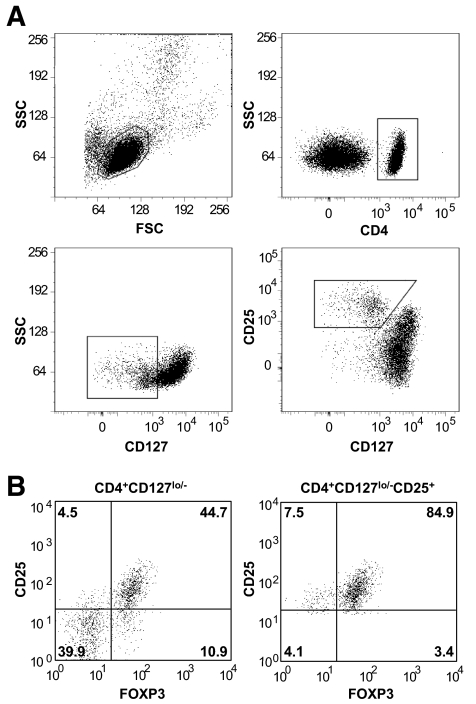
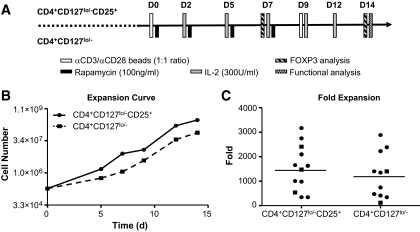
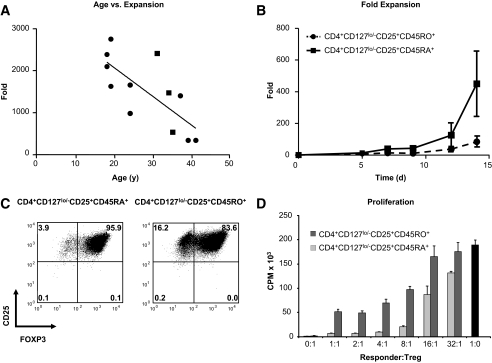
Tregs from recent-onset type 1 diabetic patients and healthy control subjects were isolated by fluorescence-activated cell sorting and compared for their capacity to expand in vitro in response to anti-CD3-anti-CD28-coated microbeads and IL-2. Expanded cells were examined for suppressive function, lineage markers and FOXP3, and cytokine production.
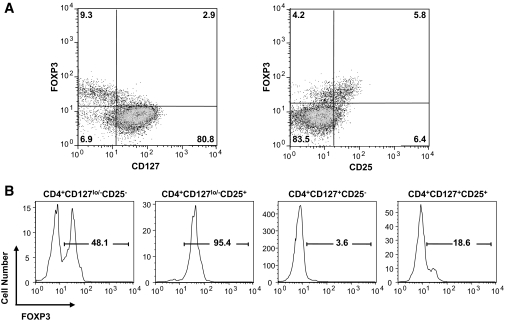
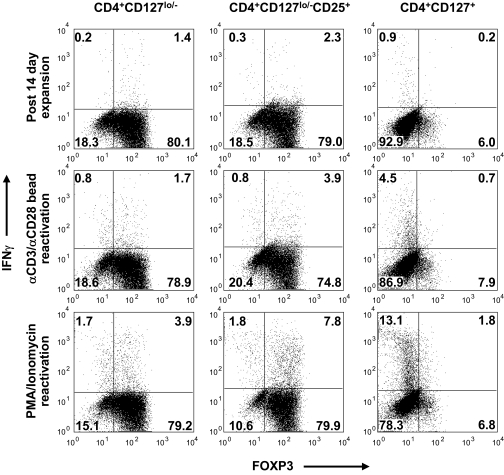
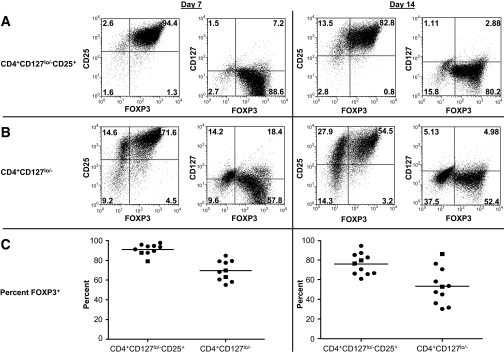
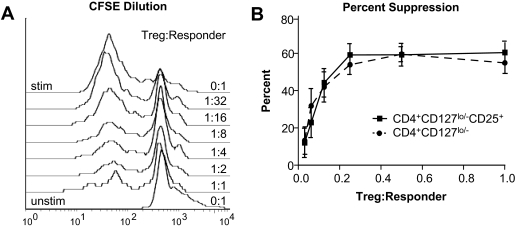
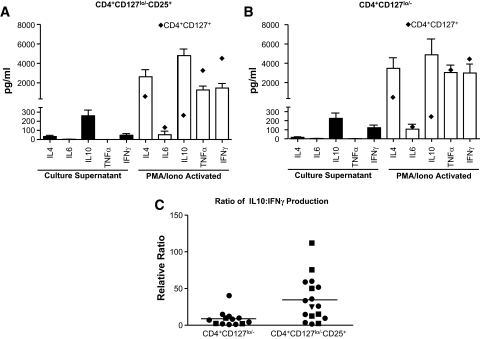
Both CD4+CD127(lo/-) and CD4+CD127(lo/-)CD25+ T-cells could be expanded and used as Tregs. However, expansion of CD4+CD127(lo/-) cells required the addition of rapamycin to maintain lineage purity. In contrast, expansion of CD4+CD127(lo/-)CD25+ T-cells, especially the CD45RA+ subset, resulted in high yield, functional Tregs that maintained higher FOXP3 expression in the absence of rapamycin. Tregs from type 1 diabetic patients and control subjects expanded similarly and were equally capable of suppressing T-cell proliferation. Regulatory cytokines were produced by Tregs after culture; however, a portion of FOXP3+ cells were capable of producing interferon (IFN)-gamma after reactivation. IFN-gamma production was observed from both CD45RO+ and CD45RA+ Treg populations.
The results support the feasibility of isolating Tregs for in vitro expansion. Based on expansion capacity, FOXP3 stability, and functional properties, the CD4+CD127(lo/-)CD25+ T-cells represent a viable cell population for cellular therapy in this autoimmune disease.
调节性T细胞(Tregs)推动了免疫调节领域的发展。然而,将基于Tregs的疗法从自身免疫性动物模型转化为人类临床试验需要强大的方法来分离和扩增这些细胞,这一需求构成了这些研究的基础。
通过荧光激活细胞分选技术分离新诊断1型糖尿病患者和健康对照受试者的Tregs,并比较它们在抗CD3-抗CD28包被微珠和白细胞介素-2刺激下体外扩增的能力。对扩增后的细胞进行抑制功能、谱系标志物、FOXP3及细胞因子产生情况的检测。
CD4+CD127(lo/-)和CD4+CD127(lo/-)CD25+ T细胞均可扩增并用作Tregs。然而,CD4+CD127(lo/-)细胞的扩增需要添加雷帕霉素以维持谱系纯度。相比之下,CD4+CD127(lo/-)CD25+ T细胞,尤其是CD45RA+亚群的扩增,可产生高产、功能性的Tregs,且在无雷帕霉素的情况下能维持较高的FOXP3表达。1型糖尿病患者和对照受试者的Tregs扩增情况相似,且同样能够抑制T细胞增殖。培养后的Tregs可产生调节性细胞因子;然而,一部分FOXP3+细胞在重新激活后能够产生干扰素(IFN)-γ。在CD45RO+和CD45RA+ Treg群体中均观察到了IFN-γ的产生。
结果支持了分离Tregs用于体外扩增的可行性。基于扩增能力、FOXP3稳定性和功能特性,CD4+CD127(lo/-)CD25+ T细胞是这种自身免疫性疾病细胞治疗的可行细胞群体。